
How We Built Our Own AI Sales Assistant: A Consultant That Recommends Systems Without Making Things Up
A case study of the AI sales assistant on nilexdigitalsystems.com: how it behaves like a consultant, what it knows, why its answers on security, payment and data come only from facts we write, how it hands visitors to the team, and the safety limits around it.
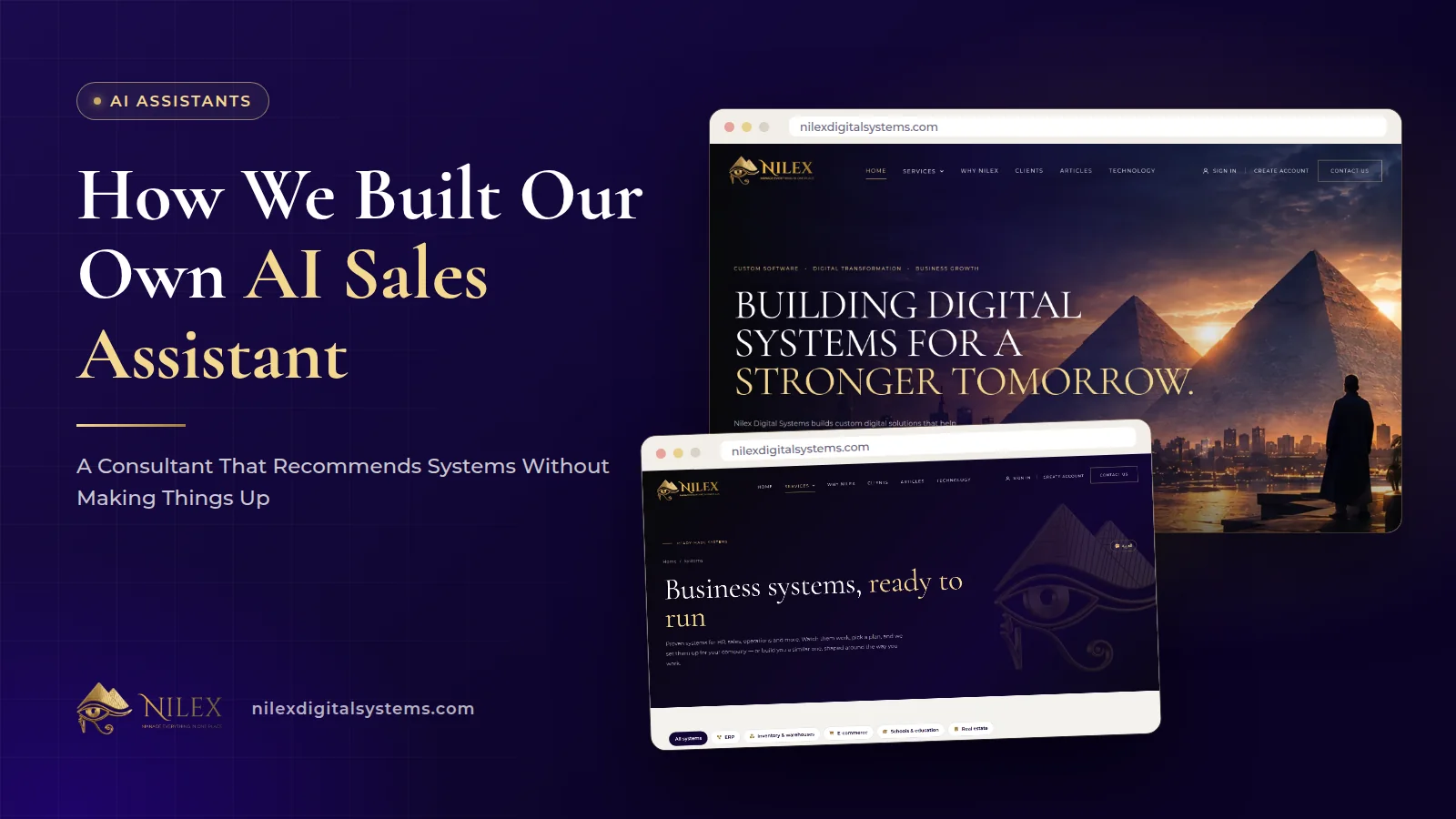
In October 2026 we added an AI sales assistant to nilexdigitalsystems.com. It runs on Claude, Anthropic's model, and it is built to behave like a sales consultant rather than a search box: it asks one short question at a time, recommends the ready-made system or service that matches the visitor's business with its real plan, and hands the visitor to our team when it is time to talk to a person.
The design goal was simple to state and harder to build: an assistant that is useful to a business owner at eleven at night, and that never says anything about Nilex that we have not written down ourselves. This case study explains how it works, what it knows, what it refuses to do and the limits we put around it, so you can judge whether something similar fits your own website.
Key takeaways
- The assistant acts like a consultant: one short question at a time, then a recommendation of a real system or service and its plan.
- It knows our published systems, services, technologies, case studies, articles, Terms and Privacy pages, plus knowledge sections our admins edit in Arabic and English.
- Questions about security, payment, warranty and data are answered only from facts Nilex has written.
- It hands off through WhatsApp, a "call me back" form that creates a CRM lead, or the contact page; it does not book meetings, see customer data or take actions.
- Private data is removed before storage or the model, every message is screened, and limits per visitor and per site keep use and cost under control.
Why did we build a sales assistant for our own site?
Our website carries a lot of information: seven ready-made systems, each with modules, plans and FAQs; four service lines; client case studies; a long list of articles; and the Terms and Privacy pages that set out how we work. That is good for search, but a visitor who runs a car repair workshop or a school does not want to read all of it to find the two pages that matter to them.
Before the assistant, the next step for that visitor was to fill a form or send a message and wait. We wanted a first conversation that could happen immediately, narrow the visitor down to the right system or service, answer the questions that usually come before a call, and then pass the visitor to a person with a clear next step.
How does it behave like a consultant?
The main design decision was behaviour, not technology. A good salesperson does not answer "what do you have?" with a list of everything; they ask about your business first. The assistant follows the same pattern:
- One short question at a time. Instead of a form disguised as a chat, it asks a single question, such as what kind of business the visitor runs, and waits for the answer.
- A recommendation, not a catalogue. Once it understands the need, it recommends the matching ready-made system or service and the plan that fits, using the real plans published on our pages.
- Follow-up suggestions. After each answer it suggests two or three follow-up questions the visitor can tap, which helps people who do not know what to ask next.
- A clear next step. When the visitor is ready, it offers the hand-off options rather than trying to close the sale itself.
It works in Arabic and English and opens full screen on phones, so the conversation is readable on a small screen.
What does the assistant know, and where does it come from?
An assistant is only as honest as its sources. Ours draws on two kinds of knowledge.
| Source | What it covers | Who keeps it current |
|---|---|---|
| Published systems | Every ready-made system: modules, plans and FAQs | The system pages themselves |
| Services and technologies | The four service lines and the technologies we use | The service and technology pages |
| Client case studies | What we built for each published client | The clients pages |
| Articles | Our guides and case studies | The articles section |
| Terms and Privacy | How projects, payments and personal data are handled | The Terms and Privacy pages |
| Admin-edited knowledge | Security, How we work with clients, Sales notes, in Arabic and English | Nilex admins, from the dashboard |
The admin-edited sections matter most for trust. Questions about security, payment, warranty and data are exactly where a general AI model is tempted to fill gaps with plausible-sounding promises. Our assistant answers those only from the facts we have written: for example, that after delivery a client has 14 days to test, that we fix errors free of charge for 30 days after acceptance, that payment can be in installments linked to dates or stages, and that clients own their data and can get a copy on request. When we change how we work, we edit the section, and the assistant's answers follow.
How does it hand visitors to the team?
We decided early that the assistant is a first conversation, not the whole sale. It offers three ways to reach a person:
- WhatsApp, for visitors who want to continue the conversation with the team directly.
- A "call me back" form, which creates a lead in our CRM so the request has an owner and is followed up.
- The contact page, for visitors who prefer to write.
Visitors who already know which system they want can also use the request form on that system's page, which is covered in our guide to requesting a ready-made system.
What the assistant deliberately does not do
Limits are part of the product. The assistant does not book meetings, it cannot see any customer's data, and it does not take actions on anyone's behalf. It talks, recommends, answers from our facts and hands off. That keeps the risk small: there is nothing inside it that a manipulated conversation could use to change an order, read a client's records or make a commitment for us.
| It does | It does not |
|---|---|
| Ask about the visitor's business, one question at a time | Book meetings or appointments |
| Recommend a real system or service and its plan | See any client's or customer's data |
| Answer security, payment, warranty and data questions from Nilex-written facts | Take actions in any system |
| Link to real pages on our site | Link to pages that do not exist |
| Hand off by WhatsApp, call-back form or contact page | Promise terms we have not written down |
Which safety limits did we put around it?
Every public chatbot accepts any text from anyone, so we treated safety as part of the build, following the risks we describe in AI chatbot security and prompt injection:
- Structured output only. Replies are plain text, and links can point only to real pages on our site, so a manipulated reply cannot inject a script or send a visitor elsewhere.
- Private data removed. Card numbers, national IDs, IBANs and passwords are removed before a message is stored or sent to the model.
- Screening. Every message and every reply is screened for harmful content and prompt injection. Three flags pause a conversation for one hour.
- Limits per visitor. Messages are limited per 5 minutes and per day, a conversation is limited to 30 messages, and each message to 800 characters.
- Site-wide caps. Daily caps across the whole site keep total use, and therefore cost, predictable. We explain this side in keeping chatbot costs predictable.
- Retention and deletion. Conversations are kept for 90 days, and visitors can delete their own conversation.
The approach is the same one we apply to stores, where a wrong price is the main risk; see keeping a store chatbot honest.
What we would tell another business building one
- Write the facts before you write the prompt. The most valuable part of our assistant is the set of admin-edited sections. If your terms, guarantees and data policy are not written down, the assistant has nothing honest to say about them.
- Decide what it will never do. Ours does not book, see data or act. Every capability you add is something to secure.
- Design the hand-off first. A chat that ends without a next step wastes the visitor's interest. A call-back form that creates a CRM lead turns the conversation into work someone owns.
- Put numbers on the limits. 30 messages, 800 characters, a pause after three flags: concrete limits are easier to reason about than "we will watch it".
- Tell visitors how long you keep their chat and let them delete it.
How Nilex helps
We build assistants like this for other businesses through our AI business chatbot service: an assistant that knows your products, your rules and your terms. Our article on the AI chatbots Nilex builds shows the store assistants we have delivered for clients. If you want to talk about yours, contact us, or try ours on this site and ask it which system fits your business.
Frequently asked questions
Which AI model does the assistant use?
It runs on Claude, the model made by Anthropic. The facts it uses come from our own pages and from knowledge sections our admins write.
Does the assistant quote prices?
It recommends the matching system or service with its real plan as published on our site. Plan prices are shown on each system page in the visitor's currency, and anything beyond a published plan is agreed in a written quotation.
Can it book a meeting with the team?
No. It hands you to the team through WhatsApp, a call-back form that creates a lead in our CRM, or the contact page, and the team takes it from there.
What happens to what I type?
Card numbers, national IDs, IBANs and passwords are removed before your message is stored or sent to the model. Conversations are kept for 90 days, and you can delete your conversation yourself.
What if it does not know the answer?
Its answers on security, payment, warranty and data come only from facts we have written. When a question goes beyond what it knows, the right next step is the hand-off to a person, which is why it offers the call-back form, WhatsApp and the contact page.
 AI Book Assistant Case Study: Recommending Legal Books From a Reader's Case11 October 2026 · 8 min
 AI Business Chatbots From Nilex: What They Do, What We Connect Them To and the Limits We Set11 October 2026 · 9 min
 Keeping an AI Chatbot's Costs Predictable: Usage Caps, Abuse Filtering and Message Limits11 October 2026 · 9 min