
AI Appliance Advisor Case Study: AC Sizing, Fridge Advice and Model Comparison at Bashayer El Khair
How the AI shopping assistant on Bashayer El Khair sizes air conditioners by room and sun, recommends fridges by family size, compares models side by side and looks up manufacturer specs.
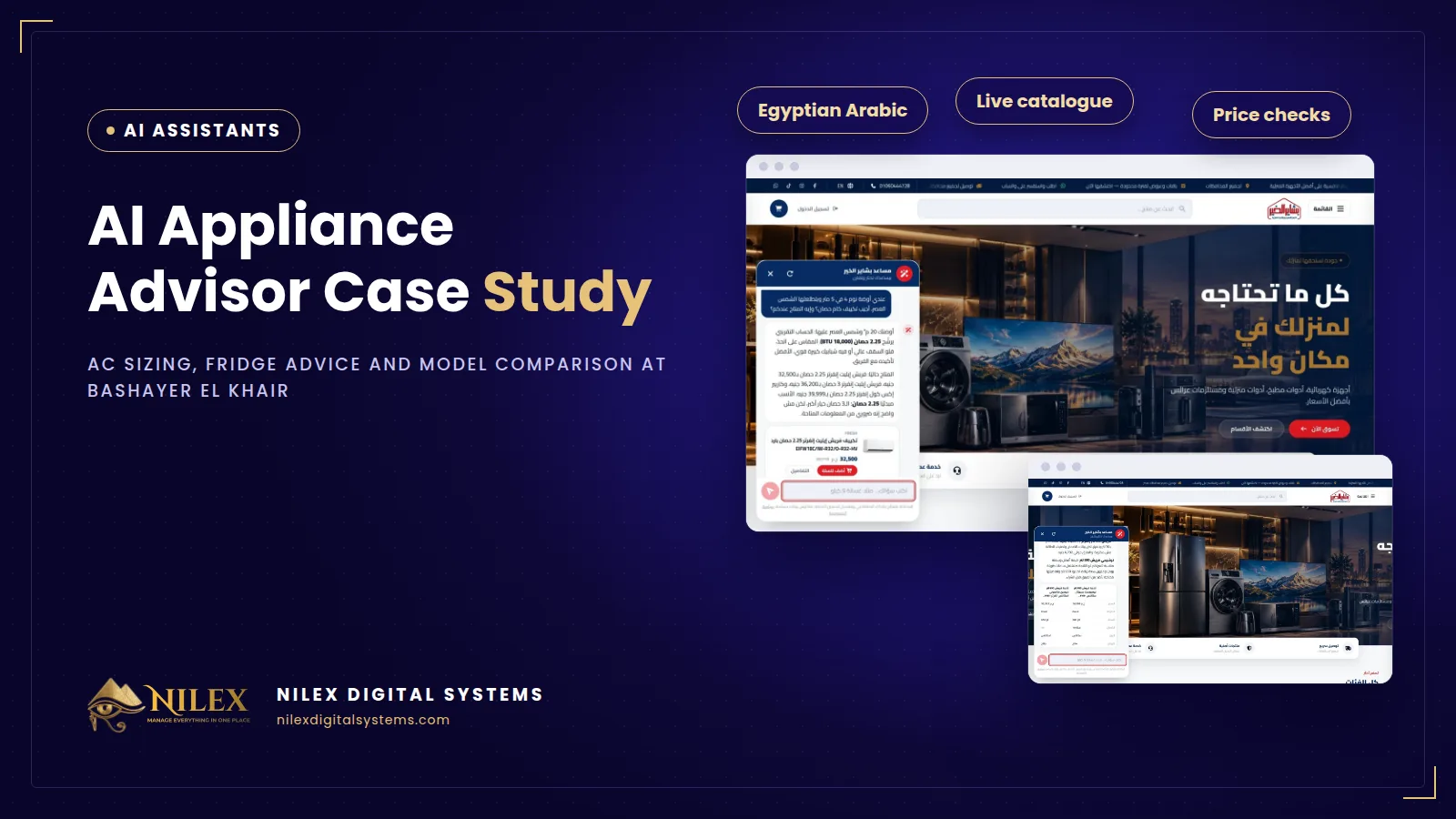
The shopping assistant on Bashayer El Khair Home Appliances works out the right size before it suggests anything: the air-conditioner horsepower for a room from its area and sun, the fridge capacity for a family from its size, and the right washer, TV, water heater or cooker by the same kind of rule. It then shows matching products from the live catalogue, compares models side by side and hands unusual cases to the team.
This case study explains how we built it for Bashayer El Khair, a home-appliance retailer, and why the sizing rules live in code rather than in the AI model. It is the second example in our guide to AI shopping assistants for online stores.
Key takeaways
- Appliance buyers ask about their room or family, not model codes. The assistant translates one into the other.
- AC sizing follows the method Egyptian installers use: room volume, sun exposure and local adjustments, then the smallest standard unit that covers the load.
- The sizing rules are deterministic code, so the answer does not change from one conversation to the next.
- Comparisons show price, brand, capacity, warranty, colour and availability side by side, and say clearly when a detail is missing.
- Every price in a reply is checked against the catalogue, and large or unusual spaces go to the team.
The problem: the same questions, one customer at a time
Before the new store, products and prices lived in social media posts, old posts kept showing old prices, and customers messaged to ask about every model. The salespeople explained sizing and differences again and again: which AC for my room, which fridge for my family, what is the difference between these two. The goal was to answer those questions on the site at any hour, next to an add-to-cart button, with prices the team edits once in the dashboard.
How the assistant sizes an air conditioner
The assistant uses the rule of thumb that Egyptian installers use. The cooling load in BTU per hour is roughly the room volume in cubic metres multiplied by 250 for a shaded room or 300 for a sun-facing room. It then adjusts for hot regions such as Upper Egypt, Aswan, Luxor, the Red Sea and Sinai, for the number of people and for a kitchen, and picks the smallest standard unit that covers the load.
| Room area (3 m ceiling) | Typical unit | Market equivalent |
|---|---|---|
| About 12 m² | 1.5 HP | About 12,000 BTU |
| About 18 m² | 2.25 HP | About 18,000 BTU |
| About 24 m² | 3 HP | About 24,000 BTU |
The answer is always presented as an estimate. For large, open-plan or unusual spaces, the assistant offers the team or a site survey instead of a confident number.
Reading what each AC actually is
Appliance listings put the important facts in the product name and model code: horsepower, BTU, inverter or not, cooling only or cool and heat, split or other unit type. The assistant reads these from the catalogue so it can match a recommended size to real products, not to a category.
A real conversation
A customer wrote: «عندي أوضة نوم 4 في 5 متر وبتطلعلها الشمس العصر، أجيب تكييف كام حصان؟» The assistant answered that the room is 20 m² with afternoon sun and the estimate points to 2.25 HP (18,000 BTU), noted that the size is at the edge and should be confirmed with the team if the ceiling is high or the windows are very large, and showed three matching units from the catalogue with their prices and add-to-cart buttons. It suggested 2.25 HP as the better fit and said the 3 HP option was larger but not clearly necessary. The prices it showed were the live catalogue prices on 5 October 2026 and change over time.
Fridges and other appliances by household
For fridges, the rule is roughly 4–6 cubic feet (about 113–170 litres) per person. In another real conversation, a family of five asked to compare the two best fridges. The assistant gave a suitable range of about 565–850 litres, showed two models that both fit, compared them in a table, recommended the smaller one for value, and said that the larger model's warranty and energy rating were not listed and should be confirmed with the team before buying.
The same approach covers the rest of the shop:
| Appliance | What the assistant asks or uses | Rule |
|---|---|---|
| Washing machine | People in the home | 6–7 kg for 1–2, 8–10 kg for 2–3, 11–12 kg for 4 or more; if unsure, the larger |
| TV | Viewing distance and resolution | 4K: sit about 1–1.5 times the diagonal away; Full HD: 1.5–2.5 times |
| Electric water heater | People in the home | 1 person 10–30 L, 2 people 50–80 L, 3–4 people 100–120 L, 5+ 150 L or more |
| Gas instant heater | Water flow | A shower needs roughly 6–9 L per minute |
| Cooker | Household size and guests | 4 burners / 60 cm for 2–4 people, 5 burners / 90 cm for 5+ or frequent guests; prefer flame-failure safety |
Side-by-side comparison and spec lookup
When a customer asks for a comparison, the assistant builds a table from the catalogue with price, brand, capacity, warranty, colour and availability. Missing fields are shown as missing, not filled in. When a catalogue product has thin specs, the assistant can look up the manufacturer's specifications for that exact model on trusted websites, so it does not have to guess.
Prices, costs and the hand-off
Every money amount in a drafted reply must be a price a catalogue tool returned in that conversation or a number the customer typed, such as a budget. Anything else is corrected before the customer sees it. The assistant also has daily and per-visitor cost limits, and a tool to hand the customer to staff. Conversations are recorded, the customer is told so under the chat box, and the owner can read them from the dashboard. We describe these safeguards in detail in keeping a store chatbot honest.
What changed for the shop
The store lists more than 400 products with model codes and prices, across 23 categories and 38 brand pages. Customers can compare models and prices before visiting the shop, the team updates prices in one place instead of in social media posts, and the questions that used to arrive on WhatsApp are now answered on the site. If you are planning a store, our conversion fixes for Egyptian online stores and our overview of practical AI automation are useful next reads.
How Nilex helps
Nilex builds the AI business chatbot connected to your catalogue, with your team's buying expertise written as rules and every price checked before it is shown. The same approach powers the coffee blend assistant on Anas Saleh Coffee. If your customers ask "which size do I need?" every day, contact us and tell us the rules your best salesperson follows.
Frequently asked questions
Is the AC size recommendation exact?
No, it is an estimate using the installers' rule of thumb. Ceiling height, large windows, open plans and unusual spaces can change the answer, which is why the assistant offers the team or a site survey.
Why are the sizing rules in code and not left to the AI?
So the answer is the same every time and matches the shop's own advice. The AI understands the customer and explains; the rules do the calculation.
What if a product's specs are missing?
The comparison shows the field as missing, and the assistant can look up the manufacturer's specs for that exact model or suggest confirming with the team.
Are the prices in the examples current?
They were the catalogue prices on 5 October 2026. The assistant always shows the price in the catalogue at the time of the conversation.
Can the owner see what customers asked?
Yes. Conversations are recorded and readable from the dashboard, and customers are told not to write sensitive data.
 AI Book Assistant Case Study: Recommending Legal Books From a Reader's Case11 October 2026 · 8 min
 How We Built Our Own AI Sales Assistant: A Consultant That Recommends Systems Without Making Things Up11 October 2026 · 8 min
 AI Business Chatbots From Nilex: What They Do, What We Connect Them To and the Limits We Set11 October 2026 · 9 min