
AI Shopping Assistants for Online Stores in Egypt: What They Do and How Two Stores Use Them
What an AI shopping assistant does for an Egyptian online store: understands Egyptian Arabic and Franco, asks the right question, recommends and compares from the live catalogue, adds to cart and hands off to staff, with two real case studies.
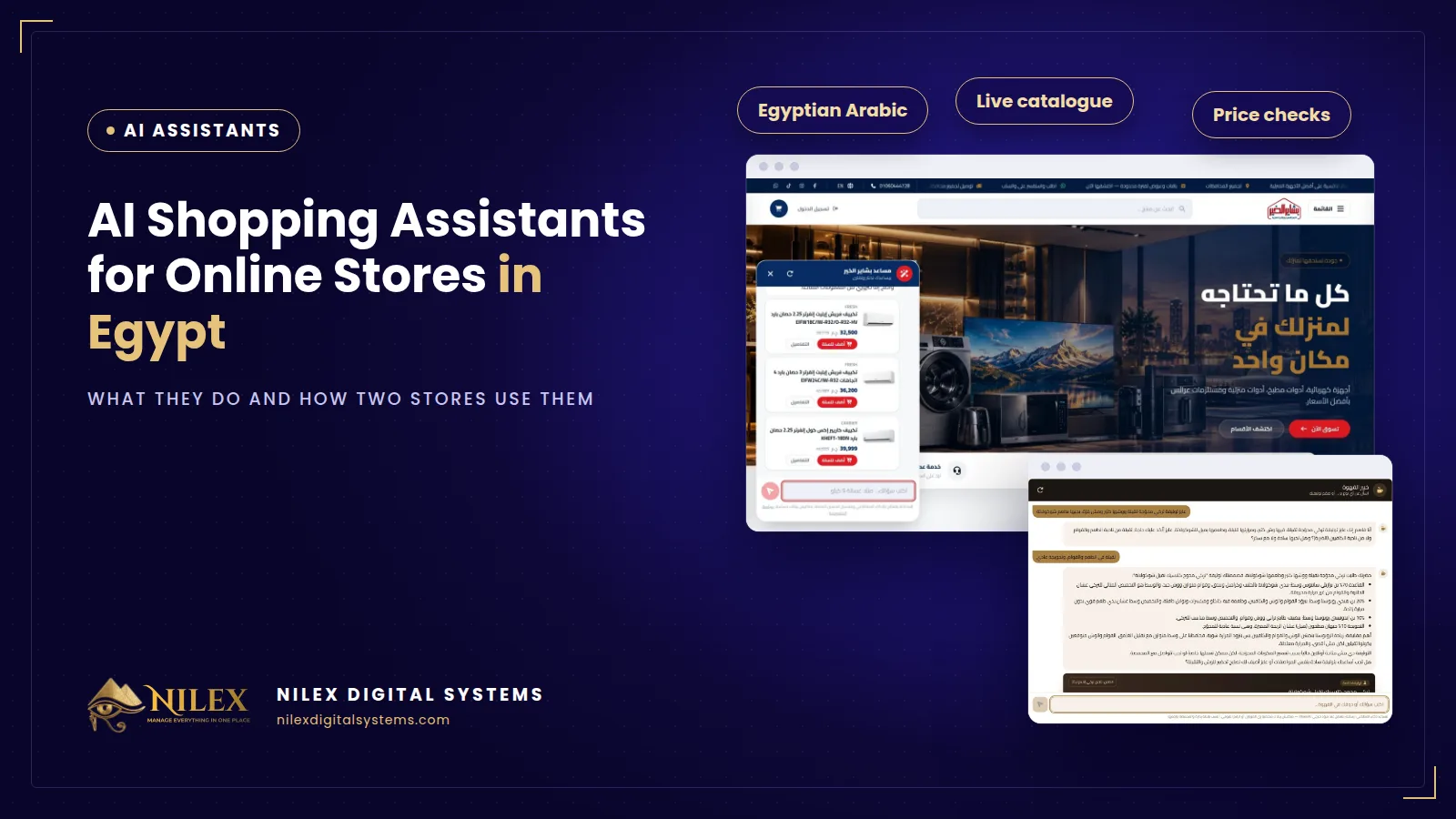
An AI shopping assistant is a chat box on your online store that talks with customers the way a good salesperson does: it understands how they actually write, asks the one question that matters, recommends products from your live catalogue with real prices, compares models and puts the right item in the cart. When a case needs a person, it hands the customer to your team instead of guessing.
This guide explains what such an assistant does for an Egyptian online store, what separates it from a FAQ widget, and what we learned building two of them: the coffee expert on Anas Saleh Coffee and the appliance advisor on Bashayer El Khair Home Appliances.
Key takeaways
- A shopping assistant is useful only when it is connected to your live catalogue: products, prices and availability come from the store, not from the model's memory.
- Egyptian customers write in colloquial Arabic, Franco and English, often in one message. The assistant has to understand all three and answer in the customer's style.
- Good assistants ask before they recommend: room size, family size, brewing method.
- Your shop's buying expertise (how to size an AC, how to build a blend) should be written as rules in code, so answers do not depend on the model's mood.
- Every price in a reply should be checked against the catalogue before the customer sees it.
- A hand-off to staff is part of the design, not a failure.
What does an AI shopping assistant actually do?
Think of the questions your team answers on WhatsApp every day: which air conditioner for my room, which fridge for a family of five, what is the difference between these two models, can you make me a coffee that is strong but not bitter. A shopping assistant answers those questions on the product pages, at any hour, next to an add-to-cart button. In practice it does six jobs:
- Understands the request in the customer's own words, including slang, typos and mixed Arabic and English.
- Asks the right question when something important is missing.
- Recommends from the live catalogue, showing product cards with the current price.
- Compares two or three models side by side on the specs that matter.
- Helps the customer buy: add to cart, or open a custom product such as a coffee blend in an editor.
- Hands off to your staff when the case needs a person.
Understanding Egyptian Arabic and Franco
A customer on an Egyptian store rarely writes in formal Arabic. They write «عايز تكييف لأوضة 4 في 5», or «3ayez 2ahwa te2ela», or mix English model names into an Arabic sentence. Keyword bots fail here, which is why we covered dialect in detail in our article on WhatsApp AI chatbots that understand Egyptian Arabic and Franco.
The Anas Saleh coffee expert understands Egyptian Arabic, Franco and English and mirrors the customer: colloquial gets light colloquial back, English gets English, Franco gets Arabic script. It also knows the words Egyptians use for coffee, such as «وش» for foam, «تقيلة» for strong and «محوّج» for spiced, and it understands negation, so «مش مُرّة» means "not bitter", not "bitter". The Bashayer El Khair assistant greets customers with «ممكن تكتب بالعامية عادي» and is built for the way people describe rooms and families, not model codes.
Asking the right question before recommending
In a real conversation on the coffee store, a customer asked for a spiced Turkish blend that is «تقيلة ووشها كتير ومش مُرّة، بطعم شوكولاتة». Before designing anything, the assistant asked one question: «قصدك تقيلة في الطعم والقوام ولا كافيين أكتر يصحّيك؟» Strong in taste and strong in caffeine lead to different blends.
On the appliance store, the question is usually about the room or the household. If the customer already said "a 4 by 5 metre bedroom with afternoon sun", the assistant has enough to estimate the air-conditioner size and does not ask again.
Recommending from the live catalogue
The difference between a toy and a sales tool is where the products come from. In both projects the assistant calls tools that search the store's own database, so it can only recommend products that exist, with the price and availability the shop entered in its dashboard. Product cards show the price, the old price where there is one, and buttons for details and add to cart.
Expertise written as rules
The shop's buying knowledge is not left to the model. On Bashayer El Khair, air-conditioner sizing follows the method Egyptian installers use, and fridge, washer, TV, water-heater and cooker sizing follow written rules. On Anas Saleh, a knowledge base of 38 coffee origins, blending rules and Egyptian spice mixes sits behind the coffee expert, and the server validates every blend. We explain each in the case studies: the coffee blend assistant and the appliance advisor with AC sizing.
Comparing, adding to cart and handing off
Comparison is where an assistant saves the most messages. Asked to compare the two best fridges for a family of five, the Bashayer assistant showed a side-by-side table of price, brand, capacity, warranty, colour and availability, recommended one for value, and said plainly that the warranty and energy rating of the other model were not listed and should be confirmed with the team.
Buying is one click from the conversation. On the coffee store, a custom blend appears as a card that the customer can open in a blend editor, adjust, and add to the cart like any product. When a blend cannot be ordered online, for example because one bean has no price yet, the card says so and offers ordering on WhatsApp instead.
Hand-off is part of the design: the appliance assistant passes large or unusual spaces and installation questions to the team, and the coffee store routes factory-visit requests to WhatsApp.
FAQ widget vs keyword bot vs AI shopping assistant
| Capability | FAQ widget | Keyword bot | AI shopping assistant |
|---|---|---|---|
| Understands Egyptian Arabic and Franco | No | Only listed words | Yes |
| Asks a clarifying question | No | Fixed menus | Yes, when something is missing |
| Recommends from the live catalogue | No | Sometimes | Yes, with current prices |
| Compares models side by side | No | No | Yes |
| Adds to cart | No | Rarely | Yes |
| Checks prices before replying | Not needed | Not needed | Required |
| Hands off to staff | Contact form | Contact form | Yes, with the conversation context |
Keeping it honest and safe
An assistant that sells must not invent prices, discounts or promises. Both stores check every amount in a reply against what the catalogue returned before the customer sees it, handle personal data openly and limit how much each visitor can use the assistant; the coffee store also filters prompt-injection attempts. We cover these safeguards in keeping a store chatbot honest.
How Nilex helps
Nilex builds the AI business chatbot as part of your store: connected to your products and prices, trained on your content, in Arabic and English, with your shop's expertise written as rules and a hand-off to your team. Both case studies in this article are live Nilex projects. If customers keep asking your team the same buying questions, tell us about your store and we will show you what an assistant would answer.
Frequently asked questions
Does a shopping assistant replace my sales team?
No. It answers the repeated questions and prepares the customer, then hands over cases that need a person, such as site surveys, installation or special orders.
What if the assistant states a wrong price?
It should not be able to. Prices come from the catalogue through tools, and every amount in a reply is checked against those results before it is shown.
Is it worth it for a small store?
It is worth it when customers ask the same sizing or comparison questions many times a day. If most questions are about delivery and payment, a good FAQ page may be enough first.
Can the same assistant work on WhatsApp?
The two assistants described here run on the store website. WhatsApp has its own rules and setup, which we explain in our WhatsApp chatbot article.
Are conversations stored?
That is a design decision per store. The Bashayer El Khair assistant records conversations so the owner can read them in the dashboard and tells customers so; the Anas Saleh coffee expert does not store chat text on the server.
 AI Book Assistant Case Study: Recommending Legal Books From a Reader's Case11 October 2026 · 8 min
 How We Built Our Own AI Sales Assistant: A Consultant That Recommends Systems Without Making Things Up11 October 2026 · 8 min
 AI Business Chatbots From Nilex: What They Do, What We Connect Them To and the Limits We Set11 October 2026 · 9 min