
Film Stock by the Meter: How PPF and Tint Centers Stop Losing Money on Film
How PPF, window tint and vinyl centers control film stock by the meter: what to record per roll, deducting meters per job, pricing with a waste allowance, purchasing and a 30-minute monthly check.
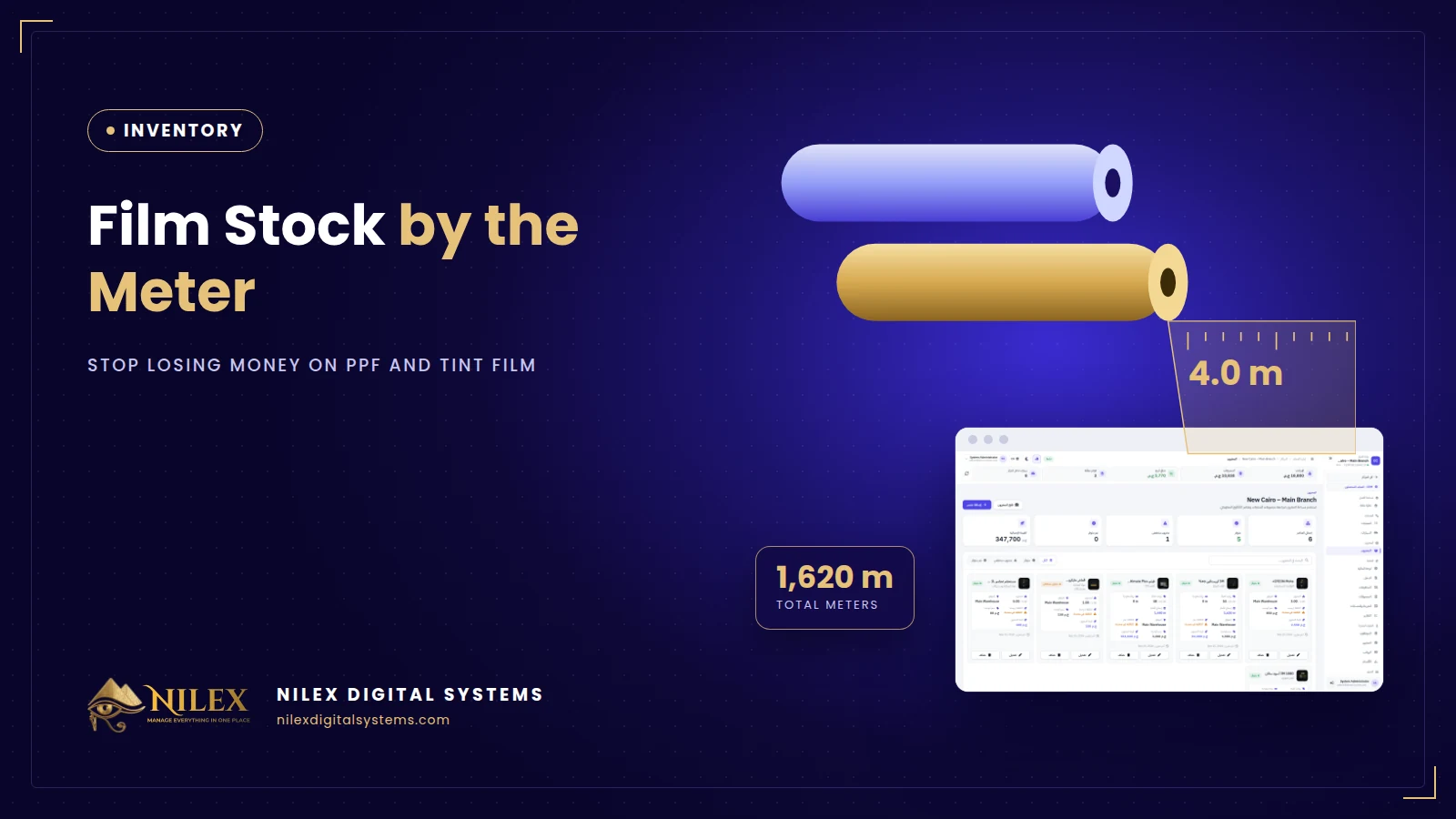
Controlling film stock by the meter means recording every PPF, window tint and vinyl roll as meters, not as "one roll", and deducting the meters each job actually used. It is the single biggest lever on a protection center's margin, because film is usually the most expensive material in the shop and the easiest to lose without noticing.
Ask a center owner how many meters of clear PPF are on the shelf right now and the honest answer is often "about two rolls". Ask how many meters last month's full-body jobs used, and there is usually no answer at all. The money is not stolen; it disappears in offcuts, re-dos, jobs priced on a guess and rolls that ran out on a Thursday afternoon.
Key takeaways
- Stock film the way you buy and use it: rolls, width and meters, with cost per meter.
- Deduct meters per job, not per week. That is what makes waste visible.
- Price each service from its real meters plus a waste allowance, not from habit.
- Track opened rolls separately from full rolls; that is where counts go wrong.
- Set a minimum per film type so you reorder before a roll runs out mid-job.
Where does film go?
In most centers the gap between what was bought and what was billed comes from five places:
- Offcuts and trimming. Every panel needs margin. Bulk cutting by hand uses more margin than pre-cut patterns, and nobody records it.
- Re-dos. A lifted edge or contamination under the film means the panel is redone. The second piece is rarely written down.
- Jobs priced by habit. "Full front" is quoted the same for a small hatchback and a large SUV, although the meters are very different.
- Opened rolls. A roll opened for one car and used on three others is invisible in a count that only knows "rolls".
- Free extras. Door cups, a headlight or a mirror added to please the customer, but never deducted.
What to record for every roll
A useful stock record for film has more fields than a normal product:
- Brand and product line (for example clear gloss PPF, matte PPF, ceramic tint 35%, color change vinyl).
- Roll width and original length, so meters can be converted to square meters when needed.
- Status: full or opened, and the meters remaining on each opened roll.
- Purchase cost and the resulting cost per meter.
- Location: which branch and which warehouse.
- Minimum quantity for a low-stock alert.
Thickness, finish and warranty period matter too, because a premium film and an entry film should never be counted as the same item. Film thickness is usually quoted in mils; one buyer's guide puts standard automotive films at 6.0–7.0 mils and premium films at 7.5–8.0 mils (The Tint Guy, 2026 guide).
Deduct meters per job
The work order is where stock control happens. When a technician finishes the hood, the fenders or the full body, the job should record which roll was used and how many meters, including re-dos. That gives you three numbers that no monthly count can: meters per service, meters per car size and meters per technician.
After a few weeks, patterns appear: one service consistently uses more film than you priced, one technician needs more re-dos, or one film line has more defects. Those are decisions you can act on.
A simple costing example
The table below is an illustration with round numbers, to show the method, not market prices.
| Item | Value | Note |
|---|---|---|
| Roll cost | 30,000 | Any currency; purchase price including shipping |
| Roll length | 15 m | Use your supplier's real length |
| Cost per meter | 2,000 | 30,000 ÷ 15 |
| Meters for a "full front" on a mid-size car | 4 m | Measure from your own jobs |
| Waste allowance | 15% | Set from your recorded re-dos and offcuts |
| Film cost of the service | 9,200 | 4 × 2,000 × 1.15 |
With real meters and a waste allowance based on your own records, the price of each service is set by numbers, and you can see immediately when a price no longer covers the film.
Purchasing, transfers and low-stock alerts
Stock control is not only counting. It connects to purchasing and, for networks, to transfers:
- Purchase orders. Draft, sent, partly received, received; with the supplier's balance and payments. Partial receipts are common with imported film and must update stock correctly.
- Transfers between branches. Ship a roll from one branch, receive it in another, and both stocks update. Without this, one branch buys urgently while another has film on the shelf.
- Low-stock alerts. A minimum per film type, in meters, so the alert comes a week before the roll ends, not during the job.
A monthly stock check that takes 30 minutes
- Print the system's list of opened rolls with meters remaining.
- Measure the opened rolls on the shelf; count full rolls.
- Record differences as an adjustment with a reason.
- Compare meters used against meters billed for each service type.
- Review re-dos by technician and by film line.
If the gap between used and billed meters keeps growing, the problem is either pricing or waste, and the job records tell you which.
How Nilex helps
The car protection film centers management system from Nilex stocks film as full and opened rolls by the square or linear meter, with cost and stock value per item, consumables by the unit, low-stock alerts per branch, purchase orders with partial receipts and supplier balances, and stock transfers between branches. Watch the inventory video on the system page. For the wider picture, read our guide to car protection center management software.
Frequently asked questions
Should I count film in linear meters or square meters?
Use the unit your supplier sells and your team measures. Linear meters are practical for rolls of the same width; square meters help when you compare rolls of different widths. A good system stores the width so it can show both.
How much waste is normal?
It depends on the car, the panel, the installer and whether you cut by hand or use pre-cut patterns. Rather than using a number from the internet, record re-dos and offcuts for a month and set your own allowance.
Can Excel do this?
Excel can hold a list of rolls, but it will not deduct meters from the right roll when a job is closed, and it will not alert you before a roll runs out. That is why counts drift.
How do I handle film in several branches?
Keep stock per branch and move it with recorded transfers. The owner then sees each branch's stock and value, and the network total, on one screen.
If you do not know how many meters of film you used last month, talk to Nilex and we will show you how the system records it from the first day.
 Car Protection Center Management Software: 10 Features a PPF, Ceramic and Tint Center Needs30 September 2026 · 7 min
 Car Check-In Reports and Digital Warranties: How Protection Centers Avoid Disputes30 September 2026 · 5 min
 Managing Several Car Protection Branches: KPIs, Finance, Stock and Technician Pay30 September 2026 · 5 min