

ERP for Construction and Contracting Companies in Egypt: Projects, BOQ, Progress Invoices and Cash Flow
How an ERP runs a contracting company in Egypt: each project as a cost center, the BOQ as the budget, subcontractor contracts and certificates, site stores, progress invoices to the owner, equipment, site worker payroll and a cash flow that shows what each project needs next.
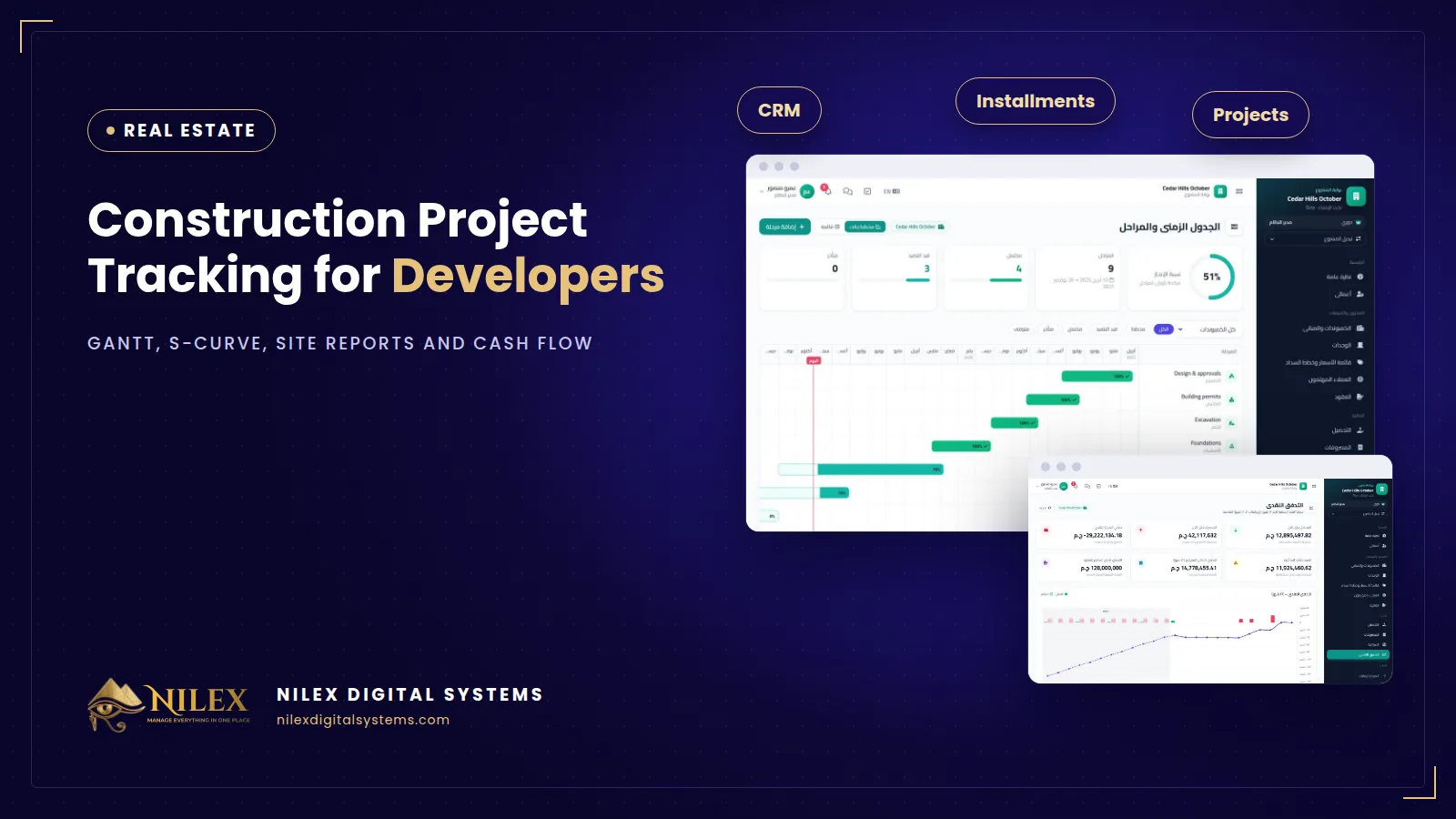
An ERP for a construction and contracting company in Egypt treats every project as its own cost center. The bill of quantities (BOQ) becomes the project budget, every purchase, site store issue, subcontractor certificate, equipment hour and worker's wage is charged to the project and the BOQ item it belongs to, and the progress invoices you issue to the owner are built from measured quantities. The result is one view per project: what was planned, what was spent, what was invoiced, what was collected and what cash the project needs next month.
Most contractors run this on separate sheets: the technical office keeps the BOQ and measurements, the site keeps a store notebook, accounts keep the ledger and the owner keeps the bank position in his head. Each part works until the company runs three or four projects at once. Then nobody can say quickly which project is making money and which one is eating the others' cash. This guide is for contractors. If you are a real estate developer following contractors on your own projects, read construction project tracking and cash flow for developers instead.
Key takeaways
- Each project is a cost center, and each BOQ item is a budget line that every cost is charged to.
- Progress invoices to the owner are built from cumulative measured quantities, with deductions such as advance recovery and retention as your contract defines them.
- Subcontractors need their own contracts, rates and certificates, paid only against approved work.
- Site stores are real warehouses: receipts, issues to BOQ items, transfers and stock counts.
- Cash flow by project combines expected collections from the owner with commitments to suppliers, subcontractors and workers.
Projects and cost centers
The starting point is the project record: owner, contract value, start and end dates, site manager, and the BOQ. Inside the project, costs can be analysed by BOQ item, by phase (excavation, concrete, finishing) or by type (materials, labor, subcontractors, equipment, site overheads). Head office expenses can be allocated to projects by a rule your accountant agrees. With this structure, the profit and loss of each project comes straight from the ledger, not from a separate sheet prepared once a quarter.
The BOQ as the budget
The BOQ lists each work item with its unit, quantity and rate. In the ERP it does three jobs:
- Budget: each item has an estimated cost broken into materials, labor and subcontract, so you can compare estimated and actual cost per item.
- Measurement: the technical office records executed quantities for each item, which feed the progress invoice.
- Variations: additional or omitted quantities and new items are recorded as approved variations, with their date and reference, instead of editing the original BOQ.
| BOQ item | Contract qty | Executed to date | Estimated cost | Actual cost to date |
|---|---|---|---|---|
| Reinforced concrete for columns (m³) | From the contract | From measurements | From the estimate | From purchases, issues and certificates |
| Block work (m²) | From the contract | From measurements | From the estimate | From purchases, issues and certificates |
The table shows where each figure comes from in the system; your own BOQ provides the real items.
Progress invoices (payment certificates) to the owner
A progress invoice is usually cumulative: it shows the total executed quantity of each item to date, the value at the contract rate, the previous invoices and the amount due for this period. The ERP should calculate this from the measurements and apply the deductions your contract specifies, for example recovery of the advance payment, retention and any agreed penalties, with taxes and statutory deductions set up as your accountant advises. Once the consultant approves the invoice, the approved amounts are recorded, the receivable is posted and the invoice can be followed until it is collected.
If your company is registered in the Egyptian e-invoice system, the invoice you issue to the owner is also a tax document. Agree with your accountant how progress invoices are issued electronically; our article on ERP integration with the e-invoice system explains the integration side.
Subcontractors
Each subcontractor gets a contract inside the project: scope, BOQ items, rates, advance, retention and payment terms. The site engineer records the work executed, the subcontractor certificate is calculated the same way as the owner's invoice, and payment is released only after approval. The system then shows, per subcontractor and per project, what was contracted, certified, paid and retained, and links each certificate to the BOQ items it covers so the project cost is complete.
Site stores
Every site has a store, and it should be a warehouse in the system, not a notebook. Materials are received against purchase orders, issued to BOQ items or to subcontractors with a signature, transferred between sites, and counted periodically. Steel, cement and finishing materials are often where the largest unexplained losses hide, so the issue to a specific item is what makes the cost per item real. Multi-warehouse stock is part of the approach described in managing several branches and warehouses in one system.
Equipment
Owned equipment, such as loaders, mixers and scaffolding, can be registered as assets with their location, operator, working hours, fuel and maintenance. An hourly or daily rate charges each piece of equipment to the project that used it. Rented equipment is recorded with its rental contract and charged in the same way, so the project cost includes equipment whether you own it or not.
Site worker payroll
Site labor is often daily or weekly and moves between projects. The ERP should record attendance per site, daily rates, overtime and advances, and charge each worker's cost to the project and, where useful, to the BOQ item. Monthly staff stay in the normal payroll. Social insurance and labor law obligations should be configured with your HR advisor; see HR, attendance and payroll inside the operations system.
Cash flow by project
Contractors run short of cash even when projects are profitable, because they pay suppliers, subcontractors and workers before the owner pays them. A useful cash flow view lists, for the coming weeks and months, expected collections from approved and pending progress invoices, and commitments: purchase orders, subcontractor certificates, payroll and equipment rent. Management can then see which project needs funding and which invoice is late.
Separate sheets vs one ERP
| Question | Separate sheets | One ERP |
|---|---|---|
| Which project is profitable? | Known at the end, if at all | Visible from the ledger at any time |
| Actual cost of a BOQ item? | Estimated | From purchases, issues, certificates and labor |
| How much do we owe subcontractors? | Different answers from site and accounts | Certified, paid and retained per contract |
| What is in the site store? | Notebook, counted rarely | Stock per site, with issues per item |
| Cash needs next month? | In the owner's head | Collections and commitments by project |
How Nilex builds a construction ERP
Nilex builds the ERP from scratch around your workflow, so project, BOQ, progress invoice and subcontractor screens follow the way your technical office, site and accounts actually work. Every action is recorded in the audit log, financial records cannot be silently changed, each person sees only what they need, and reports export to PDF and Excel. We work online only: workshops, reviews, testing and training run on video calls, which also makes it easy to include site engineers.
Construction features are part of the custom scope. As a guide: Essentials starts from EGP 150,000 in Egypt (USD 5,000 for companies abroad) for one company and one location, about 45 days; Growth starts from EGP 300,000 in Egypt (USD 8,500 for companies abroad) and adds multiple branches and warehouses, full accounting, employees and permissions and advanced reports, about 75 days; Enterprise starts from EGP 800,000 in Egypt (USD 22,000 for companies abroad) and adds assets tracking, e-invoicing integration and an AI assistant inside the system, about 120 days. A contractor with several sites, site stores and equipment usually needs more than Essentials. See the custom ERP system service page and tell us how your projects run.
Frequently asked questions
What is the difference between construction software and a construction ERP?
Many construction programs handle the BOQ and progress invoices only. A construction ERP also includes purchasing, site stores, subcontractors, payroll, equipment and the accounts, so each project's cost and profit come from one place.
Can the system issue cumulative progress invoices?
Yes, a custom ERP can calculate cumulative executed quantities, previous invoices and the amount due, with the deductions your contract defines.
Can we run several projects and sites at once?
Yes. Each project is a cost center and each site store is a warehouse, with consolidated reports for management.
Can site engineers use it from the site?
Yes. A web-based ERP works from a phone or laptop with an internet connection, with permissions limited to their project.
Can we start with progress invoices and stores, then add the rest?
Yes. Many contractors start with projects, BOQ, purchasing, site stores and progress invoices, then add subcontractors, equipment and payroll in a later phase.
 ERP System for Companies in Saudi Arabia (ZATCA-ready): What to Require and How a Custom ERP Is Delivered28 November 2026 · 8 min
 ERP Software Development Company in Egypt: How a Professional ERP Is Built28 November 2026 · 8 min
- ERP for Furniture and Woodworking Factories in Egypt: Orders, Cut Lists and Instalments28 November 2026 · 8 min