
What Is a CRM and Why You Lose Customers Without One
A CRM is one shared record of every lead, customer, conversation and deal. This guide explains what a CRM does, the signs an Egyptian company is losing customers without one, and how to roll one out without drowning your team.
A CRM (customer relationship management) system is one shared place where your company records every lead, customer, conversation, quotation and deal, so nobody has to remember who asked for what. For most Egyptian companies the real question is not "what is a CRM" but "where are our customers going". The honest answer is often: into a salesperson's personal WhatsApp, a notebook, or an Excel file that three people edit in three versions.
When a lead arrives from a Facebook ad at 11 pm, is someone assigned to call back? When your best salesperson in New Cairo resigns, does the client history leave with her phone? A CRM exists to make those answers "yes" and "no".
This guide explains what a CRM actually does, the concrete ways companies lose customers without one, what features matter for the Egyptian market, and how to adopt one without turning it into a data-entry burden.
Key takeaways
- A CRM is a shared customer memory: contacts, conversations, deals, tasks and history in one record per customer.
- Most lost customers are not lost to competitors first; they are lost to slow replies, forgotten follow-ups and handovers that never happen.
- In Egypt, leads arrive through WhatsApp, Facebook, Instagram, phone calls and walk-ins, so a useful CRM has to capture all of them, not only web forms.
- The core features are simple: lead capture, pipeline stages, follow-up tasks, activity history, permissions and reports.
- Customer data in a CRM is personal data, so Egypt's Data Protection Law 151/2020 applies; its executive regulations have a compliance deadline of 1 November 2026.
What a CRM actually does
Strip away the vendor language and a CRM does four jobs.
1. One record per customer
Every person or company you deal with has one profile: name, phones, company, source (ad, referral, exhibition), who owns the relationship, and a timeline of every call, message, visit, quotation and invoice. When the customer calls, whoever answers sees the whole story in seconds.
2. A visible sales pipeline
Deals move through stages you define, for example: new lead, contacted, needs identified, quotation sent, negotiation, won or lost. The manager sees how many deals sit in each stage, their value, and which ones have not moved for two weeks.
3. Follow-up discipline
Every open deal has a next action and a date. If the date passes, the CRM reminds the salesperson and, if needed, the manager. This single feature is where most companies recover lost revenue.
4. Reporting you can trust
Which campaign brought customers who actually paid? Which salesperson converts best? Why do deals get lost? When data is recorded in one place, these become reports rather than arguments.
Seven ways companies lose customers without a CRM
These patterns come up again and again in Egyptian companies of every size, from a clinic in Nasr City to a distributor in the Delta.
- The slow first reply. A lead messages on WhatsApp or Messenger, nobody is clearly responsible, and by the time someone replies the customer has bought elsewhere.
- The forgotten follow-up. A quotation is sent and nobody calls back. The customer reads silence as lack of interest.
- The leaving salesperson. Contacts, chats and promises live on a personal phone. When the employee leaves, the relationships leave too.
- Duplicate and conflicting contact. Two salespeople call the same customer with two different prices. The customer loses trust in both.
- No after-sales memory. A complaint is handled on the phone and never recorded, so the next person repeats the mistake.
- Marketing money with no feedback loop. You pay for ads, but nobody can say which ad produced paying customers, so budget goes to the wrong places.
- Existing customers ignored. Without purchase history, nobody knows who is due to reorder, renew a contract or book a follow-up visit.
None of these is solved by working harder. They are solved by a system that assigns, reminds and records.
Why the Egyptian market makes CRM more urgent
Leads come from many channels at once
Egypt had 51.6 million social media user identities in October 2025, and Facebook's ad reach alone was 51.6 million, according to DataReportal Digital 2026 Egypt. Many businesses run their sales through Facebook, Instagram and WhatsApp rather than through a website form. whatsapp.com was among the ten most visited websites in Egypt in August 2026 (Similarweb). A CRM that only captures web forms misses most of the demand.
Mobile-first sales teams
Field sales representatives, property brokers and medical reps work from their phones. If updating the CRM takes more than a minute on an Android phone, they will not do it. Mobile usability is not a nice extra here; it decides whether the system gets used.
Arabic and English, sometimes in one record
Customer names arrive in Arabic, English and Franco. Search has to find "محمد" and "Mohamed" as the same person, and reports and quotations often need to be printed in Arabic.
Customer data is now regulated
Egypt's Personal Data Protection Law 151/2020 has executive regulations issued in November 2025, with a one-year compliance window ending on 1 November 2026 (CMS analysis, 2026). A CRM is where most of your customer personal data lives, so it is also where consent records, retention periods and access control need to be managed.
Must-have CRM features for an Egyptian company
| Feature | Why it matters | Question to ask the vendor |
|---|---|---|
| Multi-channel lead capture | Leads arrive from WhatsApp, Facebook, calls, website and walk-ins | Can each channel create a lead automatically, with its source recorded? |
| Lead assignment rules | No lead should wait without an owner | Can leads be assigned by region, product or rotation? |
| Pipeline stages and next actions | Stops forgotten follow-ups | Does every open deal require a next step and a date? |
| Activity timeline | Keeps history when staff change | Are calls, messages and notes stored on the customer record? |
| Roles and permissions | Salespeople should not export the whole database | Can I restrict viewing and exporting by role? |
| Arabic interface and search | Staff and customers work in Arabic | Does search handle Arabic spelling variants? |
| Integration with accounting or ERP | Quotations become invoices; payments show in the customer file | Is there an API, and who maintains the integration? |
| Reports | Conversion by source, salesperson and stage | Can managers build reports without the vendor? |
CRM vs Excel vs ERP: where each fits
Excel works for a few dozen contacts and one person. It fails when several people edit the same file, when you need reminders, or when you need to know who changed what.
An ERP manages operations and money: stock, purchasing, invoices, accounts. A CRM manages the relationship before and after the sale: leads, follow-ups, quotations, complaints. Many companies need both, connected, so that a won deal in the CRM creates a sales order in the ERP and the customer's balance appears on the CRM record. If you already run an ERP, a CRM module inside it can be the simplest route.
Examples by industry
- Real estate brokers in New Cairo and the New Capital: lead source tracking, site-visit scheduling, unit interest, and follow-up over long decision cycles.
- Clinics and medical centres: patient enquiries, bookings, follow-up visits and packages, with stricter privacy because health data is sensitive.
- B2B distributors and factories: account managers, price lists per customer, visit plans and reorder reminders.
- Training centres and schools: enquiries by course, trial sessions, instalments and renewals.
How to roll out a CRM without killing it
Most failed CRM projects fail because of adoption, not software. A practical sequence:
- Write down your real sales process in five to seven stages, in the words your team already uses.
- Decide the minimum data for each stage. Every extra mandatory field lowers usage.
- Connect the channels first, so leads enter the CRM automatically instead of being typed in.
- Import clean data: remove duplicates and unify phone formats before migration.
- Start with one team for four to six weeks, fix what annoys them, then extend.
- Manage from the CRM. If weekly sales meetings use the pipeline report, the team will keep it updated.
- Set privacy rules on day one: who can export, how long you keep data for lost leads, and how consent to marketing messages is recorded.
What to measure in the first 90 days
- Time from lead arrival to first reply
- Percentage of open deals with an overdue next action
- Conversion rate by lead source
- Number of leads with no owner
These are your own numbers. Record a baseline in the first week, then compare.
How Nilex helps
Nilex builds CRM systems around your sales process, either as a standalone system or as a module of a custom ERP system so that customers, quotations, orders and invoices share one database. We design lead capture from your real channels, role-based permissions, a full audit log, and Arabic and English interfaces. When conversations are the bottleneck, an AI business chatbot can answer first-line questions and pass qualified leads to the right salesperson. You can see examples of our systems in our client projects.
Frequently asked questions
What is a CRM in simple words?
It is a shared system that stores every customer and lead with their full history: calls, messages, quotations, deals and complaints. It also reminds your team what to do next with each one. The goal is that no customer depends on one employee's memory or phone.
Does a small business in Egypt need a CRM?
If more than one person deals with customers, or you receive leads from several channels, yes. A small business can start with a simple pipeline and follow-up reminders. The cost of one lost repeat customer is often higher than the effort of recording data properly.
What is the difference between CRM and ERP?
A CRM manages relationships and sales activity before and after the deal. An ERP manages operations and money: stock, purchasing, invoicing and accounting. They work best connected, so a won deal flows into an order and an invoice.
Can a CRM work with WhatsApp?
Yes, through the WhatsApp Business Platform, which lets conversations be linked to customer records and assigned to team members. Meta's rules on opt-in and message types apply; see our guide to WhatsApp-integrated CRM for sales teams.
Does Egypt's data protection law apply to my CRM?
Yes. Names, phones and purchase history are personal data under Law 151/2020. Plan for consent records, retention periods and access control, and review the details with a specialist before the 1 November 2026 deadline.
If customers are slipping through WhatsApp chats and spreadsheets, a short conversation about your sales process is the best first step. Book a free consultation with Nilex and we will map where leads are being lost and what a CRM should look like for your team.
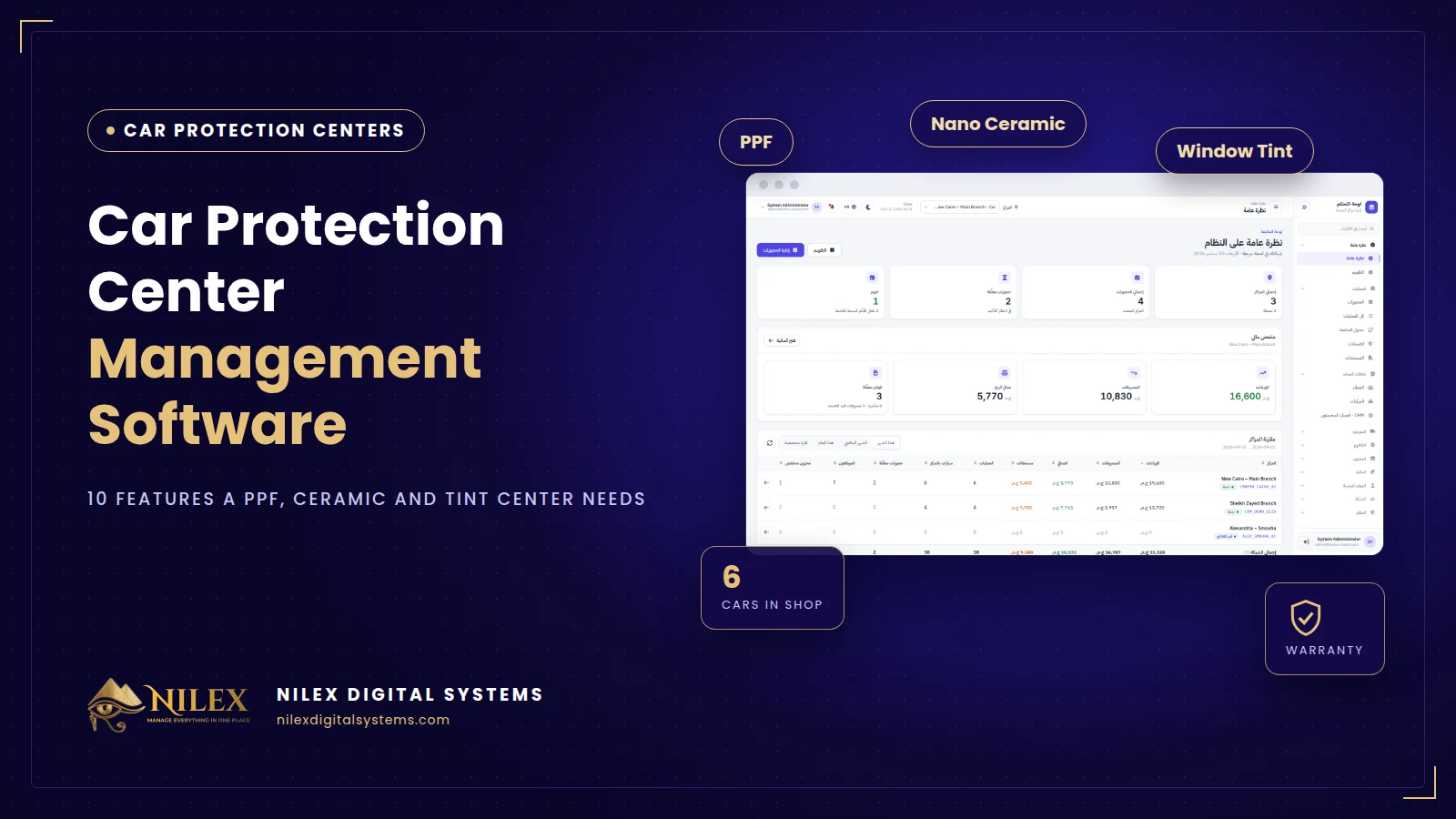 Car Protection Center Management Software: 10 Features a PPF, Ceramic and Tint Center Needs30 September 2026 · 7 min
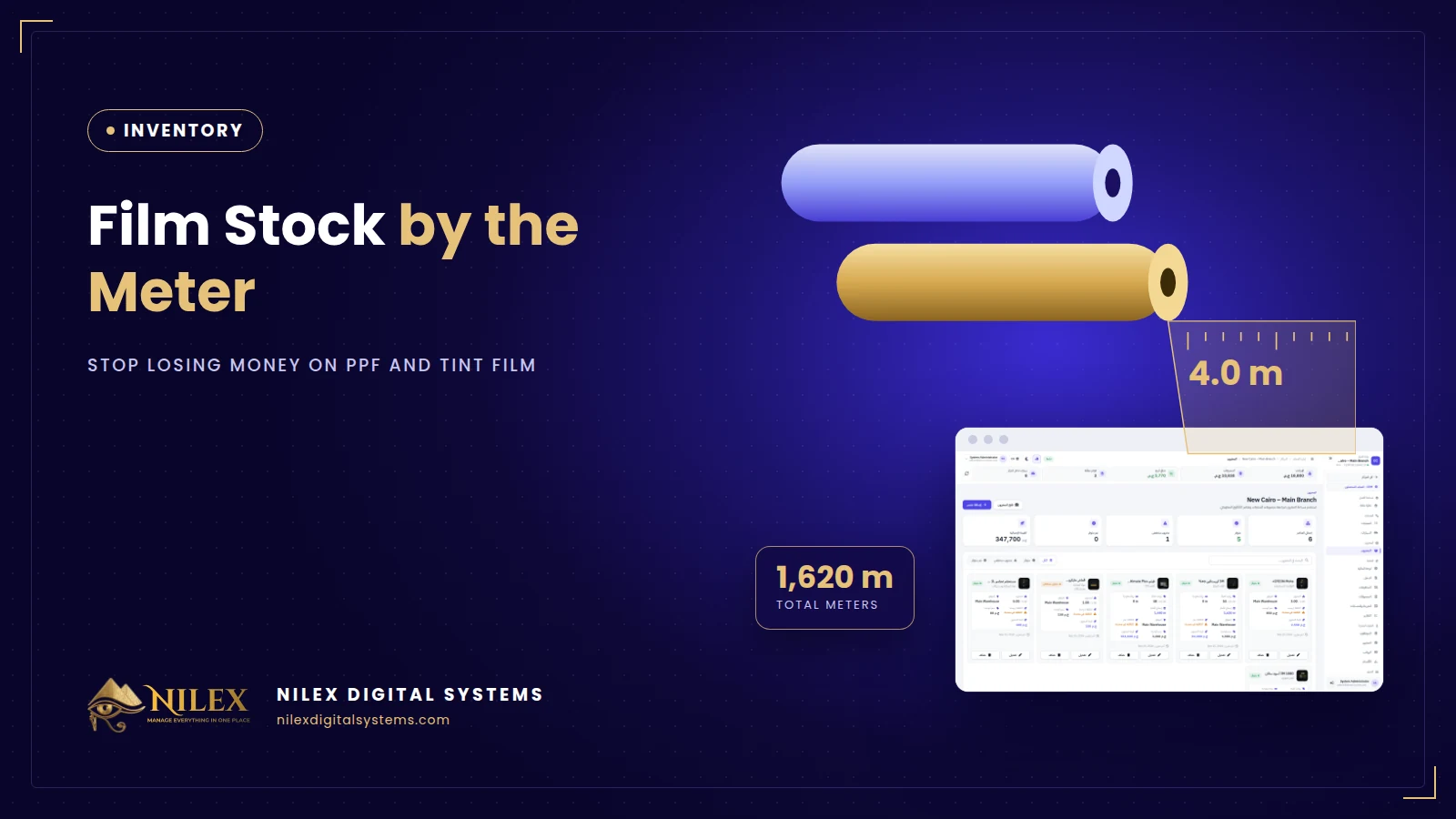 Film Stock by the Meter: How PPF and Tint Centers Stop Losing Money on Film30 September 2026 · 6 min
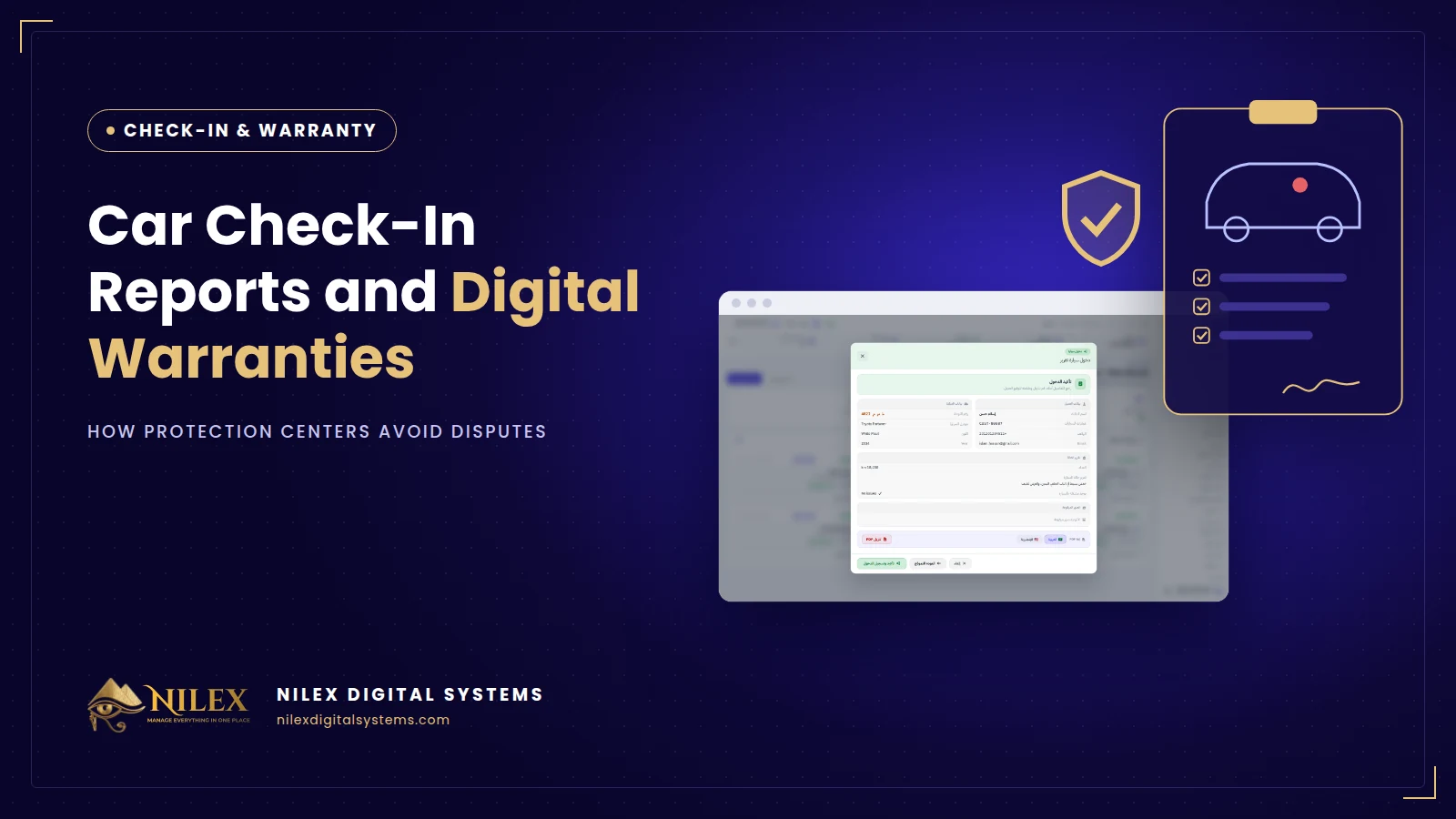 Car Check-In Reports and Digital Warranties: How Protection Centers Avoid Disputes30 September 2026 · 5 min