

ZATCA E-Invoicing for Car Protection and Tint Centers: Wave 25 Guide for 2027
ZATCA Wave 25 reaches PPF, tint and ceramic centers with VAT-subject revenue above SAR 187,500 in any year 2022–2025, with a 1 February 2027 deadline. What integration means, typical center invoices, questions to ask vendors, and where Nilex stands.
If your PPF, window tint or nano-ceramic center had VAT-subject revenue above SAR 187,500 in any year from 2022 to 2025, ZATCA's Wave 25 requires you to integrate your e-invoicing solution with the Fatoora platform by 1 February 2027. Integration means every invoice is produced by a compliant solution in ZATCA's format, stamped, and sent to ZATCA: standard (B2B) tax invoices are cleared before they reach the buyer, and simplified (B2C) invoices are reported within 24 hours. ZATCA says it will notify the targeted taxpayers directly.
For a protection center, that is not only an accounting question. Your invoices start life in the work order: the car, the services, the film, the deposit and the final payment. If the e-invoicing part and the operations part do not fit together, the cashier types every job twice. Owners are clearly asking: in Saudi Arabia «فاتورة الكترونية» is searched about 1,000 times a month and «ربط الفاتورة الالكترونية» about 260 times (Google Keyword Planner, Oct 2026). This guide explains who is in Wave 25, what integration means in practice for a center, which questions to ask any system vendor, and where Nilex stands today. It is information for owners, not tax advice; confirm your own position with your accountant or with ZATCA.
Key takeaways
- Wave 25 covers taxpayers whose VAT-subject revenue exceeded SAR 187,500 in 2022, 2023, 2024 or 2025. The integration deadline is 1 February 2027.
- SAR 187,500 a year is about SAR 15,600 a month, so most working tint and PPF centers that are VAT-registered should check whether they are in scope.
- Integration is done by an e-invoicing solution that meets ZATCA's technical requirements; ZATCA's list of solution providers is indicative, not an approval.
- Fleet, rental and corporate customers usually need standard tax invoices (cleared); walk-in customers usually get simplified invoices (reported).
- Ask every vendor in writing whether their product is integrated with Fatoora or relies on a separate solution. The Nilex system issues VAT invoices with the buyer's VAT number but is not integrated with Fatoora today.

Who is in Wave 25?
ZATCA's announcement is short and clear. Wave 25 targets taxpayers whose revenues subject to VAT exceeded SAR 187,500 during 2022, 2023, 2024 or 2025, and they must integrate their e-invoicing systems with Fatoora no later than 1 February 2027. ZATCA states that it will notify all targeted taxpayers in the wave. KPMG and EY summarise the announcement in the same terms.
Two details matter for a center owner:
- Any single year counts. A center that had one strong year in 2023 and a weaker 2025 is still in scope if the 2023 figure crossed the threshold.
- The threshold matches the voluntary VAT registration level. ZATCA's registration service says registration is mandatory above SAR 375,000 a year and voluntary between SAR 187,500 and SAR 375,000. In practice, many VAT-registered centers, including those that registered voluntarily, now fall inside Phase 2.
Illustrative example: a single-bay tint shop invoicing SAR 20,000 a month (before VAT) has SAR 240,000 a year, above the Wave 25 threshold. A busy PPF center will usually be in an earlier wave already. If you are unsure which wave you belong to, check the notification in your ZATCA account or ask your accountant before you change any system.
Phase 1 and Phase 2 in one table
ZATCA's e-invoicing page lists two phases: Phase 1 from 4 December 2021 and Phase 2 from 1 January 2023, rolled out in waves. Our article on Egypt ETA vs Saudi ZATCA e-invoicing compares the Saudi regime with Egypt's in detail. The short version for a center:
| Aspect | Phase 1 (generation) | Phase 2 (integration) |
|---|---|---|
| Since | 4 December 2021, all resident VAT taxpayers | 1 January 2023, in waves; Wave 25 by 1 February 2027 |
| What is required | Invoices generated by a compliant electronic solution | The solution is connected to Fatoora and exchanges each invoice with ZATCA |
| Standard tax invoice (B2B) | Generated electronically | Cleared by ZATCA before it is shared with the buyer |
| Simplified tax invoice (B2C) | Generated electronically, with a QR code | Reported to ZATCA within 24 hours of issue |
| Format and security | Electronic format | Structured XML, cryptographic stamp, QR code and the hash of the previous invoice |
Sources: ZATCA's e-invoicing page and announcement, and the technical summary in VATupdate and our article 30. The exact technical rules are in ZATCA's published standards, which your solution provider should follow.
What integration actually means for a center
Integration is not a printer setting. According to the summaries we reviewed, an integrated solution must issue invoices in the approved XML format, apply a cryptographic stamp, give each invoice a unique identifier, embed a QR code, chain each invoice to the previous one with a hash, and connect to ZATCA through a secure interface. Each e-invoicing solution unit is onboarded with ZATCA and receives its own cryptographic identifier, so a center with three cashier points or three branches has more to set up than a center with one.
In daily terms, a center inside Phase 2 needs to know:
- Which customers are B2B. Car rental companies, dealerships, fleet owners and companies that pay for an employee's car usually need a standard tax invoice with their VAT number. That invoice must be cleared by ZATCA before it is sent.
- How refunds and changes are handled. A cancelled ceramic job or a discount after delivery needs a credit or debit note through the same solution, not a deleted invoice.
- How deposits are invoiced. Many centers take a booking deposit for full-body PPF. Ask your accountant how advance payments should be invoiced in your case and make sure the solution supports it.
- What happens when the internet is down. Simplified invoices can be reported within 24 hours, but B2B clearance needs a connection. Ask the vendor how the solution behaves offline.
Typical center invoices and how they are treated
| Situation (illustrative) | Invoice type | What to check |
|---|---|---|
| Walk-in customer, full tint and front PPF, pays by card at delivery | Simplified tax invoice (B2C) | Reported within 24 hours; QR code printed |
| Rental company, ceramic coating for 10 cars | Standard tax invoice (B2B) | Buyer's VAT number; cleared before sending |
| Dealership sends new cars for windshield film | Standard tax invoice (B2B) | Monthly or per-car invoicing agreed with your accountant |
| Customer cancels after paying a deposit | Credit note | Issued through the same solution, linked to the original |
| Free re-inspection under warranty | Usually no invoice if nothing is charged | Keep the visit on the car's record for warranty history |
The table is a general guide only. The correct treatment of each case is a question for your accountant.
Questions to ask any system vendor
Owners often hear "our system supports ZATCA" without knowing what it covers. Ask for written answers to these questions:
- Is your product itself integrated with Fatoora for Phase 2, or do you connect to a separate e-invoicing solution? Which one?
- Does it handle both clearance (B2B) and reporting (B2C), including credit and debit notes?
- How are several cashier points or branches onboarded, and who renews the cryptographic credentials?
- What happens when ZATCA rejects an invoice, and who sees the error?
- How does the solution behave offline?
- Can I export all my invoices and data if I leave? (See your data stays yours.)
- Is the provider on ZATCA's solution providers directory? ZATCA describes the directory as an indicative, non-binding list and says it is not an approval of any product, so ask for evidence of compliance, not only a listing.
- What does integration cost per year, per branch and per device?
Our comparison of PPF and tint shop software for GCC owners shows how accounting tools, US shop tools and Nilex differ on this point.
Operations system and e-invoicing: two layers that must agree
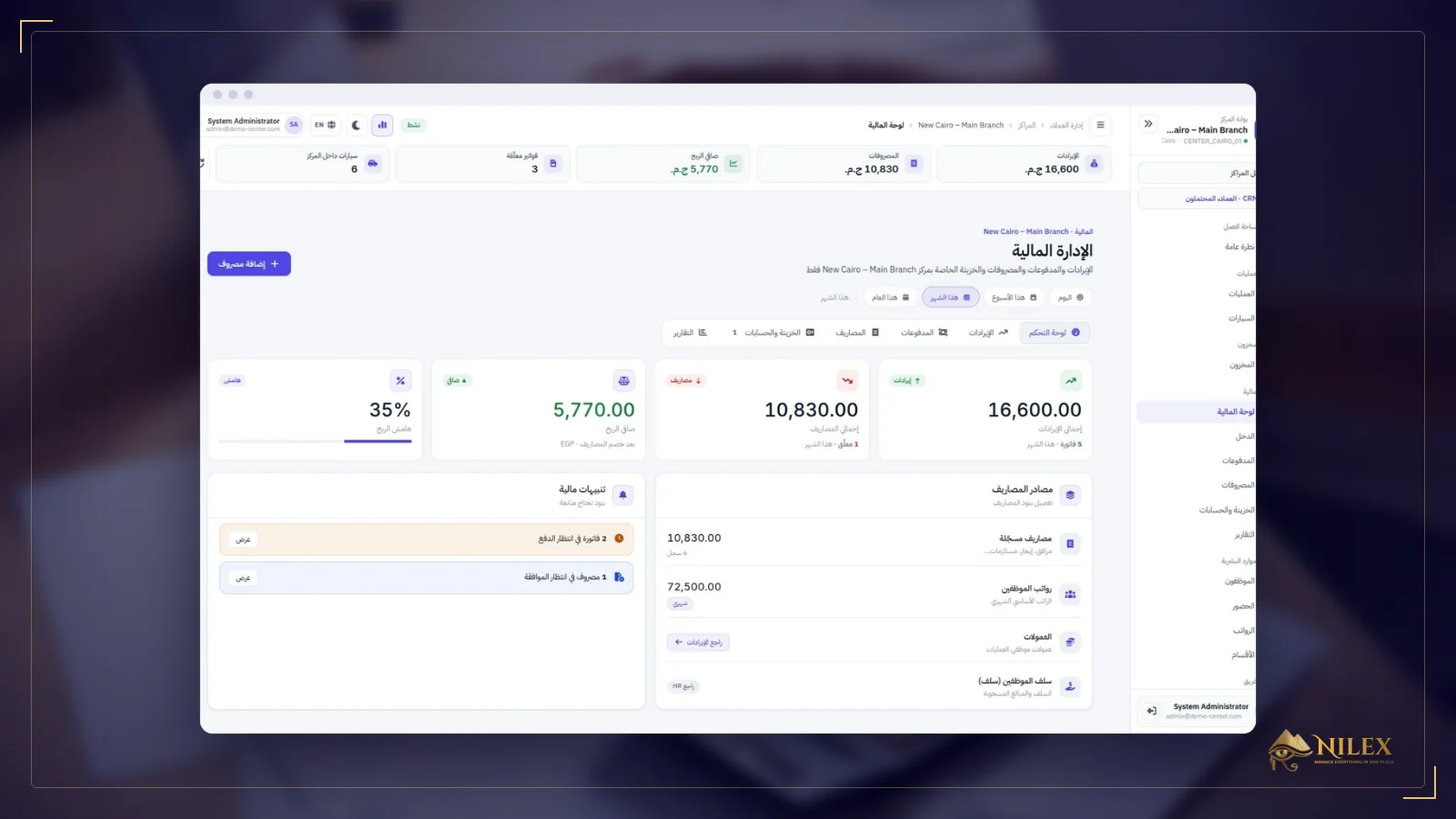
A protection center needs two things that are easy to confuse. The operations system knows the car, the VIN, the services, the technicians, the film used, the warranty and the follow-ups. The e-invoicing solution turns the final amount into a ZATCA-compliant invoice. Some products do both; many accounting tools do the second well and the first poorly; specialised shop systems often do the first well and not the second.
Whatever you choose, aim for one flow: the work order is closed once, the invoice amount comes from it, and the payment is recorded against the job. If the two layers are separate products, decide who enters what and reconcile daily totals, so the operations report and the tax report never tell two stories. Read more in our guide to the car protection center system in Saudi Arabia.
A simple plan before 1 February 2027
- Confirm your scope. Check your VAT-subject revenue for 2022–2025 and any ZATCA notification with your accountant.
- List your invoice types. B2C walk-ins, B2B fleets and dealers, deposits, refunds and warranty visits.
- Choose the e-invoicing solution. Either your management system is integrated, or you add a compliant solution and agree how it fits your operations.
- Onboard every branch and cashier point and test with real invoices, including a credit note and a B2B invoice.
- Train reception to capture the buyer's VAT number and name correctly at booking, not at the last minute.
- Keep the work order as the source. Opening a new center? Our guide to opening a car protection and tint center in Saudi Arabia covers VAT and systems from day one.
How Nilex helps
Here is where the Nilex car protection film centers management system stands in October 2026, plainly:
- What it does: work orders, check-in with photos and the VIN, film by the meter, warranties with PDF certificates, follow-ups, bookings, the sales CRM, finance, HR and payroll, in Arabic and English. Its invoices carry a VAT amount at a configurable rate and the buyer's VAT registration number.
- What it does not do: it is not integrated with ZATCA's Fatoora platform, it does not clear or report invoices to ZATCA, and it does not print a ZATCA QR code.
So a center inside Phase 2 that uses Nilex for operations must also issue its tax invoices through a compliant e-invoicing solution, and should agree with its accountant how the two are reconciled. If Fatoora integration is a requirement for you, say so in your request and we will tell you clearly whether and how it can be done for your project. After delivery you have 14 days to test and 30 days of free fixes for errors in the delivered work, as explained in testing, acceptance and the free-fix period. Questions? Contact us.
Sources
- ZATCA: Wave 25 of e-invoicing integration
- ZATCA: e-invoicing (Fatoora) overview and phases
- ZATCA: e-invoicing solution providers directory and disclaimer
- ZATCA: VAT registration service and thresholds
- KPMG Saudi Arabia: announcement of the 25th wave
- EY Tax News: Saudi Arabia announces 25th wave (Aug 2026)
- VATupdate: Wave 25 threshold halved to SAR 187,500
Frequently asked questions
How do I know if my center is in Wave 25?
If your VAT-subject revenue exceeded SAR 187,500 in 2022, 2023, 2024 or 2025, ZATCA's announcement places you in Wave 25, and ZATCA says it notifies targeted taxpayers directly. Confirm with your accountant and your ZATCA account.
What is the deadline for Wave 25?
Targeted taxpayers must integrate their e-invoicing solutions with Fatoora no later than 1 February 2027, according to ZATCA.
Is a provider on ZATCA's directory approved by ZATCA?
No. ZATCA describes the solution providers directory as an indicative, non-binding list and says it is not an approval of the providers' solutions. What counts is that your solution meets the requirements.
Is the Nilex system integrated with Fatoora?
No. It issues invoices with VAT at a configurable rate and the buyer's VAT number, but it does not clear or report invoices to ZATCA and does not print a ZATCA QR code. Centers in Phase 2 need a compliant e-invoicing solution for their tax invoices.
Do fleet and rental customers need a different invoice?
Usually yes. Business customers generally receive a standard tax invoice with their VAT number, which in Phase 2 must be cleared by ZATCA before it is shared. Walk-in customers usually receive a simplified invoice that is reported within 24 hours. Check each case with your accountant.
 Clinic Management System for Every Specialty: One Professional Core, Built Around Your Clinic8 November 2026 · 8 min
 Dental Clinic Management Software: Treatment Plans, Chairs, Visits and Installments in One System8 November 2026 · 6 min
 Dermatology and Laser Clinic Management System: Session Packages, Photos and Follow-Ups Done Right8 November 2026 · 5 min