

An AI Shopping Assistant for Your Online Store in Saudi Arabia and the Gulf: What It Does and What It Takes
What an AI shopping assistant does inside a Saudi or Gulf online store, lessons from three live Nilex stores in Egypt, what Gulf dialect tuning involves, and how to keep prices accurate and running costs predictable.
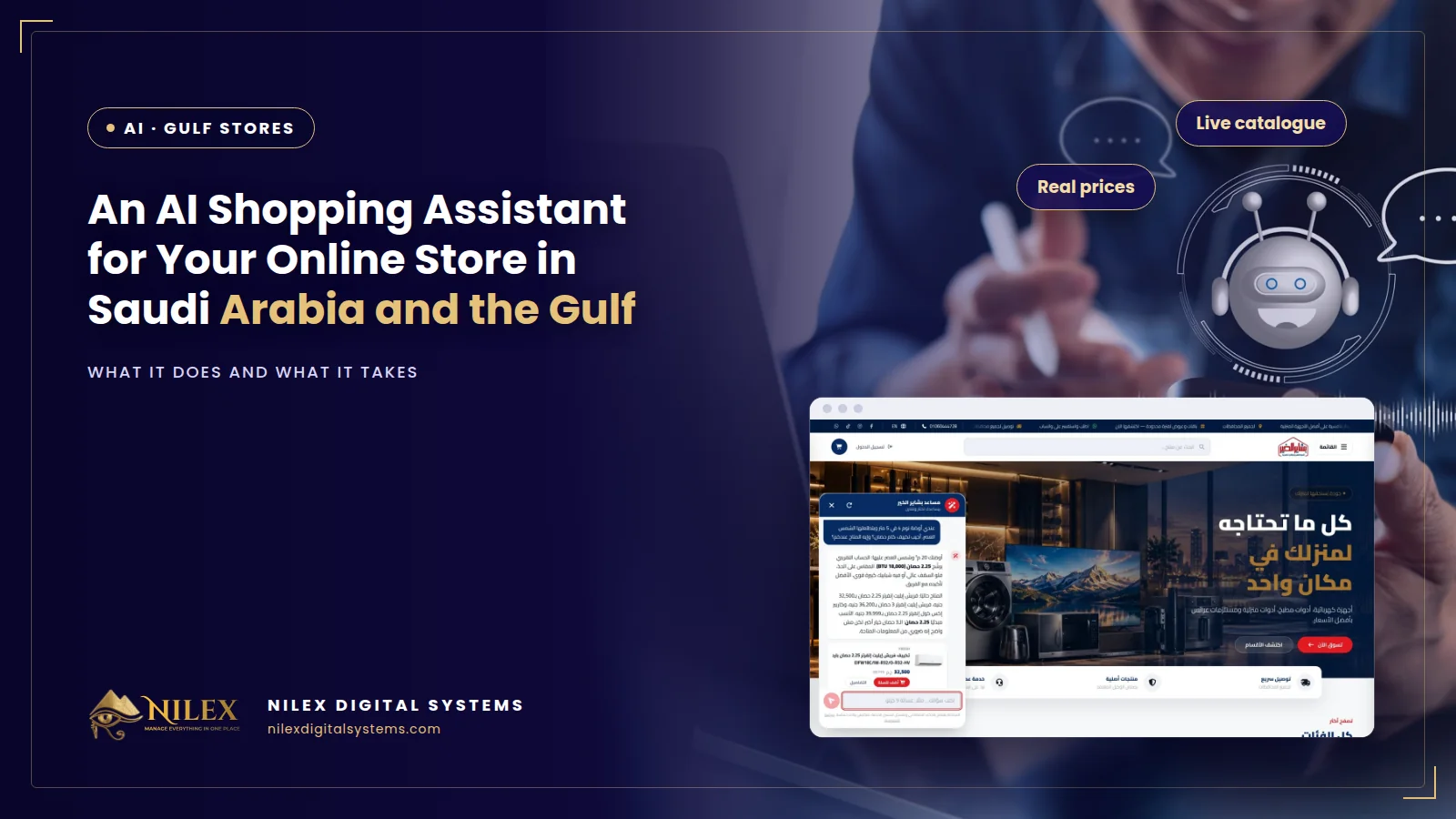
An AI shopping assistant is a chat inside your online store that advises customers the way a good salesperson does: it understands how they write, asks the one question that matters, recommends products from your live catalogue with the real price, compares models, and hands the customer to your team when a person is needed. For a Saudi or Gulf store it is worth building when customers keep asking the same buying questions on WhatsApp, and only after the catalogue, prices and checkout are working.
In Google Keyword Planner data for Saudi Arabia (October 2026), «شات بوت» (chatbot) is searched about 880 times a month. Most of those searches are for general chatbots. This guide is about the narrower thing that sells: an assistant connected to your store. We explain what it does, what we learned building three of them for stores in Egypt, what changes for Gulf customers, and how to keep it accurate and affordable.
Key takeaways
- A shopping assistant is only useful when products, prices and availability come from your live catalogue, not from the AI model's memory.
- The shop's buying expertise, such as sizing an air conditioner or building a coffee blend, should be written as rules, so answers do not depend on the model's mood.
- Every price in a reply should be checked against the catalogue before the customer sees it.
- Our three live assistants were built for Egyptian Arabic, Franco and English; tuning one for Gulf dialects is a new project that needs testing with real Gulf customer messages.
- Abuse filtering, rate limits and usage caps keep the running cost predictable from day one.
A chatbot, a FAQ widget or a shopping assistant?
The word "chatbot" covers very different tools. A FAQ widget shows fixed answers. A keyword bot follows menus. A shopping assistant reads the customer's request in their own words and works with your catalogue. The difference shows up in what each can do for a sale:
| Capability | FAQ widget | Keyword bot | AI shopping assistant |
|---|---|---|---|
| Understands free-form Arabic and English | No | Only listed words | Yes |
| Asks a clarifying question | No | Fixed menus | Yes, when something is missing |
| Recommends from the live catalogue | No | Sometimes | Yes, with current prices |
| Compares models side by side | No | No | Yes |
| Adds to cart | No | Rarely | Yes |
| Hands off to staff | Contact form | Contact form | Yes, with the conversation context |
If most of your customers' questions are about delivery times and payment methods, a clear FAQ page may be enough first. A shopping assistant earns its place when questions are about which product to buy.
What an AI shopping assistant does
Think of the questions your team answers on WhatsApp every day: which air conditioner for my majlis, which fridge for a family of seven, what is the difference between these two perfumes, which coffee suits my espresso machine. An assistant answers them on the product pages, at any hour, next to an add-to-cart button. In practice it does six jobs:
- Understands the request in the customer's own words, including mixed Arabic and English and typos.
- Asks one question when something important is missing, such as the room size or the brewing method.
- Recommends from the live catalogue, with product cards that show the current price.
- Compares two or three products on the specifications that matter.
- Helps the customer buy, by adding to cart or opening a custom product.
- Hands off to your team when the case needs a person.

What we learned from three live stores in Egypt
We have built shopping assistants for three online stores in Egypt. Each one solves a different buying problem, and each came after the store's catalogue, checkout and dashboard were already working:
| Store | The buying problem | What the assistant does |
|---|---|---|
| Anas Saleh Coffee (roastery) | Customers wanted special blends but had to call to describe them | Designs custom blends from a knowledge base of 38 coffee origins at three roasts, blending rules and spice mixes; the server validates and prices every blend; the customer adjusts it in a blend editor and adds it to the cart |
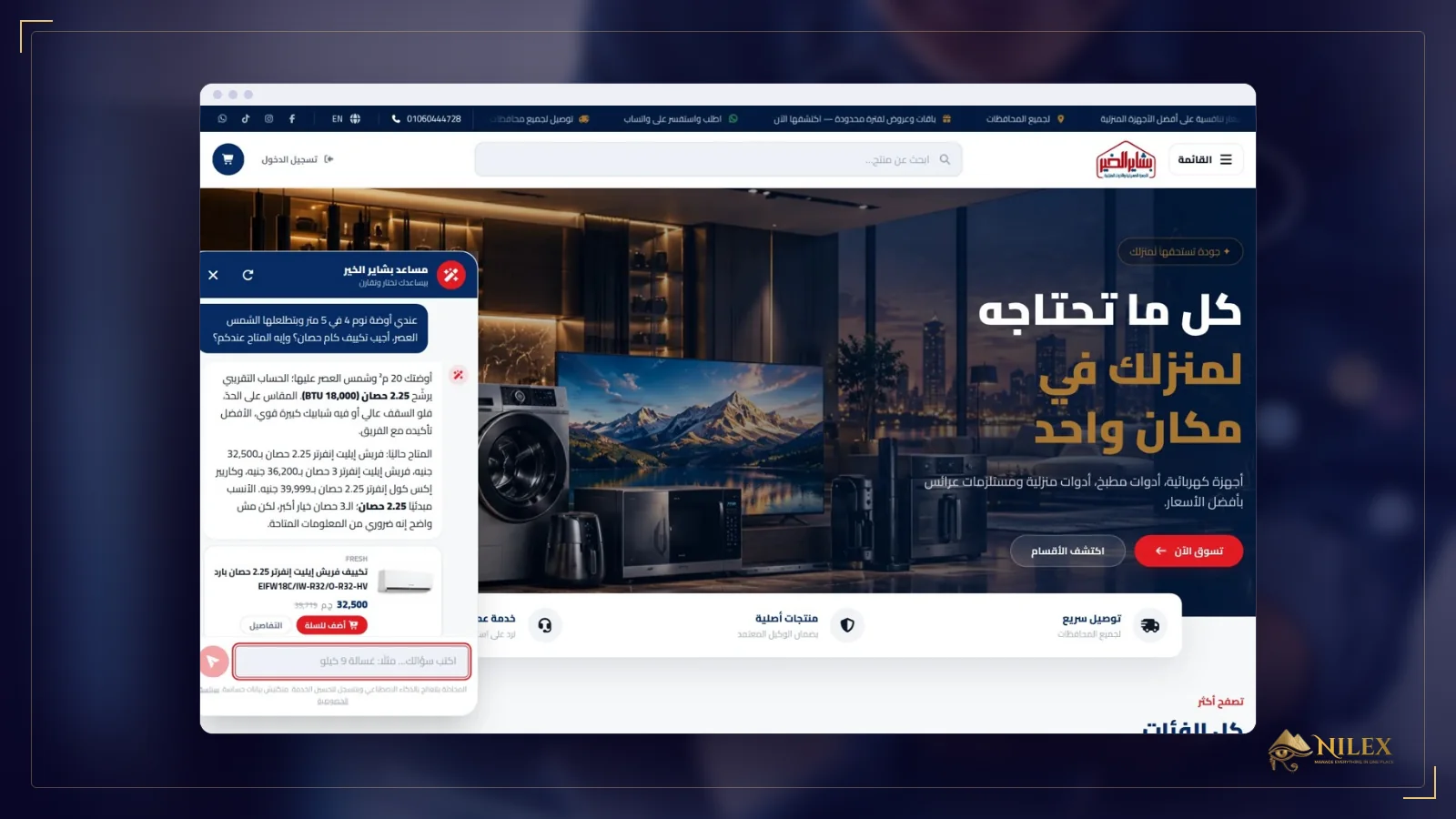
| Bashayer El Khair (home appliances) | Customers asked one by one which model suits their room or family | Sizes air conditioners by room size and sun, sizes fridges, washers, TVs, heaters and cookers by written rules, compares models side by side and checks every price against the catalogue |
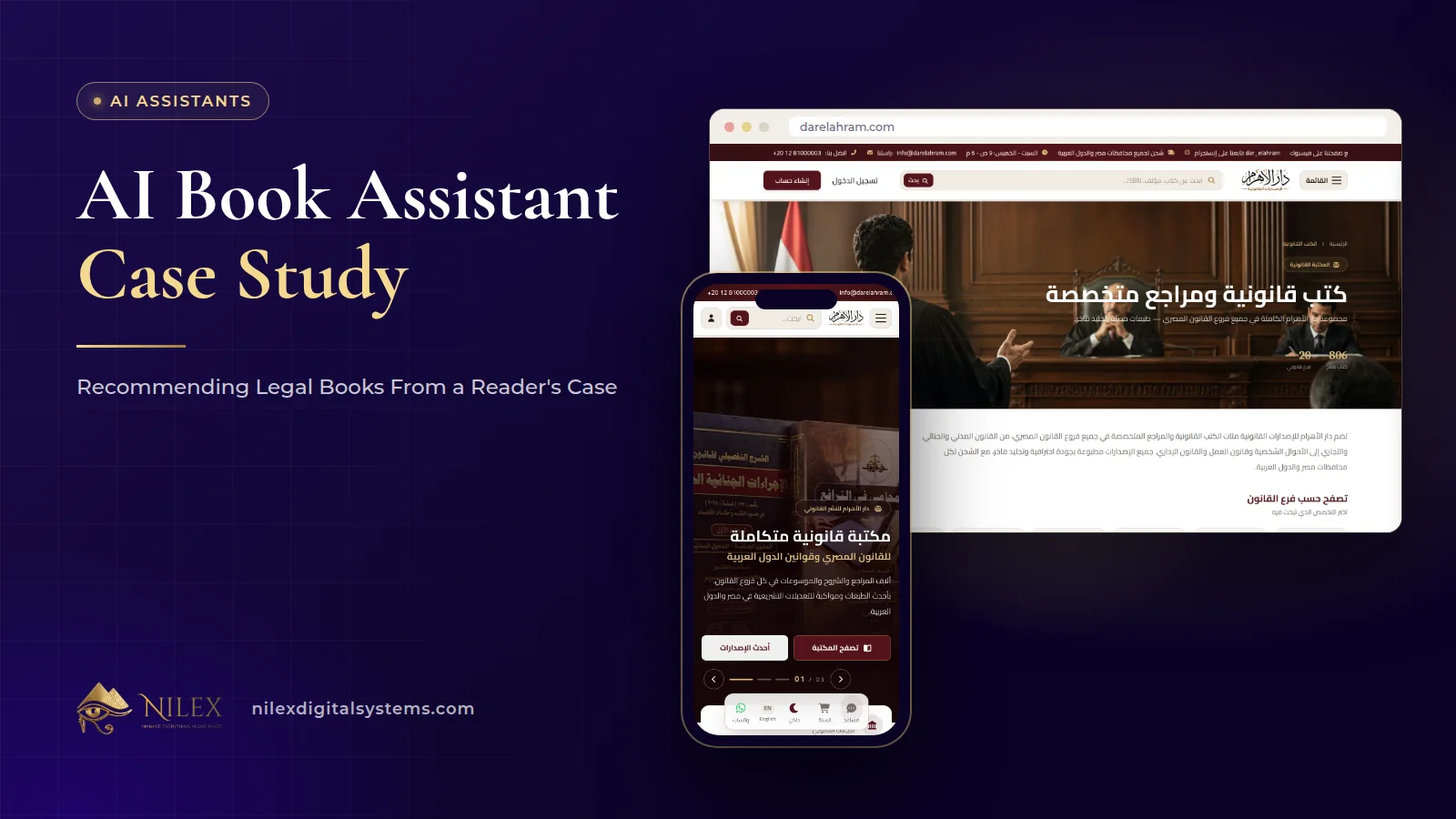
| Dar El Ahram (legal books) | Readers knew their legal situation but not the book title | Reads the catalogue together with the books' table-of-contents PDFs and answers with the books that fit and why, plus price, stock and shipping |
Three lessons carry over to any market. First, write the shop's expertise as rules: at Bashayer El Khair air-conditioner sizing follows the method local installers use, rather than whatever the model guesses. Second, hand-off is part of the design: the appliance assistant passes large or unusual spaces and installation questions to the team. Third, decide openly whether conversations are stored: the Bashayer El Khair assistant records conversations so the owner can read them in the dashboard and tells customers so, while the Anas Saleh coffee expert does not store chat text on the server. The full stories are in AI shopping assistants for online stores and the AI appliance advisor case study.
What changes for Saudi and Gulf customers
Our assistants were built for how Egyptian customers write: Egyptian Arabic, Franco (Arabic in Latin letters) and English, often in one message. Gulf customers write differently, with their own words for asking, wanting, prices and products, and their own product vocabulary. We have not yet built an assistant tuned for Saudi or other Gulf dialects, so for a Gulf store that tuning is a new project, not a setting we switch on.
What that project involves, in practice:
- Collect real questions. A few hundred WhatsApp and Instagram messages from your own customers, with personal data removed, show how they actually ask.
- Write the vocabulary. Product names, local terms and units your customers use, mapped to your catalogue.
- Write the expertise. The rules your best salesperson follows, for example how to size a product for a Gulf home or climate.
- Test before launch with real messages and check every answer and every price.
- Decide the reply style: Modern Standard Arabic, light Gulf phrasing, or the customer's own style.
Language matters commercially. CSA Research's 2020 survey of 8,709 consumers in 29 countries found that 76% prefer to buy products with information in their own language and 40% will not buy from websites in other languages. An assistant that understands how your customers write removes one more reason to leave.
Keeping prices and promises accurate
An assistant that sells must not invent prices, discounts or promises. In our stores the assistant gets products and prices only through tools that search the store's own database, so it can only recommend products that exist, and every amount in a reply is checked against what the catalogue returned before the customer sees it. When something cannot be confirmed, such as a warranty term that is not listed, the assistant says so and suggests confirming with the team. We explain these safeguards in keeping a store chatbot honest.
Keeping the running cost predictable
A public chat box receives every kind of message, and every message to an AI model costs money. The controls we put in place are simple and are built in from day one:
- Filter before the AI call. At Dar El Ahram every message passes a free moderation check first, so abusive messages never reach the paid model.
- Limit each visitor. A per-minute rate limit stops one visitor flooding the assistant.
- Cap the total. Dar El Ahram has a monthly usage cap, and Bashayer El Khair daily cost limits, so the bill cannot surprise the owner.
- Filter manipulation attempts. The Anas Saleh coffee store filters prompt-injection attempts.
The detail is in keeping an AI chatbot's costs predictable.
When is it worth it for a Gulf store?
There is no independent study we could find that measures how much an on-site shopping assistant raises sales, so we will not quote one. Adobe Analytics data from the UK (vendor data, May 2026) found that shoppers referred by external AI tools converted better than those from search engines, which tells you that shoppers increasingly use AI to research products, not that a chat box on your site adds a fixed percentage. A practical test is simpler:
- Your team answers the same "which one should I buy?" questions many times a day.
- Your products need advice: sizes, capacities, compatibility, taste, or a customer's situation.
- Your catalogue and prices are already correct in one place.
- Customers expect fast answers; Checkout.com's 2024 survey (vendor data) shows how quickly MENA shoppers switch after a single bad experience at payment, and the same impatience applies before it.
If the first three are true, an assistant is likely to pay for itself in staff time alone.
How Nilex helps
Nilex builds AI shopping assistants as part of custom online stores: connected to your products and prices, with your shop's expertise written as rules, prices checked before every reply, cost limits, and a hand-off to your team. All three of the assistants above are live Nilex projects in Egypt. We have not yet built one for a Saudi or Gulf store, so dialect tuning and testing with your customers' real messages are part of the project scope.
After delivery you have 14 days to test and report errors, and errors in the delivered work are fixed free of charge for 30 days after acceptance. Read custom e-commerce development for Saudi Arabia and Kuwait, see the AI business chatbot service, or contact us with the questions your customers ask most.
Sources
- CSA Research: Can't Read, Won't Buy, B2C (2020)
- Express & Star: Adobe Analytics data on AI-referred shopping in the UK, May 2026 (vendor data)
- Checkout.com: 4th annual MENA report, May 2024 (vendor survey)
FAQ
Does an AI shopping assistant replace my sales team?
No. It answers the repeated buying questions and prepares the customer, then hands over cases that need a person, such as installation, large orders or special requests.
Will it understand Saudi and Gulf dialects?
Our live assistants were built for Egyptian Arabic, Franco and English. For a Gulf store, tuning for your customers' dialect is a new project: we collect real customer questions, write the vocabulary and test before launch.
What if it gives a wrong price?
It should not be able to. Prices come from the catalogue through tools, and every amount in a reply is checked against those results before it is shown.
Can the same assistant work on WhatsApp?
The assistants described here run on the store website. WhatsApp has its own rules and setup, so it is scoped separately.
How is the AI cost controlled?
With filtering before any AI call, per-visitor rate limits, and daily or monthly usage caps, so the monthly cost stays predictable.
 WhatsApp Inbox and AI Sales Assistant for a PPF, Ceramic and Tint Studio5 November 2026 · 11 min
 AI Book Assistant Case Study: Recommending Legal Books From a Reader's Case11 October 2026 · 8 min
 How We Built Our Own AI Sales Assistant: A Consultant That Recommends Systems Without Making Things Up11 October 2026 · 8 min