

Custom Online Store Development for Saudi Arabia and Kuwait: What Nilex Builds and How Payments Are Connected
What a custom online store from Nilex includes for a Saudi or Kuwaiti business: an AI shopping assistant, Arabic-first pages with English, SEO on every product, delivery fees by area, customer accounts and a dashboard. Proof from three live stores in Egypt, and an honest note on Gulf payments.
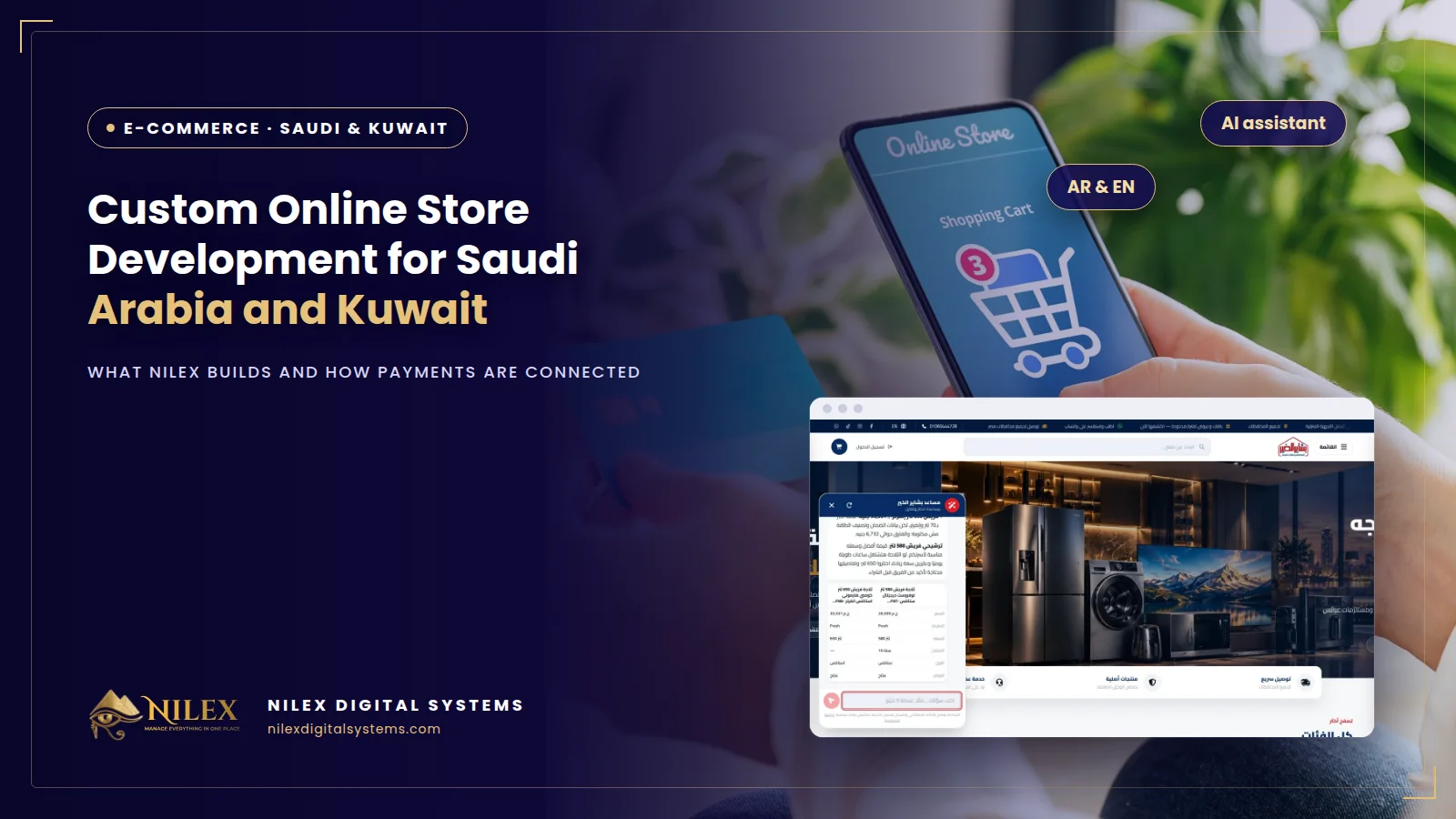
Nilex builds custom online stores for businesses that have outgrown a template: an Arabic-first store with a full English version, a page for every product prepared for Google, an AI shopping assistant that recommends and compares products from your live catalogue, delivery fees shown at checkout, customer accounts and a dashboard for orders, stock and offers. Three such stores are live today, all in Egypt. For a Saudi or Kuwaiti store, the local payment and shipping providers are connected per project to the ones you choose; we say plainly that we have not yet delivered a store for a Gulf client.
This article is for owners in Saudi Arabia and Kuwait comparing a custom build with a hosted platform. It sets out what we build, the evidence from stores already selling, what is connected per project, and how a project starts and is protected. If you are still at the cost or platform question, start with how much an online store costs in Saudi Arabia in 2026 and Salla, Zid or a custom store.
Key takeaways
- A custom store makes sense when your catalogue, your selling advice or your systems do not fit a template: an AI assistant, custom catalogue logic, integration with your own system, B2B pricing or full control of design and data.
- Our three live stores (Dar El Ahram, Anas Saleh Coffee, Bashayer El Khair) are in Egypt and show the features working with real catalogues and real orders.
- Gulf payment providers and couriers are connected per project to the providers you choose; none of them is finished work for a Gulf client yet.
- Speed, Arabic content and reliable payment are measurable sales levers, and each one is under the store owner's control in a custom build.
- Every project has a written quotation, a 14-day testing window, 30 days of free fixes after acceptance and the option to pay in installments; your data stays yours.
When does a custom store make sense?
A hosted platform is the right start for many shops: it is quick and the plan price is known. Salla's official plans page, for example, lists a free Basic plan without online payments or a custom domain, Plus at SAR 990 a year and Pro at SAR 2,990 a year, with staff accounts and design code customisation reserved for Pro. A custom store becomes the better choice when one or more of these is true:
- Your customers need advice before they buy. Sizing an air conditioner, choosing a coffee for a brewing method or finding the right reference book. An AI assistant connected to your catalogue answers that next to the add-to-cart button.
- Your catalogue has its own logic. Authors and legal branches, model codes and brand pages, bundles with end dates, or prices per customer type.
- The store must talk to your system. Stock, customers or orders shared with the system your team already runs.
- You want to own the design and the customer data. No theme limits, and every order and customer record exportable on request.
If you also sell on marketplaces, a custom store is usually where repeat customers buy; the arithmetic is in selling on noon or your own store.
What a Nilex custom store includes
The table lists what our live stores already do, so each line can be checked on a real site.
| Part of the store | What it does | Where it is live (Egypt) |
|---|---|---|
| AI shopping assistant | Understands how customers write, asks the question that matters, recommends from the live catalogue with current prices, compares models, adds to cart and hands off to staff | Anas Saleh Coffee, Bashayer El Khair; a book assistant on Dar El Ahram |
| Arabic-first, full English | Every public page exists in Arabic and English under its own address, with one product record behind both | Anas Saleh Coffee, Bashayer El Khair |
| SEO on every product | Own title, description, address and share image per product, category and brand; structured data, XML sitemap, Search Console at launch; server-side rendering | All three stores |
| Catalogue built around how you sell | By brewing method and roast; 23 categories and 38 brand pages with model codes; 19 legal branches and 340+ author pages | Anas Saleh, Bashayer El Khair, Dar El Ahram |
| Delivery pricing | A fixed fee per area added at checkout; prices per country and shipping method for orders abroad | All three stores |
| Checkout and accounts | Guest checkout or verified accounts with order history; card payment beside cash on delivery with a payment result page checked against the server | All three; card payment on Dar El Ahram |
| Offers and merchandising | Timed offers and bundles with countdowns, coupons, hero slides managed from the dashboard | Bashayer El Khair, Dar El Ahram |
| Dashboard | Products, orders with editable items, PDF invoices emailed from the order, financial figures, owner and staff roles | All three stores |
For a Saudi or Kuwaiti store, delivery areas would be your regions, cities or Kuwaiti governorates instead of Egyptian governorates; the model is the same, a fee the customer sees before confirming.
The AI shopping assistant: how it sells
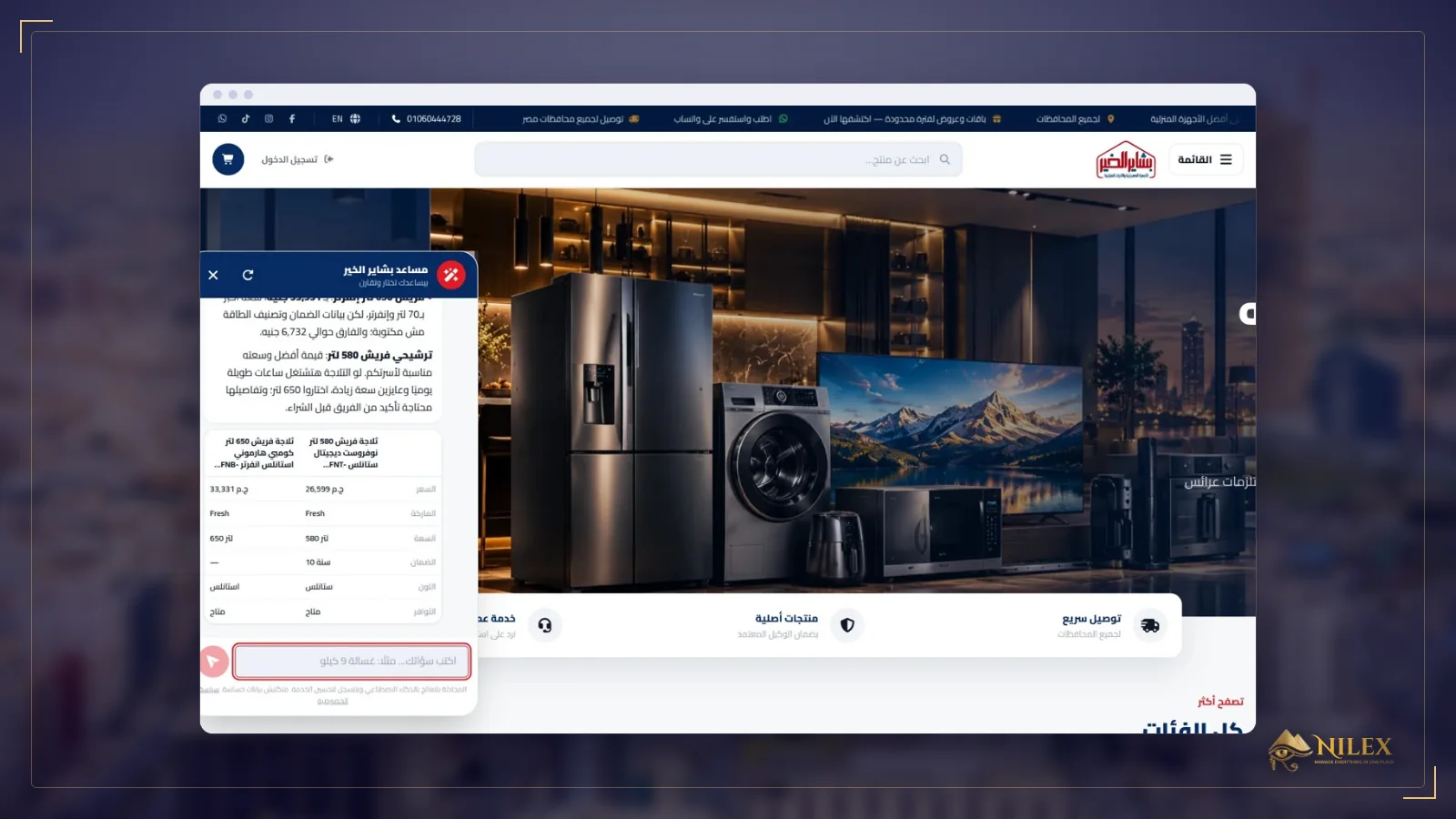
The assistant is the part a template cannot give you. On Bashayer El Khair, a customer asked to compare the two best fridges for a family of five. The assistant showed a side-by-side table of price, brand, capacity, warranty and colour, recommended one for value, and said plainly that the warranty and energy rating of the other model were not listed and should be confirmed with the team.
On Anas Saleh Coffee, the coffee expert asks one clarifying question before designing a blend, works from a knowledge base of 38 coffee origins and blending rules, and the server validates every blend before it reaches the cart. In both stores, prices come from the catalogue through tools, and every amount in a reply is checked before the customer sees it.
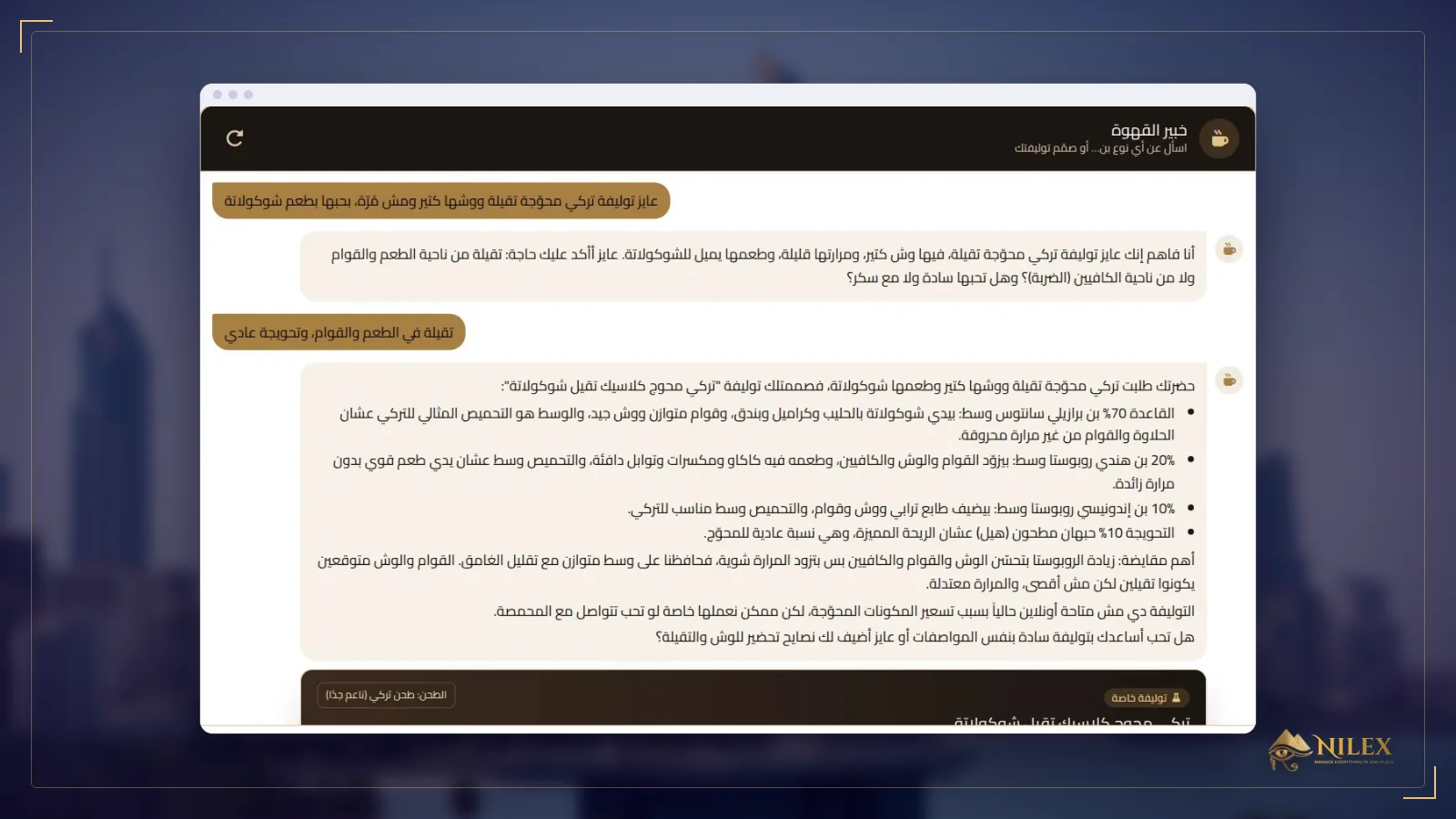
These two assistants were built for Egyptian customers, who write in colloquial Arabic, Franco and English. For a Gulf store, the assistant's instructions, product vocabulary and tests are written for how your customers write, and that tuning is part of the project rather than something we have already shipped. The full method is in our guide to AI shopping assistants for online stores.
Why speed, Arabic and payment reliability matter
Three independent or clearly labelled studies explain why we build the way we do:
- Speed. In a Google-commissioned Deloitte study published on web.dev (37 brands, 2019 data), a 0.1-second improvement in mobile site speed was associated with an 8.4% rise in retail conversions. Server-side rendering and light pages are part of every store we build.
- Language. CSA Research's survey of 8,709 consumers in 29 countries found that 76% prefer to buy products with information in their own language and 40% will not buy from websites in other languages. That is the case for Arabic-first stores with real Arabic product content, explained in bilingual online stores.
- Payment. Checkout.com's 2024 MENA survey (vendor data) found that a third of shoppers would switch to a competitor after a single failed payment, and that preference for cash on delivery has fallen to as low as 10% in Saudi Arabia and Kuwait. The payment provider and the checkout flow are sales decisions, not technical details.
Payments, shipping and e-invoicing in the Gulf: what is connected per project
This is where we are deliberately precise. Our stores so far take card payment through an Egyptian gateway and cash on delivery, and ship within Egypt and abroad. For a store in Saudi Arabia or Kuwait:
| Area | What a Gulf store usually needs | How Nilex handles it |
|---|---|---|
| Payment | mada and cards in Saudi Arabia, KNET and cards in Kuwait, often Apple Pay and buy-now-pay-later | Connected per project to the licensed provider you choose; not yet delivered for a Gulf client |
| Shipping | A local courier account and delivery fees by city or region | Delivery fees by area are built in; a courier connection is added per project with the courier you use |
| E-invoicing (Saudi Arabia) | ZATCA e-invoicing obligations for VAT-registered sellers | No ZATCA integration today; plan it with your accountant and your invoicing system |
| Kuwait digital commerce law | MOCI registration, CBK-licensed payment providers, 14-day returns | Policies, returns records and the licensed provider built in; registration is your step |
Whatever the provider, the order is marked paid only when the provider confirms it to the store's server, and the store never asks for or stores card numbers. Kuwaiti sellers should read opening an online store in Kuwait under Decree-Law 10/2026 before choosing a provider.
Proof: three live stores
| Store (Egypt) | What it sells | At launch |
|---|---|---|
| Dar El Ahram | Legal books, shipping in Egypt and abroad | 800+ titles, 340+ authors, 19 legal branches; launched March 2026; AI book assistant |
| Anas Saleh Coffee | Specialty coffee by brewing method | 98 products, fees for 27 governorates; launched August 2026; AI coffee expert |
| Bashayer El Khair | Home appliances and household goods | 400+ products, 23 categories, 38 brands; launched September 2026; AI appliance advisor |
Each has a client page with screens: Dar El Ahram, Anas Saleh Coffee and Bashayer El Khair. What we learned launching them is in lessons from launching three online stores.
How a project runs and what protects you
- Written quotation. Scope, price, payment schedule and delivery time in one document before you agree to anything.
- Build in phases. Catalogue and checkout first, then payments, shipping and the dashboard, then the assistant and content; Dar El Ahram's first version was live within days.
- 14 days to test, 30 days of free fixes. After delivery you test and report errors, which we fix; after acceptance, errors in the delivered work are fixed free of charge for 30 days. See testing, acceptance and the free-fix period.
- Installments. One payment or installments linked to dates or stages, with the first due before work starts; details in paying in installments.
- Your data stays yours. You own your content and data and can get a copy, for example in Excel or CSV, on request; Nilex keeps the source code and gives you a licence to use it. See data ownership and the software licence.
How Nilex helps
Tell us what you sell, roughly how many products and brands you have, where you deliver, and which payment provider and courier you use or are considering. We will reply with what we would build, what would be connected per project, and a written quotation. The service is described on the e-commerce store page, and the AI assistant on the AI business chatbot page. When you are ready, contact us.
Sources
- web.dev: Milliseconds make millions (Deloitte study commissioned by Google)
- CSA Research: Can't Read, Won't Buy, B2C (2020)
- Checkout.com: 4th annual MENA report, May 2024 (vendor survey)
- Salla: official plans page
Frequently asked questions
Have you built stores for clients in Saudi Arabia or Kuwait?
Not yet. Our three live stores are in Egypt. The store itself is the same work; the payment provider, courier and local legal requirements are handled per project.
Can the store take mada or KNET?
Through a licensed payment provider that offers them, connected as part of your project. We have not yet delivered that connection for a Gulf client, so it is scoped and tested in your project.
Does the store issue ZATCA e-invoices?
No. Our stores generate a PDF invoice from the order, which is not a ZATCA e-invoice. Plan e-invoicing with your accountant and your invoicing system.
How much does a custom store cost?
It depends on the catalogue, the assistant and the integrations. We send a written quotation after understanding your scope; the cost components are explained in our Saudi store cost guide.
Will the AI assistant understand Gulf Arabic?
Our live assistants were built and tested for Egyptian customers. For a Gulf store, we write and test the assistant for your customers' phrasing as part of the project.
Can I move from Salla or Zid to a custom store?
Yes. Products, customers and orders exported from your platform can be imported, and old product addresses should be redirected so you keep your Google rankings.
 Payment Gateways in Saudi Arabia for Online Stores: mada, Apple Pay, STC Pay, Tabby and Tamara5 November 2026 · 11 min
 Documenting an Online Store in Saudi Arabia: Commercial Registration, Freelance Document and E-Commerce Law5 November 2026 · 9 min
 Shipping for Online Stores in Saudi Arabia: Couriers, National Address, Cash on Delivery and Delivery Fees5 November 2026 · 9 min