

Sell on noon or on Your Own Store? Commissions, Margins and a Hybrid Strategy for Saudi Sellers
noon's official referral fees in Saudi Arabia (27% for apparel, 15% for books, 14% for home and kitchen, 8% for TVs) plus fulfilment fees, compared with the cost of your own store, with an illustrative margin per order in SAR and a hybrid strategy that uses both.

Selling on noon gives you immediate access to shoppers who are already on the marketplace, in exchange for a referral fee on every sale: 27% for apparel and footwear, 15% for books, 14% for home and kitchen and most other categories, 9% for food and beverages and 8% for TVs in Saudi Arabia, according to noon's official seller help centre, plus fulfilment and storage fees if noon handles your stock. Your own store has no commission, but you pay for the store and for bringing every visitor yourself. For most Saudi sellers the strongest answer is both: noon for reach, your own store for repeat customers, higher margins and the customer relationship.
The decision is easier with numbers than with opinions. This guide sets out what noon charges, what your own store costs instead, an illustrative margin comparison per order in Saudi riyals, and a practical way to run the two channels together.
Key takeaways
- noon's referral fees in KSA range from 5% to 27% by category, excluding VAT, with a minimum of SAR 1 per item.
- Fulfilled by noon adds storage (SAR 2.75 per cubic foot per month from 1 October 2026) and outbound fees of SAR 5.5 to 28 per unit.
- Your own store replaces commission with fixed costs and marketing: you must bring the traffic.
- A first order can be more profitable on noon, while a repeat order is usually more profitable on your own store.
- A hybrid strategy uses the marketplace to be found and the store to keep customers coming back.
What noon charges sellers in Saudi Arabia
noon publishes its seller fees for Saudi Arabia in its partners help centre. The referral fee is a percentage of the selling price, excluding VAT, with a minimum of SAR 1 per item. The main categories:
| Category (noon KSA) | Referral fee |
|---|---|
| Apparel and footwear | 27% |
| Other bags | 25% |
| Headphones | 20% |
| Fragrance | 15% |
| Books | 15% |
| Furniture | 15%, then 10% (tiered) |
| Home and kitchen | 14% |
| Food and beverages | 9% |
| TVs | 8% |
| Mobiles | 5%, then 4.5% (tiered) |
| All other categories | 14% |
If you use Fulfilled by noon (FBN), where noon stores, packs and ships your products, two more fees apply: storage at SAR 2.75 per cubic foot per month from 1 October 2026, and outbound fulfilment of SAR 5.5 to 28 per unit depending on the item. Returns carry an admin fee of SAR 15 or 20% of the referral fee, whichever is lower. Fees change, so read the help centre page for your category before you price.
What your own store costs instead
Your own store removes the referral fee, but it moves three costs onto you:
- The store: a platform plan (for example Salla Plus at SAR 990 a year or Pro at SAR 2,990 a year, from Salla's official page) or a one-off custom build priced by scope.
- Payments and shipping: the payment gateway's rate per transaction and your courier contract.
- Traffic: nobody arrives by default. Ads, social media, search and word of mouth are your job, and for new customers this is usually the largest cost per order.
Payment reliability matters as well. In Checkout.com's 2024 MENA survey (vendor data), one third of shoppers said they would switch to a competitor after a single failed payment, so test your checkout as seriously as your ads. For a full first-year budget, see how much it costs to open an online store in Saudi Arabia.

Illustrative margin per order: noon vs your own store
The table below is an illustrative example. It assumes a home and kitchen product sold at SAR 200 with a product cost of SAR 110. noon's 14% referral fee comes from its help centre; the fulfilment, payment, shipping and marketing figures are example numbers chosen within realistic ranges only to show the method.
| Per order (SAR) | noon with FBN | Own store, new customer | Own store, repeat customer |
|---|---|---|---|
| Selling price | 200 | 200 | 200 |
| Product cost | 110 | 110 | 110 |
| Referral fee (14%) | 28 | 0 | 0 |
| Fulfilment or shipping (example) | 12 (FBN outbound) | 25 (courier) | 25 (courier) |
| Storage (example) | 1 | Your own space | Your own space |
| Payment processing (example 2.5%) | Per noon's seller terms | 5 | 5 |
| Marketing to win the order (example) | 0 (shopper already on noon) | 30 | 5 |
| Left before overheads | 49 | 30 | 55 |
Illustrative example: all figures except the 14% referral fee are invented to show the calculation, not results from any seller. Replace them with your own costs. The lesson is in the pattern, not the totals. When you must pay to attract a new customer, the marketplace can leave you more per order. When the same customer comes back to your store on their own, your margin is higher than on the marketplace, because you pay neither commission nor much marketing. In a category such as apparel at 27%, the gap on repeat orders grows much larger.
Who keeps the customer?
On a marketplace, the shopper is first of all the marketplace's customer. Your product appears beside competitors on the same page, the marketplace decides how search and offers work, and how you may contact buyers afterwards is governed by its seller rules; read the seller agreement before you plan any follow-up marketing.
On your own store, the relationship is yours. Customers create accounts and see their order history, you can run your own offers and bundles, and your brand is the only one on the page. The stores we built in Egypt let customers register with email verification and view their past orders, which is the foundation for repeat sales; we describe it in customer accounts in an online store.
What your own store can do that a listing cannot
A marketplace listing is a product card. Your own store can sell the way your best salesperson does:
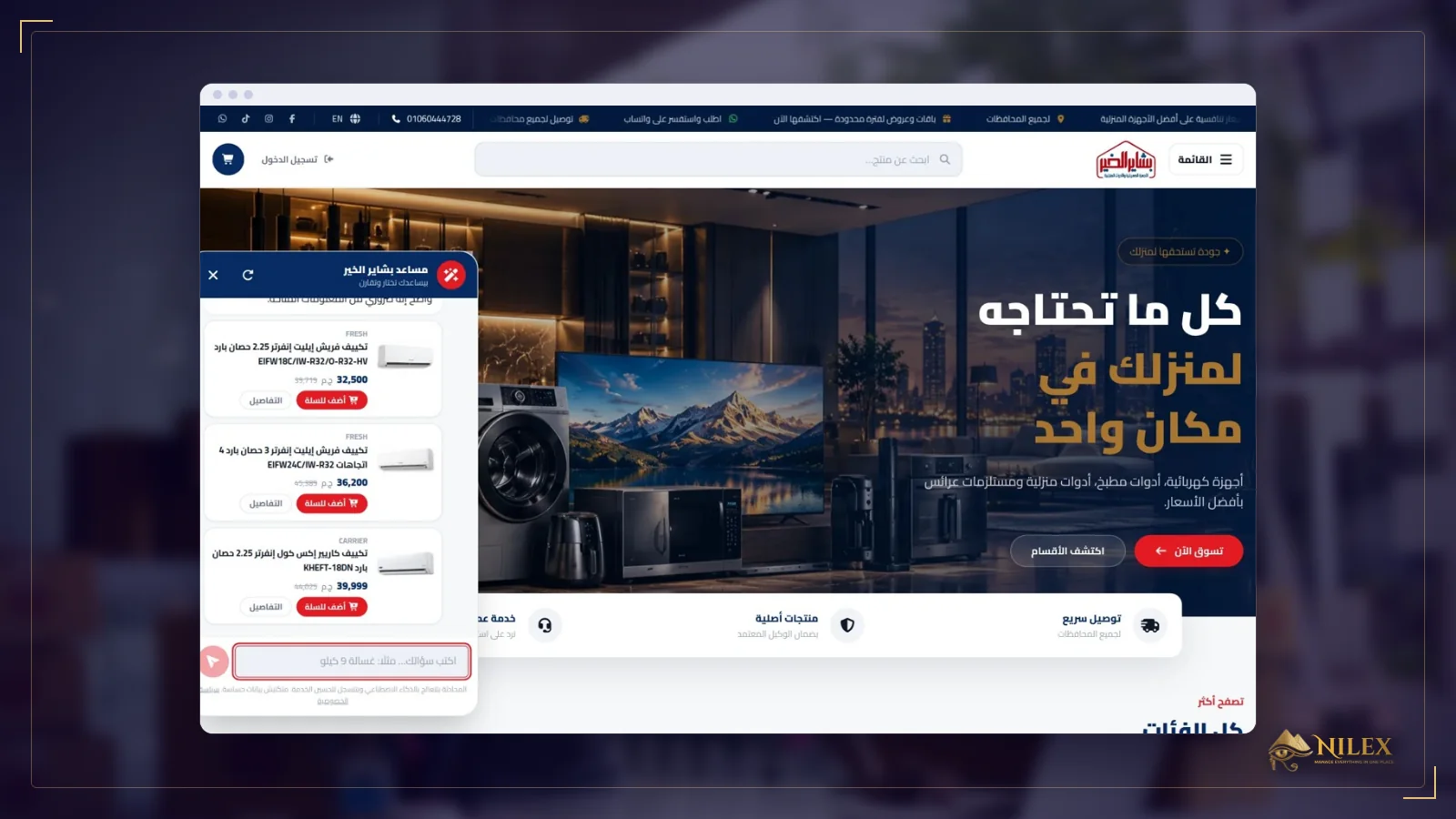
- Advice before purchase. Bashayer El Khair, a home appliances store we built in Egypt, has an AI advisor that asks about the room before recommending an air conditioner and compares models side by side, using the store's live catalogue. See the AI appliance advisor case study.
- Bundles and timed offers on your terms, with countdowns, such as bridal or kitchen sets. Planning them is covered in offers, bundles and countdowns.
- Brand pages, buying guides and policies that build trust, such as a warranty policy for appliances.
- A catalogue structured your way: Bashayer El Khair has more than 400 products in 23 categories with 38 brand pages, each product carrying its model code. The full build is in the home appliances store case study.
A hybrid strategy: the marketplace for reach, your store for repeat sales
You do not have to choose one channel forever. A practical sequence for many Saudi sellers:
- Use noon to test demand. List your best sellers and learn which products move, at which price.
- Open your own store with the full range, your bundles and your content.
- Send your own traffic to your store. Your social media, ads and search pages should point to your domain, not to a marketplace listing.
- Keep marketplace-exclusive tactics within the rules. Check noon's seller terms on pricing and on what you may include with orders.
- Measure margin per channel, using a table like the one above with your real numbers every quarter.
Categories with high referral fees, such as apparel at 27%, have the most to gain from moving repeat customers to their own store. Low-fee categories, such as mobiles at 5% or TVs at 8%, may find the marketplace efficient for longer.
Which route fits your situation?
| Your situation | Better starting point |
|---|---|
| New brand, no audience, testing products | noon, with a simple store or platform plan alongside it |
| Category with a high referral fee and loyal buyers | Your own store, with the marketplace for discovery |
| Products that need advice or comparison | Your own store, where you can explain and advise |
| Low-fee category, price-driven shoppers | The marketplace may stay efficient; review margins regularly |
| Large catalogue with brands and bundles | Your own store, structured the way your customers buy |
If you decide on your own store, the next question is platform or custom, which we answer in Salla, Zid or a custom store.
How Nilex helps
Nilex builds custom online stores for sellers who want their own channel next to, or instead of, a marketplace. Our live stores are in Egypt: Bashayer El Khair for home appliances with an AI appliance advisor, Anas Saleh Coffee with an AI coffee expert, and Dar El Ahram's legal bookshop, described in the online legal bookshop case study. They include customer accounts and order history, timed offers and bundles, brand and category pages prepared for Google, delivery fees at checkout and a dashboard for orders and stock.
We have not yet launched a store for a Saudi client. For a Saudi store, the payment gateway and courier are connected per project to the providers you choose, and the scope is written into a quotation that can be paid in installments. After delivery you have 14 days to test and report errors, and errors in the delivered work are fixed free of charge for 30 days after acceptance. Read custom e-commerce development for Saudi Arabia and Kuwait or contact us with your categories and catalogue size.
Sources
- noon partners help centre: referral fees and Fulfilled by noon (FBN) fees in KSA
- Salla: official plans and pricing page
- Checkout.com: 4th annual MENA report, May 2024 (vendor survey)
FAQ
How much commission does noon take in Saudi Arabia?
According to noon's seller help centre, referral fees range from 5% to 27% by category, for example 27% for apparel and footwear, 15% for books, 14% for home and kitchen and 8% for TVs, excluding VAT and with a minimum of SAR 1 per item.
What does Fulfilled by noon cost?
Storage is SAR 2.75 per cubic foot per month from 1 October 2026, and outbound fulfilment is SAR 5.5 to 28 per unit depending on the item. Returns carry an admin fee of SAR 15 or 20% of the referral fee, whichever is lower.
Is my own store always cheaper than noon?
No. For a new customer you must pay to attract, the marketplace can leave you more per order. Your own store is usually more profitable on repeat orders, where you pay no commission and little marketing.
Can I sell on noon and on my own store at the same time?
Yes, and many sellers do. Use the marketplace for reach and your own store for repeat customers, bundles and advice. Check noon's seller terms on pricing and on what you may include with orders.
Do I get my customers' data on noon?
You receive what you need to fulfil orders, and how you may contact buyers afterwards is governed by noon's seller rules. On your own store, customer accounts and order history are part of your store's data.
 Payment Gateways in Saudi Arabia for Online Stores: mada, Apple Pay, STC Pay, Tabby and Tamara5 November 2026 · 11 min
 Documenting an Online Store in Saudi Arabia: Commercial Registration, Freelance Document and E-Commerce Law5 November 2026 · 9 min
 Shipping for Online Stores in Saudi Arabia: Couriers, National Address, Cash on Delivery and Delivery Fees5 November 2026 · 9 min