
Customer Accounts in an Online Store: Sign-Up, Email Verification, Social Login and Order History
How customer accounts work in the stores we built: guest checkout alongside accounts, sign-up with an emailed verification code, Google and Facebook sign-in, order history, password recovery, consent settings and the security behind each login.
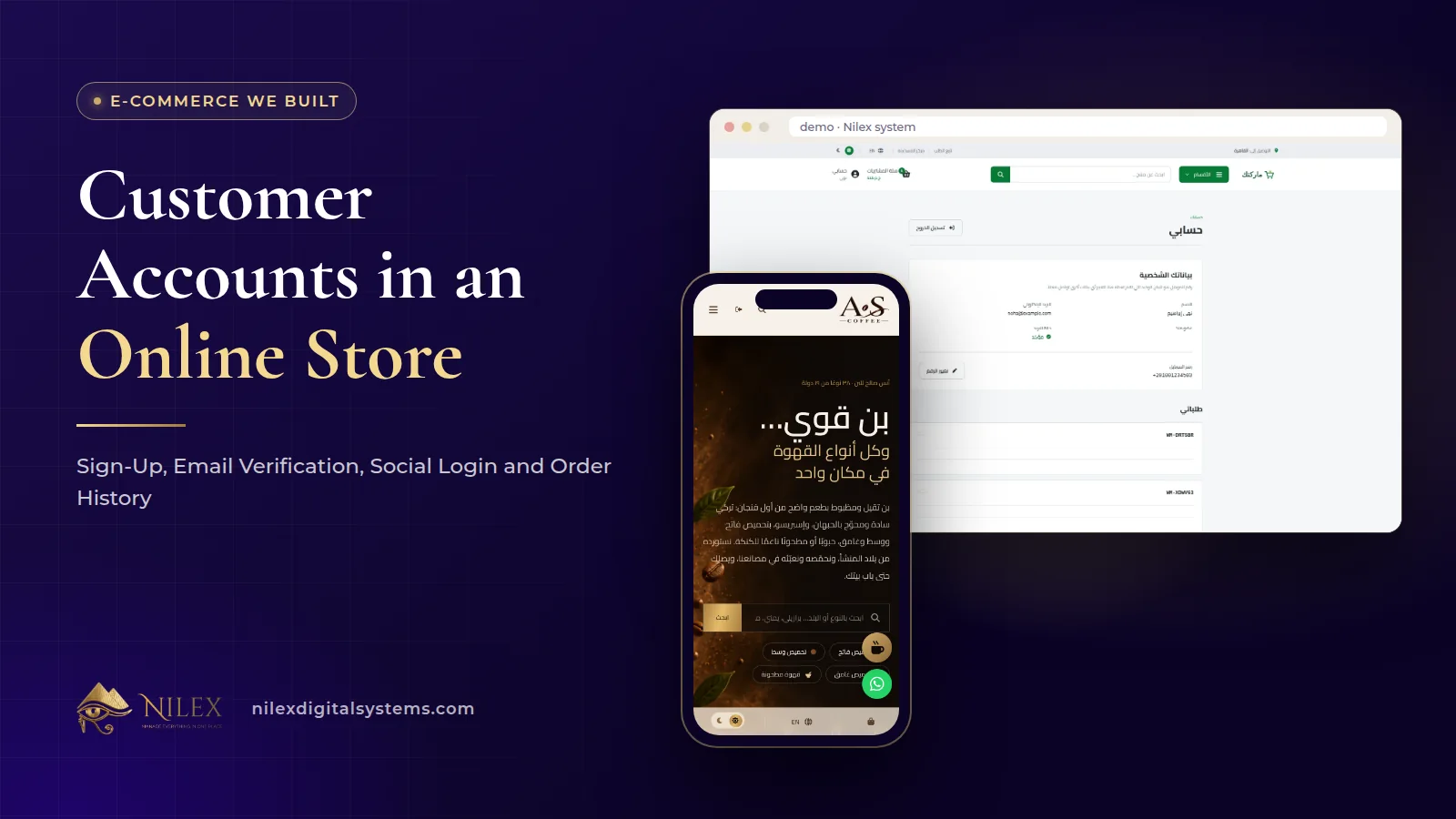
A customer account lets a shopper see their past orders, keep their details for next time and, in some stores, do more: cancel an order, retry a payment, use their coupons or manage their consent. In the stores we build, accounts are optional. Customers can always check out as guests, and an account is offered for those who come back. Sign-up confirms the email address with a code, and some stores add sign-in with Google or Facebook.
This article compares how accounts work in three stores we built: Anas Saleh Coffee, Bashayer El Khair and Dar El Ahram. It is meant for store owners deciding what their account area should include, and how much to ask of customers before they can buy.
Key takeaways
- Never force an account before the first order. Guest checkout keeps the path to buying short; the account is a benefit, not a gate.
- Verify the email with a code at sign-up, so order emails and password resets reach a real inbox.
- Social sign-in removes the password step for customers who prefer it, but you still need their phone number for delivery.
- The account page should start with order history, then add only what your store really uses: payments, coupons, consent, content.
- Accounts hold personal data, so login security and a clear privacy policy are part of the feature, not extras.
Guest checkout or account?
All three stores accept orders from guests. When a signed-in customer orders, the order is attached to their account; when a guest orders, it is not, and neither is turned away. This is the same rule as our e-commerce store service: customers can check out as guests or create an account to track orders.
Guests still need a way back to their order. In the Anas Saleh Coffee and Bashayer El Khair stores, the order confirmation page lets a guest look up an order with the order number and the phone number used. The lookup is sent in a way that keeps the phone number out of the page address and server logs, a small detail that matters when the data is personal.
Sign-up and email verification
Sign-up asks for the minimum: name, email, phone and a password. On Dar El Ahram's store the phone field includes a country-code selector, which matters for a store with readers abroad. Right after sign-up, the store emails a short code, and the customer types it on a verification screen. If the email does not arrive, the customer can request a new code.
Why verify? Because the email is where order confirmations, invoices and password resets go. An unverified typo means a customer who never receives their invoice and cannot recover their account. Login attempts are also rate-limited across the systems we build, against password-guessing attacks.
Signing in with Google or Facebook
Dar El Ahram's bookshop adds social sign-in buttons on its login and sign-up pages, so readers can use their Google or Facebook account instead of creating a password. A social account does not always provide a phone number, so after the first social sign-in the store asks the customer to complete their profile, including the phone number needed for delivery.
Social login is worth adding when many of your customers already sign in to other services that way and when your store has a reason for repeat visits, such as a large catalogue or reader content. For a small catalogue, email sign-up with guest checkout is usually enough.
What the account page contains
The account area should match what customers actually do in your store. Here is how the three compare:
| Feature | Anas Saleh Coffee | Bashayer El Khair | Dar El Ahram |
|---|---|---|---|
| Guest checkout | Yes | Yes | Yes |
| Email verification code at sign-up | Yes | Yes | Yes |
| Google or Facebook sign-in | No | No | Yes, with a complete-profile step |
| Own order history | Yes | Yes | Yes |
| Edit details | Phone number | Phone number | Profile and password |
| Forgot-password screen | No | No | Yes, with a reset code |
| Cancel an order, retry a card payment | No | No | Yes |
| Coupons available to the customer | No | No | Yes |
| Manage WhatsApp consent | No | No | Yes |
| Write and submit articles | No | No | Yes, reviewed before publishing |
The difference is deliberate. A roastery and an appliance shop need order history and correct contact details, and the appliance store also lets signed-in customers pick a saved address at checkout. A legal bookshop with card payment, coupons and a community of lawyers and researchers needs more: readers can retry paying for an order, see the coupons they can use, and write articles from their profile that the publisher reviews before they appear on the site.
Which details can customers edit?
In the coffee and appliance stores, customers can update their phone number themselves, while name and email are not edited from the account page. That keeps the email that was verified as the account's identity. Every edit is limited to the customer's own account, so one customer can never change another's data.
Password recovery
On Dar El Ahram's store, a customer who forgets their password requests a reset, receives a code by email, enters it and sets a new password; the code can be resent if needed. Recovery by code follows the same logic as verification: it only works because the email was confirmed at sign-up.
Login security behind the account
Accounts are only as safe as the login. Across the systems we build, the same protections apply:
- Passwords are never stored as text; they are hashed with bcrypt.
- After 5 wrong passwords an account is locked for 15 minutes, and login attempts are rate-limited.
- Sessions use short-lived access tokens and refresh tokens kept in secure HttpOnly cookies that change on every use.
- Every page and request goes over HTTPS.
We explain these measures for store owners in e-commerce security beyond HTTPS, and the wider topic of passwords and two-step login in MFA, passwords and passkeys.
Privacy, consent and personal data
An account holds a name, email, phone, addresses and order history: personal data under Egypt's Personal Data Protection Law No. 151 of 2020, which Nilex follows when handling client data. Each of the three stores publishes a privacy policy, and Dar El Ahram's account page lets customers manage their own consent to WhatsApp messages. Collect only what you use, say why you collect it, and give customers a way to change their choices. Our articles on your website and Egypt's data protection law and CRM data and the data protection law explain what that means in practice.
What the store team sees
Accounts also help the team. In Bashayer El Khair's dashboard, the users screen lists customers and staff with simple statistics, opens each user's details with their orders, and lets an admin change a user's status or role. Dar El Ahram's dashboard can activate or deactivate a customer and change roles. Seeing a customer's full order history next to a new order is what lets your team treat a loyal customer differently from a first-time buyer; our guide to the online store back office covers that daily work.
How Nilex helps
We build the account area around what your customers actually do, from a simple order history to payments, coupons and reader content, with guest checkout always available. See the stores behind this article: Anas Saleh Coffee, Bashayer El Khair and Dar El Ahram, whose online legal bookshop case study covers the rest of that store. Customer accounts are listed among the package features on our e-commerce store service page; contact us to plan yours.
Frequently asked questions
Should customers have to register before ordering?
We recommend not. Guest checkout keeps the first order easy, and customers who return will create an account when it is useful to them.
Can verification be by SMS instead of email?
The stores in this article verify by email code. SMS verification is a separate integration with its own costs and would be scoped as part of a project.
Do guest orders join the account if the customer registers later?
An order is attached to an account when the customer is signed in while ordering. In the coffee and appliance stores, guests find their orders with the order number and phone number instead.
Can a customer ask us to delete their data?
Plan how your team handles such requests in line with Egypt's Personal Data Protection Law No. 151 of 2020, and say in your privacy policy how a customer can make one.
Which social sign-in options are available?
Dar El Ahram's store offers Google and Facebook sign-in. Whether to add social sign-in to your store depends on your customers and is decided when the project is scoped.
 Starting Online Orders for Your Supermarket: A Practical Launch Plan, Decision by Decision11 October 2026 · 9 min
 Online Legal Bookshop Case Study: How Dar El Ahram Sells 800+ Legal Titles Online11 October 2026 · 11 min
 Selling Online From Egypt to Other Countries: Shipping Prices per Country, Local Zones and Card Payment11 October 2026 · 8 min