
Online Legal Bookshop Case Study: How Dar El Ahram Sells 800+ Legal Titles Online
How Nilex turned Dar El Ahram, one of the largest legal publishers in Egypt, into an online bookshop: 800+ titles, 340+ author pages, 19 legal branches, card or cash payment, shipping abroad and an AI book assistant.
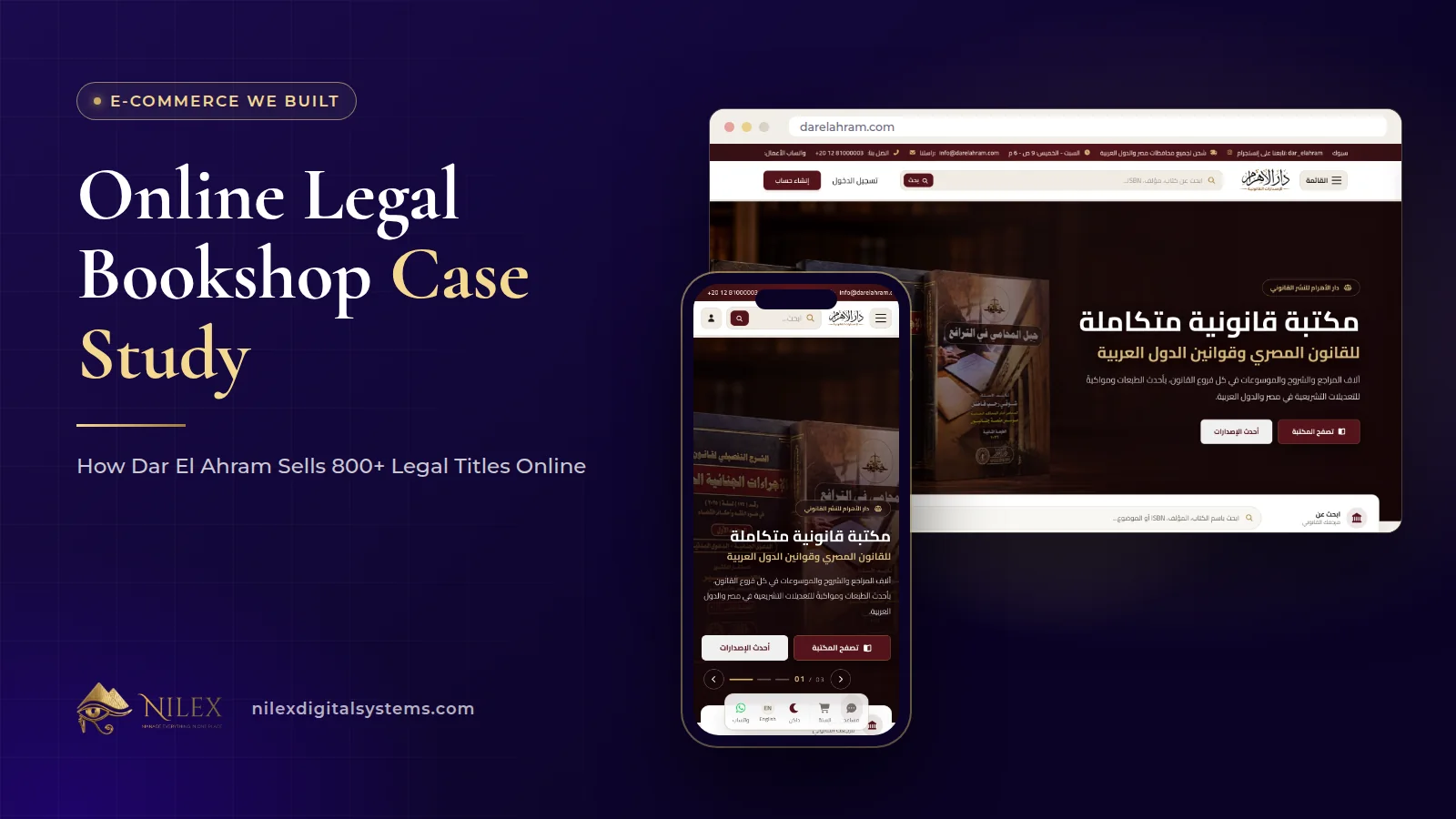
Dar El Ahram, one of the largest legal publishing houses in Egypt, now sells more than 800 legal titles online. Every book, every one of more than 340 authors and each of 19 legal branches has its own page. Readers pay by card or cash on delivery, orders ship to every governorate and to other countries, and an AI assistant recommends books for a reader's legal situation.
This case study is the overview of the project: the problem we started from, the four phases we built it in, what readers and the team see, and what changed. Four companion articles go deeper into the AI assistant, the SEO of a large catalogue, shipping abroad and the publishing features beyond the store. The live project summary is on the Dar El Ahram client page.
Key takeaways
- Before the project, the catalogue lived in the branches and in the heads of the sales team, orders were tracked on paper and payment was cash only.
- We started with what sells: books, authors and legal branches with their own pages, a cart and cash-on-delivery checkout, live within days.
- Card payment, shipping prices per country, local delivery zones, coupons, offers and a full dashboard came in the second phase.
- An AI assistant reads the catalogue, including table-of-contents PDFs, and answers a legal question with the books that fit and why.
- Every book, author, category and article page is prepared for Google, so a lawyer searching for a reference can land on it directly.
Who is Dar El Ahram, and what was the problem?
Dar El Ahram publishes legal books: hundreds of titles written by hundreds of authors, bought by lawyers, judges, researchers and law students. Before the project, its catalogue was known by the branches and the sales team. A lawyer who needed a book on a specific point of law had to call, describe what he was looking for and wait while someone checked.
The rest of the process followed the same pattern:
- Orders came in by phone and WhatsApp and were followed on paper.
- Payment was cash only.
- No book or author page could be found on Google.
- Readers outside Cairo, and outside Egypt, had no easy way to buy.
- A reader had to know the exact title to ask for it.
The house needed a real online bookshop, but one that understands legal books.
Why a legal bookshop is not a normal online store
In most stores the customer knows the product: a model, a size, a colour. A legal reader rarely knows the exact title. He knows his case: a lease dispute, a labour claim, a question of criminal procedure. That one fact shaped the whole design.
- Browse by legal branch. The catalogue is organised into 19 legal branches, each with its own page listing its books, so a reader can start from his field of law.
- Browse by author. Lawyers often trust a specific jurist. More than 340 authors have their own page with their books.
- Search and filters. The books page filters by branch and by author, and a site search sits in the navigation bar.
- Ask in words. For the reader who only knows his situation, the AI assistant turns a description of the case into a short list of fitting books.
We wrote more generally about structuring a catalogue in product categories, brands and filters. Here the "brand" is the author and the "category" is the branch of law.
How we built it: four phases
We did not try to launch everything at once.
- Catalogue and store first. Books, authors and legal branches with their own pages, a cart and checkout with cash on delivery and order emails. That first version was live within days.
- Payments, shipping and the dashboard. Online card payment through Paymob, shipping prices per country, local delivery zones, coupons and offers, and a dashboard where the team follows every order, customer and payment.
- The AI book assistant. A chat assistant that reads the catalogue, including the books' table-of-contents PDFs, and answers with the books that fit and why. It streams its answers, filters abusive messages before any AI call and has a monthly usage cap.
- Content, SEO and growth. Legal articles, book-fair events, author applications, academic collaboration requests, a newsletter and WhatsApp book announcements, with every page prepared for Google indexing.
The store is built with Angular with server-side rendering, Node.js, Express and PostgreSQL, with Paymob for cards and the OpenAI API for the assistant. It is Arabic-first. The store launched in March 2026. If you are weighing a hosted platform against a store built this way, our guide on SaaS platforms versus custom stores sets out the trade-offs.
What the reader sees
The home page brings together featured books, active offers, the latest articles and the coming events, with a newsletter sign-up. From there the reader can move through:
- The books page, with filters by branch and author and the current offers.
- A page for every book, with its author and reader reviews. Signed-in readers can write a review, edit it and mark other reviews as helpful.
- A page for every author and a page for every legal branch.
- Latest releases and an offers page.
- Articles, events and a questions section, covered in our article on the features beyond the store.
Readers can buy as guests or create an account. Sign-up verifies the email address, and Google or Facebook sign-in is available. In the profile the reader sees his orders, his valid coupons, can cancel an order, can start or retry paying for an existing order, and manages his own consent settings. The site also publishes its privacy policy, terms, purchase policy, disclaimer, intellectual property terms and publishing policies as separate pages.
Checkout: card or cash, inside Egypt and abroad
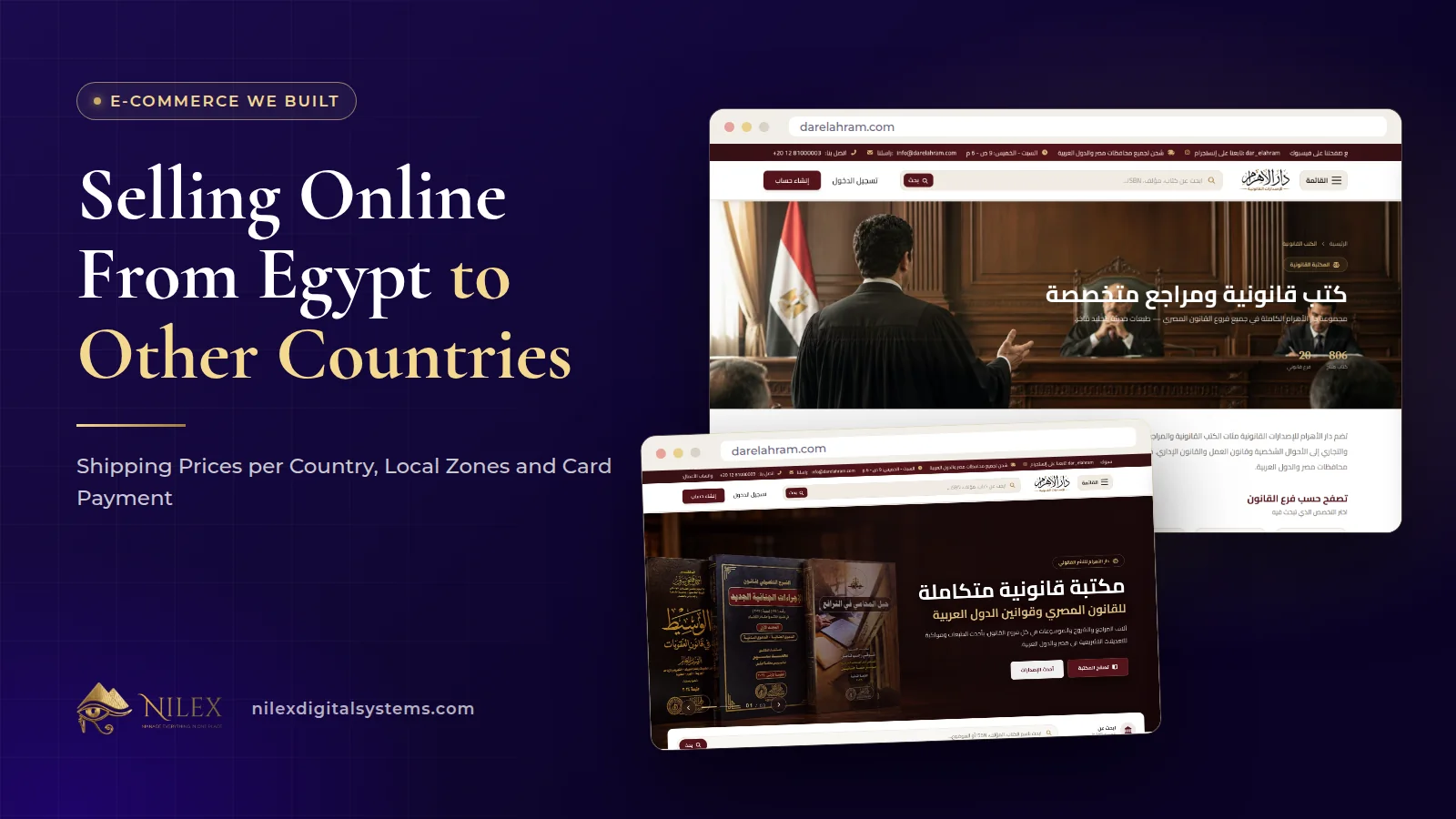
At checkout the reader chooses where the order goes. Inside Egypt, the delivery rate comes from the governorate. Outside Egypt, he picks from the countries the store ships to, then a shipping method for that country, and the cost is calculated for that method and the books in the cart before he confirms. Phone numbers are entered with their country dialling code and the address can be set with a location picker.
He then pays by card online or chooses cash on delivery. A payment result page shows whether the card payment went through, without exposing any card data. The details of the shipping set-up are in selling online from Egypt to other countries, and the story of adding card payment to a cash-on-delivery store is in adding card payment to Dar El Ahram.
The dashboard the team works from
The biggest change for the team is that orders stopped living on paper. Everything now sits in one dashboard, with its own login.
| Dashboard screen | What the team does there |
|---|---|
| Dashboard | Sees store and order statistics and the number of books in each branch |
| Orders | Updates status and shipping, edits order items and details, applies a discount and emails it to the customer, cancels, opens the invoice |
| Books | Adds and edits books with their files, shows or hides a book on the public site, deletes and restores |
| Categories and writers | Manages the legal branches and the author profiles, including photos and active status |
| Customers | Activates or deactivates accounts and sets roles |
| Payments and finance | Follows online card payments and a finance overview |
| Shipping and local delivery | Switches countries on or off, manages shipping methods per country and the rate per governorate |
| Offers and coupons | Builds offers with a banner and chosen books, creates coupons and sends coupon emails |
| Content and requests | Blog, events, questions, reviews, author applications, academic collaboration and publication requests, QR flyers |
Admin login is rate-limited, and each screen is behind the admin check, so a customer account cannot reach it. For how a store back office should work in general, see the online store back office.
The assistant, Google and growth
An assistant that starts from the case
The AI assistant answers around the clock. It recommends books for a legal situation and explains why, gives the price and whether a book is in stock, and answers questions about ordering and shipping. Because it reads the table-of-contents PDFs, it looks at what a book covers, not only at its title. The full story is in the AI book assistant case study.
Pages Google can find
SEO covers the whole store, not just the home page. Every book, author, category and article carries its own title, description, address and share image, with structured data, an XML sitemap that keeps itself up to date and Google Search Console connected at launch. We explain the structure in SEO for a large book catalogue.
More than a store
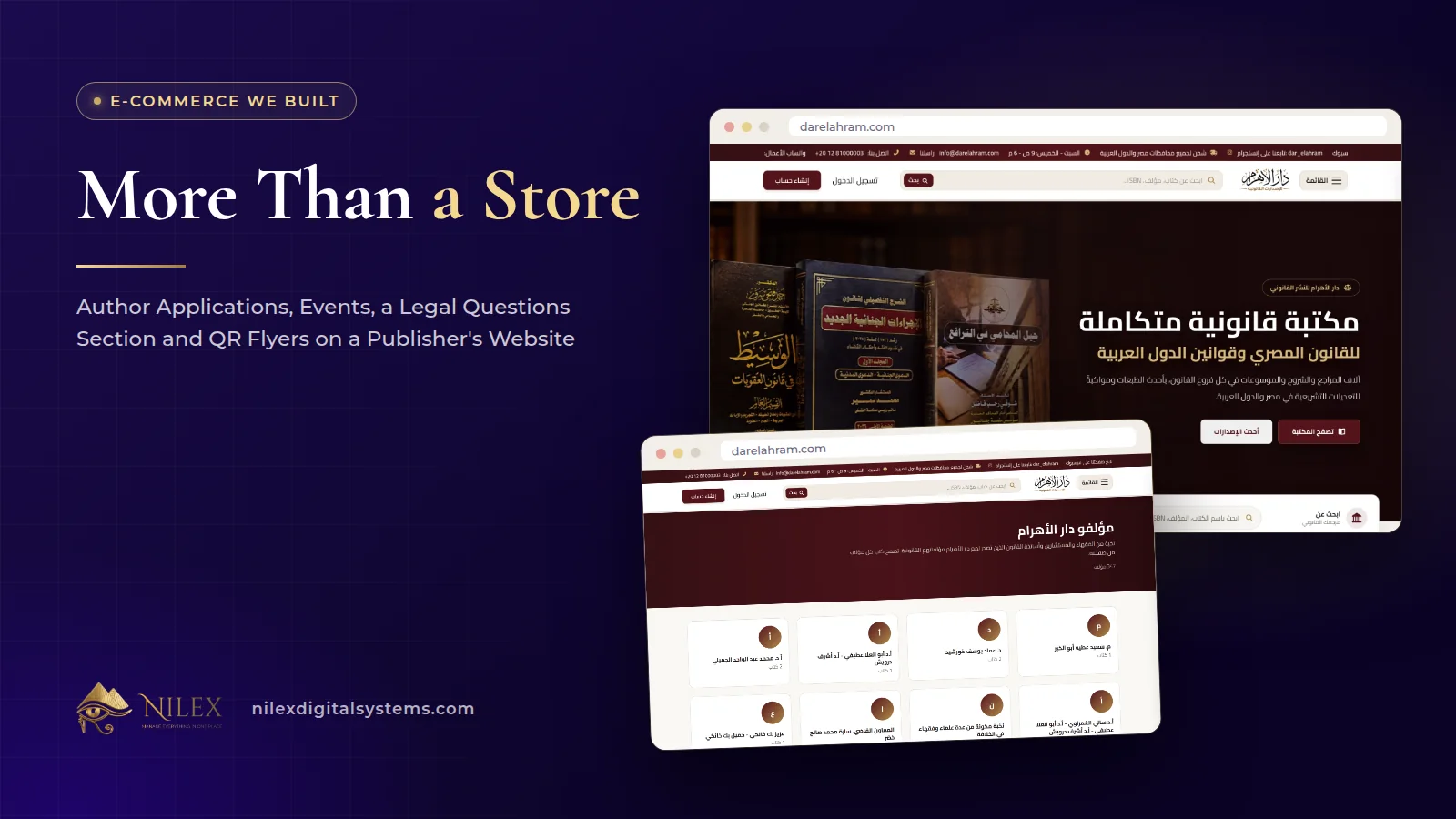
A publisher needs authors and academics as much as buyers. The site takes author applications and academic collaboration requests, publishes book-fair events, articles and a questions section, and gives the team a QR flyer tool, a newsletter and WhatsApp book announcements.
Results: before and after
| Before | After |
|---|---|
| Catalogue known only by the branches and the sales team | 800+ titles online, each with its own page |
| Readers had to know the exact title | An AI assistant recommends books for a legal situation |
| Cash payment only | Card payment online or cash on delivery |
| Hard to sell outside Cairo and abroad | Shipping to every governorate and to other countries |
| Orders by phone and WhatsApp, tracked on paper | All orders, stock and customers in one dashboard |
| No book or author pages on Google | Authors, legal branches and articles found on Google |
In numbers: more than 800 legal titles online, 19 legal branches with their own page and more than 340 authors with their own page. Lawyers, judges and researchers now find and order books without calling a branch, and the team follows every order from one screen instead of from paper lists and phone messages.
What other businesses with a large catalogue can take from it
- Start with what sells. A working catalogue and checkout first, then payments, then the extras. Each phase earns its place.
- Organise the catalogue the way your buyer thinks. For Dar El Ahram that is branch of law and author, not a generic shelf.
- Give every item its own page. Hundreds of pages each answering one search beat one long list.
- Bring the orders into one place before you scale. Card payment and shipping abroad only help if the team can follow each order.
- Use AI where your customers struggle. Here, readers did not know titles, so the assistant starts from the case.
How Nilex helps
We build online stores around the way a business sells, with a page for every product, online and cash payments and an order dashboard. If you have a large catalogue, a publishing house or any shop that still takes orders by phone, these are the next steps:
- Read the full project summary on the Dar El Ahram client page.
- See what is included in our e-commerce store development service; the packages are listed there.
- If you want an assistant on your own store, see our AI business chatbot service.
- Tell us about your catalogue through the contact page and we will reply with a proposal and a written quotation.
As with every project, Nilex keeps the source code and the client gets a licence to use the system; the client owns its data and can get a copy of it on request.
Frequently asked questions
How many books does the Dar El Ahram store have online?
More than 800 legal titles, organised into 19 legal branches, with more than 340 authors who each have their own page.
Can readers outside Egypt order books?
Yes. The store ships to every governorate in Egypt and to other countries. The team chooses which countries are open and sets the shipping methods for each, and the cost is shown at checkout before the order is placed.
Does a reader need an account to buy?
No. Checkout works for guests. An account adds order history, valid coupons, the option to retry a card payment and the ability to write reviews.
How long did the first version take?
The first version, with books, authors, legal branches, a cart and cash on delivery, went live within days. Payments, shipping, the dashboard, the assistant and the content features followed in later phases.
Can Nilex build a similar store for my business?
Yes. The same approach works for any business with a large catalogue: a page per item, browsing by the way buyers think, card and cash payment and one dashboard. Send us your details through the contact page.
 Starting Online Orders for Your Supermarket: A Practical Launch Plan, Decision by Decision11 October 2026 · 9 min
 Selling Online From Egypt to Other Countries: Shipping Prices per Country, Local Zones and Card Payment11 October 2026 · 8 min
 More Than a Store: Author Applications, Events, a Legal Questions Section and QR Flyers on a Publisher's Website11 October 2026 · 8 min