
More Than a Store: Author Applications, Events, a Legal Questions Section and QR Flyers on a Publisher's Website
The features on the Dar El Ahram website that go beyond the cart: author applications, academic collaboration requests, book-fair events, a questions section, reviews, reader articles, a newsletter, offers, coupons and a QR flyer tool.
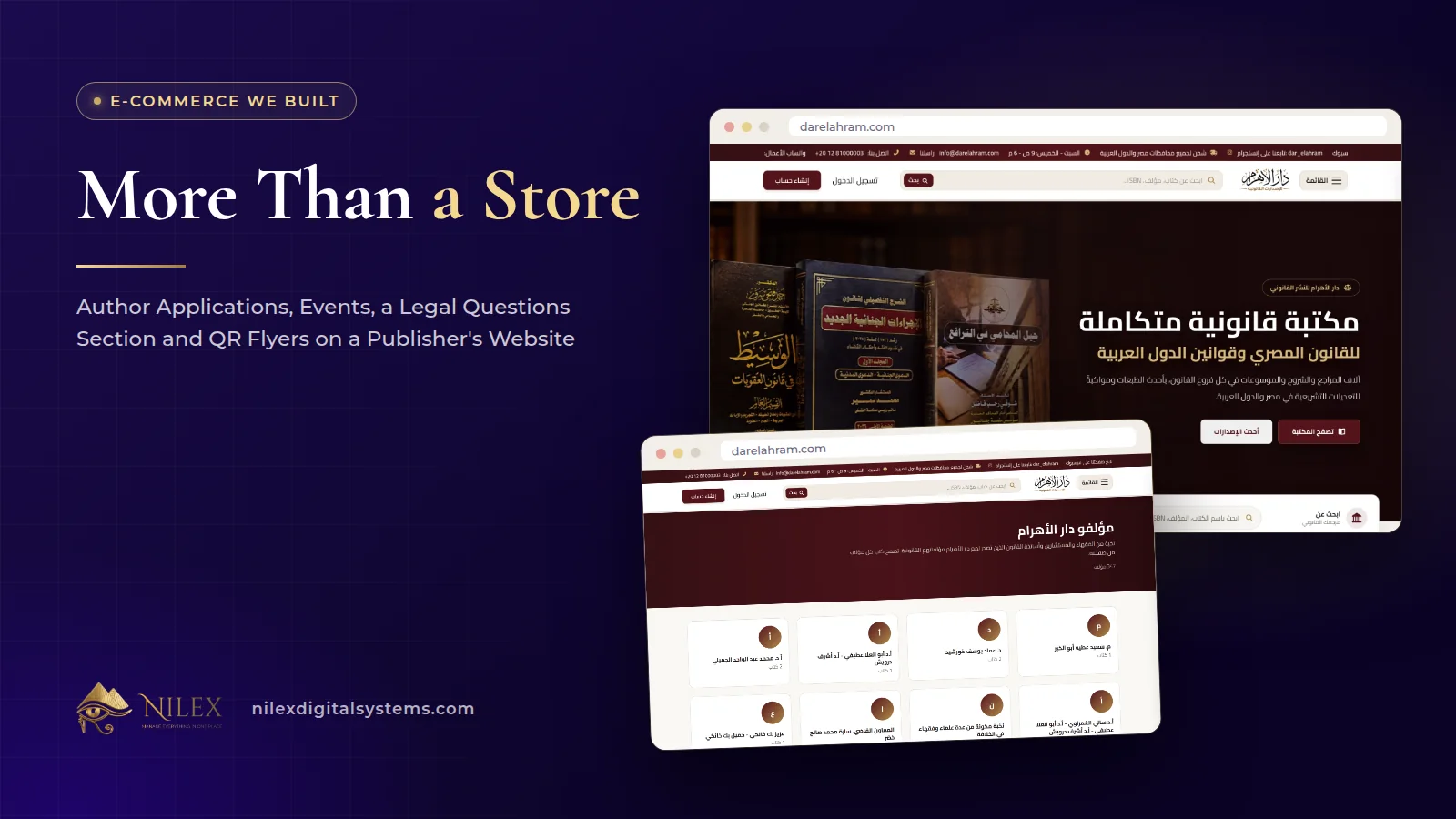
A publisher's website has more jobs than selling books. On the Dar El Ahram site, the same system that runs the store also takes author applications and academic collaboration requests, publishes book-fair events, articles and a questions section, collects reviews, grows a newsletter, runs offers and coupons, and produces printable QR flyers. Most of these are managed from their own screen in the dashboard.
These features matter because a publishing house grows from two sides: readers who buy, and authors and academics who bring the next books. This article goes through each feature, who it serves and what the team does with it, as a guide for any publisher or business that wants its website to do more than take orders. The full project is in the Dar El Ahram online bookshop case study.
Key takeaways
- Authors apply through a form on the site, and the team reviews each application and updates its status from the dashboard.
- Academic collaboration and publication requests arrive as records with a status, not as scattered emails.
- Book-fair events, articles and a questions section give readers reasons to return and give Google more pages to find.
- Reviews, reader-submitted articles, a newsletter and WhatsApp book announcements keep readers involved between purchases.
- Offers, coupons with notification emails and a QR flyer tool connect online and offline selling.
Why a publisher's website must do more than sell
Before the project, everything at Dar El Ahram ran through the branches, the phone and WhatsApp. That applied to authors and academics as much as to buyers. A website that only sells would have moved orders online and left everything else where it was. We built the fourth phase of the project around content, SEO and growth: legal articles, book-fair events, author applications, academic collaboration requests, a newsletter and WhatsApp book announcements, with every page prepared for Google indexing.
| Feature | Who it serves | What the team does in the dashboard |
|---|---|---|
| Author applications | Authors who want to publish | Reviews each application and updates its status |
| Academic collaboration | Universities, researchers, academics | Publishes collaborations, follows requests and their status |
| Publication requests | Academics asking about publications | Follows each request and its status |
| Events | Readers who visit book fairs | Creates events with an image, edits and removes them |
| Questions | Readers with a question | Writes questions and answers grouped by type |
| Reviews | Buyers and future buyers | Sees all reviews in one list |
| Blog and reader articles | Readers and legal writers | Writes posts, approves or rejects submitted articles |
| Offers and coupons | Buyers | Builds offers, creates coupons and sends coupon emails |
| QR flyer | Visitors at fairs and branches | Generates a printable PDF flyer |
Authors and academics: the supply side
Author applications
An author who wants to publish with Dar El Ahram fills in an application on the site, with a phone field that accepts any country's dialling code. The application lands in its own dashboard screen, where the team opens it, reviews it and updates its status. Next to the form, the site publishes the author publishing terms, the publishing policy and the intellectual property terms as separate pages, so an author knows the rules before applying.
For a publisher this replaces a pile of emails and phone calls with a list where every application has a status.
Academic collaboration and publication requests
Legal publishing works closely with universities and researchers. The site has an academic collaboration page that shows the collaborations the house publishes, a form to request a collaboration and a separate form for academic publication requests. In the dashboard the team creates and edits the published collaborations, and follows each incoming request with its own status, on its own screen.
Book-fair events
Book fairs are where many readers meet the publisher in person. The team creates each event in the dashboard with an image and its details, and the site shows them on a coming events page, on the home page and on a page for each event. A reader who finds the store online learns where to meet the house, and a reader who meets the house at a fair can find the event page afterwards.
Each event page is a page Google can find, which matters when people search for the fair by name. We explain this side of the catalogue in SEO for a large book catalogue.
Keeping readers involved
A questions section
The team writes questions and their answers and groups them by type. Readers browse the questions section and filter it by type. This answers the searches that are questions rather than titles, and it lets the team write an answer once instead of repeating it on the phone. For questions that need a book recommendation, readers also have the AI assistant described in the AI book assistant case study.
Reviews
Signed-in readers write a review on a book's page, can edit or delete it, and can mark other readers' reviews as helpful. Reviews are rate-limited to keep out floods of posts, and the team sees all reviews in one dashboard list. For a buyer comparing two legal references, a review from another lawyer is often the deciding detail.
The blog and reader articles
The team publishes legal articles from a blog editor with images and categories; staff with the moderator role can write and edit posts as well as admins. Each article shows related and recent articles and books, so reading leads to the catalogue.
Readers can contribute too. A signed-in reader writes an article from his profile and submits it, and the team approves or rejects it before it appears. This brings in new content from the legal community while keeping the publisher in control of what is published under its name.
Newsletter and WhatsApp book announcements
Visitors subscribe to the newsletter from the home page, and customers manage their own consent settings from their profile. For new books, the system also supports WhatsApp book announcements, with the expected reach and cost visible before a send. Asking for consent and respecting it is the basis of any list worth having.
Offers, coupons and latest releases
Selling still matters, and these tools give the team ways to move titles without changing prices across the catalogue:
- Offers. The team builds an offer with a banner and the books it covers, and switches it on or off. Active offers appear on the home page, the books page and an offers page.
- Coupons. The team creates coupons and can send coupon notification emails to customers. A signed-in customer sees his valid coupons in his profile, and the coupon is checked in the cart.
- Order discounts. On a single order, the team can apply a discount and email it to the customer.
- Latest releases. A dedicated page shows the newest titles, filterable by branch.
How to run offers without hurting margins or trust is covered in timed offers, bundles and countdowns.
The QR flyer tool: bringing offline visitors online
A publisher still meets many readers in branches and at book fairs. The QR flyer tool in the dashboard generates a PDF flyer with a QR code, ready to print. A flyer on a fair stand or a branch counter lets a visitor scan and carry on browsing on his phone, instead of leaving with a business card he will lose. It is a small tool, but it joins the two places where the house sells.
What other businesses can take from it
- List every relationship your business depends on, not only buyers. For a publisher that includes authors, academics and fair visitors.
- Turn each incoming request into a record with a status. That is what stops applications and requests getting lost.
- Publish what you know. Articles, questions and events bring searches your product pages cannot.
- Let your community contribute, with approval. Reviews and reader articles add content you could not write alone.
- Connect offline to online. A QR flyer costs little and carries a fair visitor to your store.
How Nilex helps
We build websites that run the whole business around the store: forms that become records, content that Google can find, and marketing tools the team uses from the same dashboard. Next steps:
- See the project summary on the Dar El Ahram client page.
- Read about our e-commerce store development and SEO business website services; packages are listed on each page.
- Tell us which requests, content and campaigns your business handles today through the contact page, and we will reply with a proposal.
Frequently asked questions
How do authors apply to publish with Dar El Ahram?
Through an application form on the site. Each application appears in the dashboard, where the team reviews it and updates its status. The author publishing terms and publishing policy are published on their own pages.
Can readers publish articles on the site?
Signed-in readers can write and submit an article from their profile. The team approves or rejects it before it appears.
What does the QR flyer tool do?
It generates a printable PDF flyer with a QR code from the dashboard, for use at book fairs, branches or anywhere the publisher meets readers in person.
How do customers find out about coupons?
The team can send coupon notification emails, and signed-in customers see their valid coupons in their profile. The coupon is checked in the cart.
Are these features only for publishers?
No. Application forms, requests with a status, events, questions, reviews, offers and QR flyers suit many businesses. We build the set that fits how your business grows.
 Starting Online Orders for Your Supermarket: A Practical Launch Plan, Decision by Decision11 October 2026 · 9 min
 Online Legal Bookshop Case Study: How Dar El Ahram Sells 800+ Legal Titles Online11 October 2026 · 11 min
 Selling Online From Egypt to Other Countries: Shipping Prices per Country, Local Zones and Card Payment11 October 2026 · 8 min