

Law Library and Legal Procedure Guides: Content That Brings Clients to a Law Firm Website
How a law library and step-by-step procedure guides bring people to a law firm's website: Al Hasswa's 552 law-library pages and 84 procedure guides, how each page is structured, how they link to services and booking, how the firm keeps them accurate and how they get indexed.
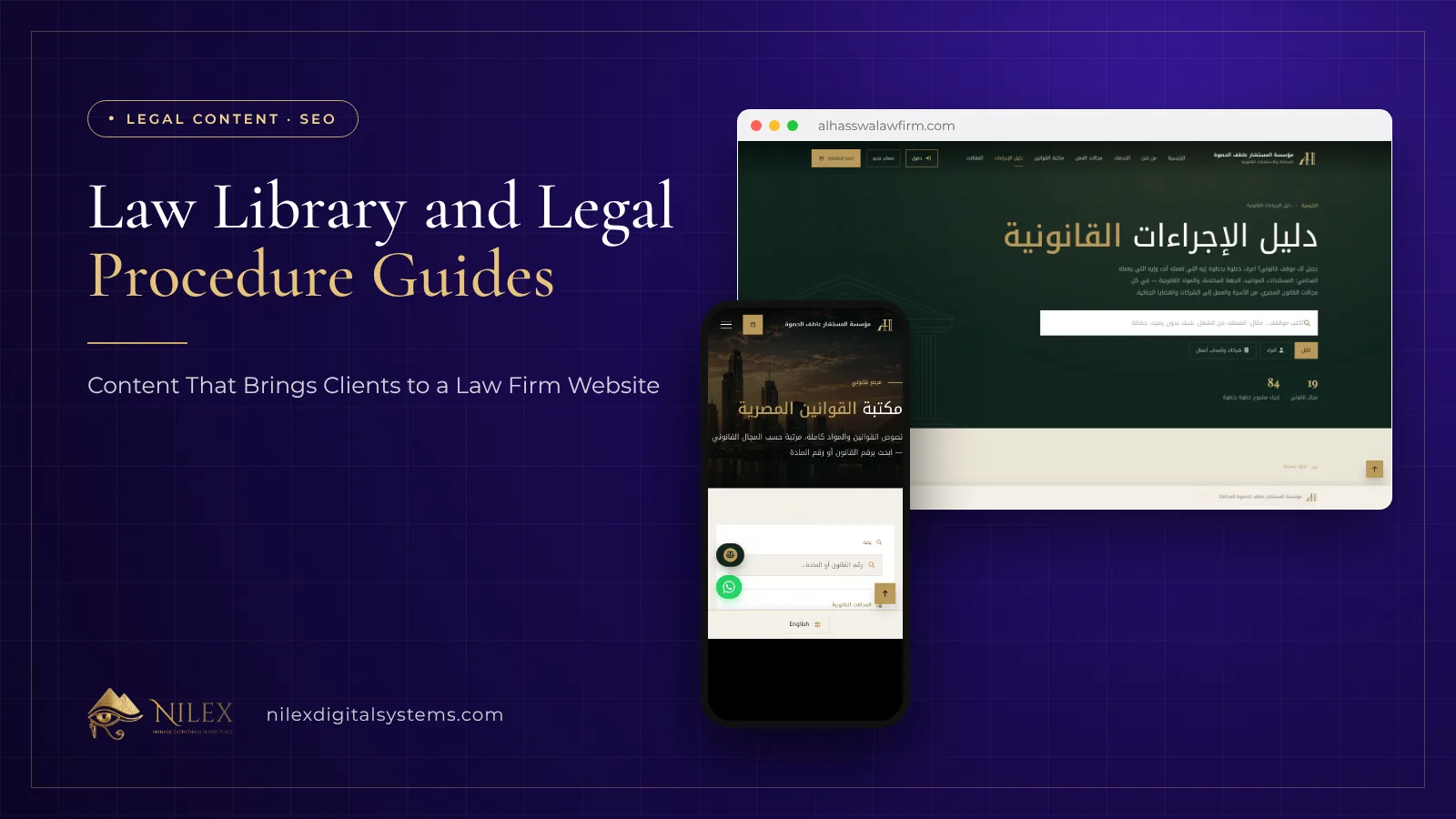
A law library and step-by-step procedure guides bring people to a law firm's website because they answer the searches that come before "I need a lawyer": the text of a specific law or article, and "what do I do now?". Built well, every law and every procedure is its own indexable page, linked to the matching practice-area service and to consultation booking, and kept accurate by the firm that publishes it.
This article is for law firms, legal publishers and consultancies in Egypt that want content that keeps working for years, not only a blog. Our example is the public website of Al Hasswa Law Firm in Nasr City, Cairo, built by Nilex. In November 2026 its sitemap lists 552 law-library pages and 84 procedure guides, next to about 250 articles and 51 service pages. We describe how these sections are structured and linked; the content itself is the firm's, and nothing here is legal advice. For the site's overall search structure, see our companion guide on law firm website SEO in Egypt.
Key takeaways
- A law library answers reference searches (a law number, an article number); a procedures guide answers task searches (what to do in a situation). Articles answer questions. Each is a different content asset.
- Al Hasswa's library is one index page plus 551 law and decree pages, searchable by law or article number and filterable by legal area, related service, year and type of legislation.
- Its procedures guide has 84 step-by-step guides in 19 legal areas, each with the competent authority, steps, documents, deadlines, legal basis, common mistakes and FAQs.
- The value comes from linking: procedures link to the laws they rely on, laws and procedures link to services, and every page links to booking.
- Laws change, so accuracy is a process: an official-source section on each law, and the firm reviewing its guides when the law changes.
- A site of about 1,000 pages needs a complete sitemap, a correct robots.txt and Search Console checks, more than it needs tricks.
Laws, procedures and articles: three kinds of search
A blog is the content most firms think of first, but it answers only one kind of search. People looking for legal information search in at least three different ways, and each one suits a different section of the site:
| Content asset | What the visitor searches | One page is | It should link to | Kept accurate by |
|---|---|---|---|---|
| Law library | A law by number and year, or a specific article | One law or decree with its articles | Related laws, related services, booking | The firm, against the official source |
| Procedures guide | "What do I do if…", in everyday words | One situation, step by step | The laws it relies on, the related service, booking | The firm, when laws or practice change |
| Articles | A specific question about the person's case | One question answered | Related articles, service, booking | The firm |
| Service pages | A lawyer for a type of case | One practice area or service | Articles, laws, procedures, booking | The firm |
The first two are what this article is about. They are large, structured and evergreen: once a law page or a procedure guide exists, it can keep answering searches for as long as it stays accurate.
How the law library is organised
The library's index page is titled «مكتبة القوانين المصرية | نصوص القوانين والمواد كاملة»: the Egyptian laws library, full texts of laws and articles. It lists the laws twenty at a time, with a search box for a law number or an article number. Alongside the list, filters narrow it by:
- Legal area (for example criminal, civil, family, arbitration), which mirrors the firm's practice areas.
- Related services, matching laws to the firm's own services.
- Year of issue and type of legislation (law, decree, executive regulation).
- Tags.
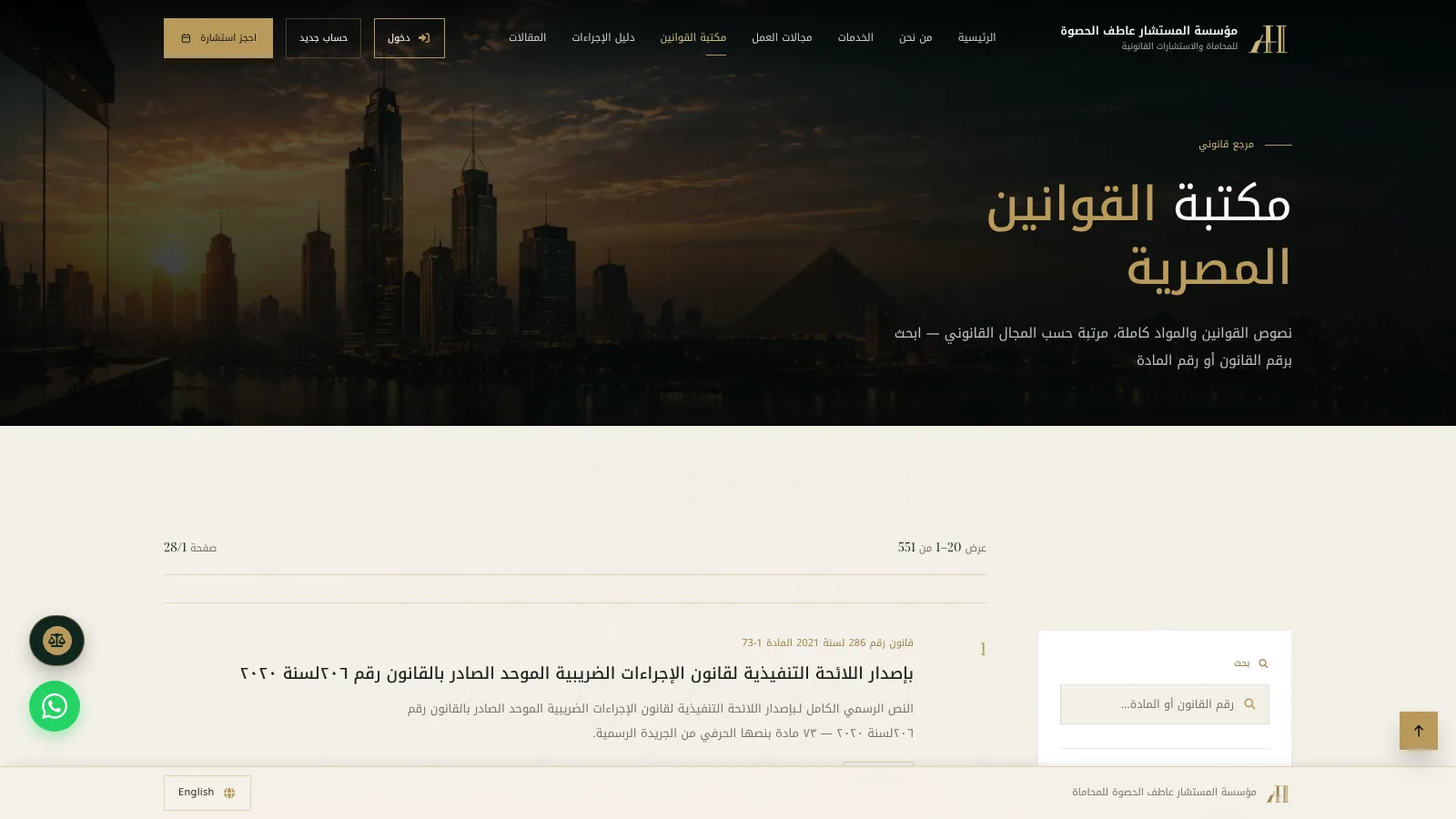
The index links to every law page, and filtering by related service ties the library to the firm's practice areas. That is the point of a library on a firm's own site rather than on a separate reference website: a visitor who came for the text of a law is already on the site of a lawyer who works with it, with booking one click away.
What a single law page contains
Each law or decree has its own page and address, for example /law-library/law-212-1980. The page title states the law's number and year, the range of articles on the page and the law's full name, then the section name. The description says the page holds the full official text and how many articles it has. Inside, the page is organised in sections:
- Preamble of the law.
- Articles, each under its own heading (Article 1, Article 2…), so a reader looking for one article can find it on the page.
- Official source, stating where the text comes from.
- Attachments, where there are any.
- Related laws, linking to other laws in the library.
The page also carries a breadcrumb and structured data describing it as legislation. Structured data does not guarantee any special display in Google, but it describes clearly what the page is.
A law's text is the same everywhere it is published, so a library's strength is not the text alone. It is how the text is organised, how easy it is to search, and how it connects to the guides, articles and services around it.
The procedures guide: one situation per page
The procedures index, titled «دليل الإجراءات القانونية في مصر خطوة بخطوة», is written for someone who has just had something happen to them. It opens with a search box where the visitor types their situation in everyday words, and quick filters for everyone, individuals, or companies and business owners. It shows the size of the guide (84 procedures in 19 legal areas), a section of urgent situations, the areas to choose from, and what people ask about most.
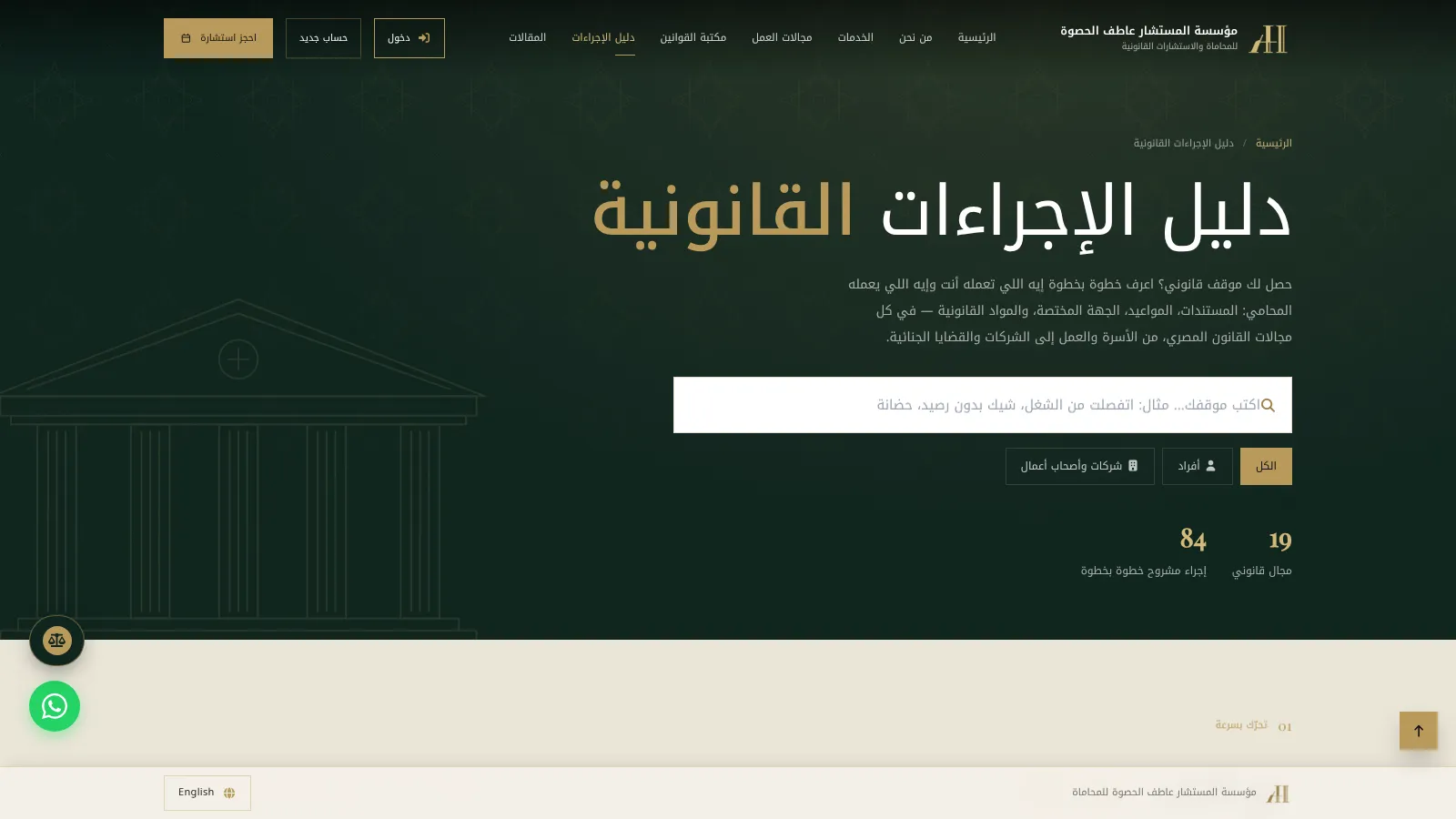
Each of the 19 legal areas has its own page (family, inheritance, labour, criminal, cybercrime, consumer, real estate, tax, banking, data privacy and others), listing the procedures in that area. Each procedure then has its own page under the area, for example /procedures/family/wife-and-children-maintenance. Procedure titles are phrased as the person would describe the situation, such as «اتفصلت من الشغل بدون سبب: ماذا تفعل؟» (dismissed from work without a reason: what to do?), because that is what they type.
What a single procedure page contains
Every procedure page follows the same template, which makes the guide consistent for readers and easy for the firm to extend:
- Competent authority: where the matter is handled.
- Steps in order, each step under its own heading.
- Required documents.
- Important deadlines.
- Legal basis, linking to the relevant laws in the library.
- Common mistakes and warnings.
- Frequently asked questions.
- A prompt for readers who want someone to walk them through the steps, leading to booking.
- Other procedures in the same area.
The pages carry step-by-step and FAQ structured data. Google announced in 2023 that it no longer shows HowTo rich results and limits FAQ rich results to a small set of authoritative sites, so this markup describes the page but should not be expected to change how it looks in results. The ranking work is done by the content and its structure.
Linking laws, procedures, services and booking
Large content sections only help the firm if readers move from information to action. On the Al Hasswa site the sections are wired together:
- A procedure page links to the laws it relies on; the maintenance procedure page alone links to the law library several times.
- The library index can be filtered by related service, and each law page links to related laws.
- Service pages link back to the law library and to related articles.
- Every page has the booking button in its header, and procedures end with a prompt to get help with the steps.
- The home page links to urgent procedures, so they are close to the top of the site.
These links let readers continue, and they help Google discover deep pages and understand how topics relate. Google's guidance asks for crawlable links with descriptive anchor text, which is what a template that links by law name or procedure title provides. The same idea for a book catalogue, with author and category pages, is in our article on SEO for a large book catalogue.
Keeping legal content accurate
Laws are amended, new decrees are issued, and procedures change in practice. A legal content section that is not maintained becomes a liability. The library already includes laws issued in 2025 and 2026, so it has to be kept current. The website can make maintenance easier, but the review belongs to the firm:
- The firm reviews the content. Lawyers who practise the law check the guides and articles; Nilex builds the structure and does not write or review legal content.
- An official-source section on every law page lets readers and reviewers see where the text came from.
- One template for every procedure means a change, such as a new deadline, has an obvious place to go.
- A reminder that cases differ. The procedures index ends with a section saying every case has its own details, pointing readers to a consultation rather than presenting the guide as a substitute.
Google's guidance on helpful, reliable content asks whether content shows clear sourcing and expertise. For legal topics, that is what readers need too.
Getting about 1,000 pages indexed
The Al Hasswa sitemap lists about 988 addresses: 552 in the library, 104 in the procedures section (the index, 19 area pages and 84 guides), about 250 articles, the service pages and the main pages. What keeps a site this size healthy in Google is mostly basic hygiene:
- Every real page in the sitemap, nothing else, with the date it last changed. Google explains how to build and submit a sitemap.
- The sitemap declared with the "Sitemap:" directive in robots.txt. A note in the site's own robots.txt records why: a sitemap address written on a line without the directive is ignored by crawlers.
- Private areas blocked, such as the admin area, client portal and API, so crawling is spent on public pages.
- One canonical address per page, so Google knows which address to index.
- Search Console checks: submit the sitemap, watch the Pages report, and look at pages that are discovered but not indexed. Our Search Console guide explains these reports.
Google's crawl budget guide is written for much larger sites, so at around 1,000 pages the question is usually quality and duplication, not crawl capacity. Online stores face a different problem, thousands of filter and sort addresses; we cover that in keeping filter URLs out of Google.
How Nilex helps
Nilex builds SEO-ready websites with large structured sections: law libraries, procedure guides, catalogues and article sections, each entry its own page, with search, filters, templates, internal links, structured data, sitemaps and Search Console set up. The firm writes and reviews the content and publishes it itself; we do not write legal content, build links or guarantee rankings. See how this came together for one firm in the law firm web app case study and on the Al Hasswa client page, read how our clients publish at scale in publishing hundreds of articles, and contact us to plan yours.
Frequently asked questions
Why would a law firm put a law library on its website?
Because people search for the text of laws and articles, and a library gives the site a page for each one. When those pages link to the firm's related services and to booking, a reader who came for a legal text can reach a lawyer in one click.
Isn't the text of a law duplicate content?
The text itself is public and appears on many sites. What makes a library useful is the organisation around it: search by law and article number, filters, related laws, and links to the firm's guides and services. Pages that are only copied text with nothing around them add little.
What is the difference between a procedure guide and an article?
A procedure guide answers "what do I do?" for one situation in a fixed structure: authority, steps, documents, deadlines, legal basis and mistakes. An article answers a specific question and can explain, compare or discuss. Both should link to the related service and to booking.
Who keeps the library and guides up to date?
The firm. Lawyers review the guides and articles when laws or practice change. The website should make that easy, with one template per page type and an official-source section on each law.
Does structured data make these pages appear differently in Google?
Not necessarily. Since 2023 Google no longer shows HowTo rich results and limits FAQ rich results to a small set of sites. Structured data still describes the page clearly, but rankings come from the content and how well it answers the search.
 Technical SEO From Development to Launch: Building a Site Google Can Actually Find11 November 2026 · 6 min
 Get Every Page Indexed: A Clean Google Search Console With No Coverage Errors11 November 2026 · 6 min
 Sitemaps, robots.txt and Structured Data: The Three Things That Get You Crawled, Indexed and Shown11 November 2026 · 5 min