Content at Scale: How Our Clients' Websites Publish Hundreds of Articles That Bring Visitors
How a clinic, a law firm and a legal publisher publish 100+, 140+ and hundreds of pages of content: the publishing tools behind them, the article structure we use for our own 157 topics, and what it takes to keep going.
A website publishes hundreds of articles that bring visitors when three things are in place: a publishing tool the business can use without a developer, SEO built into every article page automatically, and a repeatable article structure that answers one real question at a time. Volume alone does not do it; each page has to be findable and useful on its own.
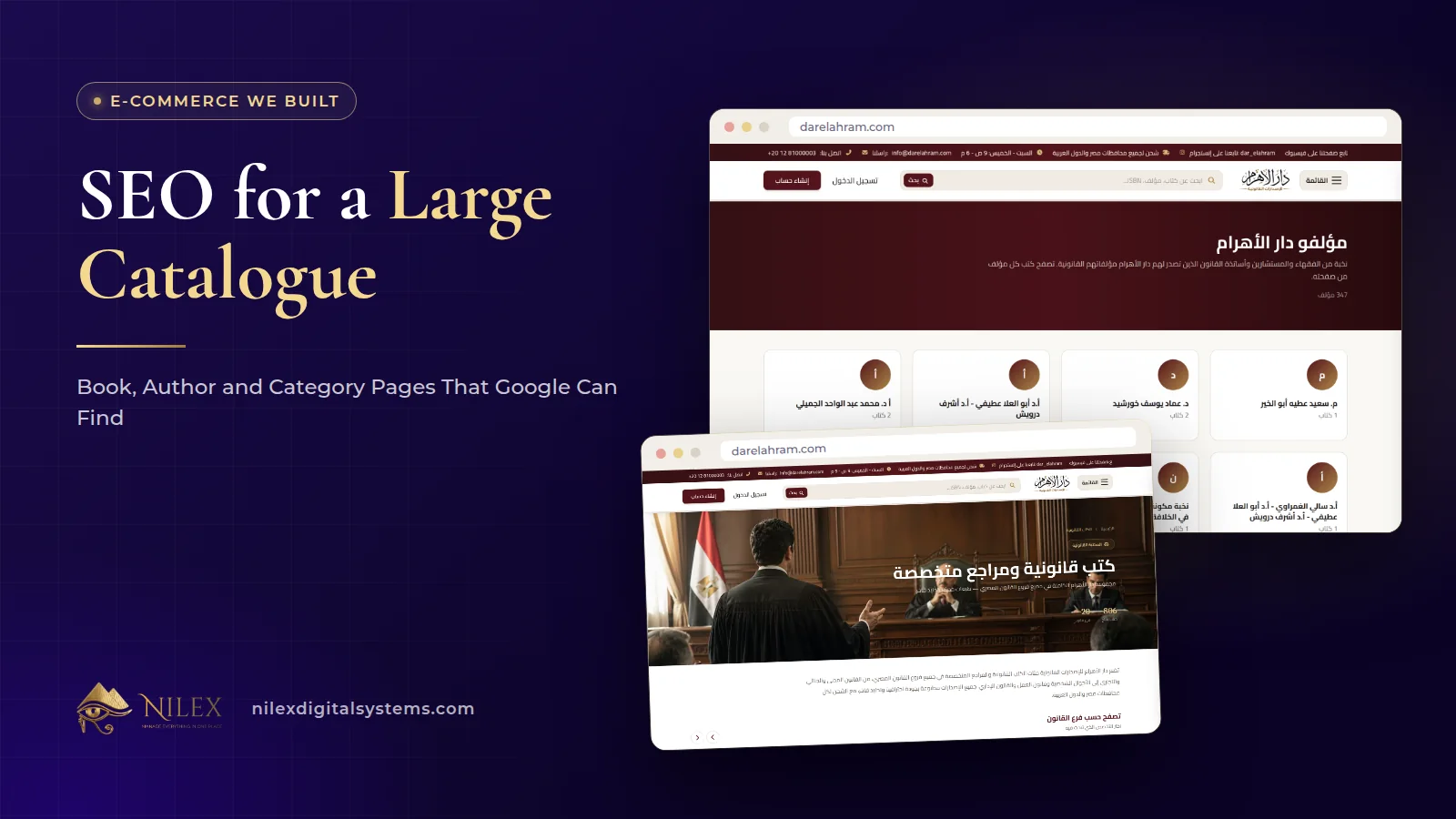
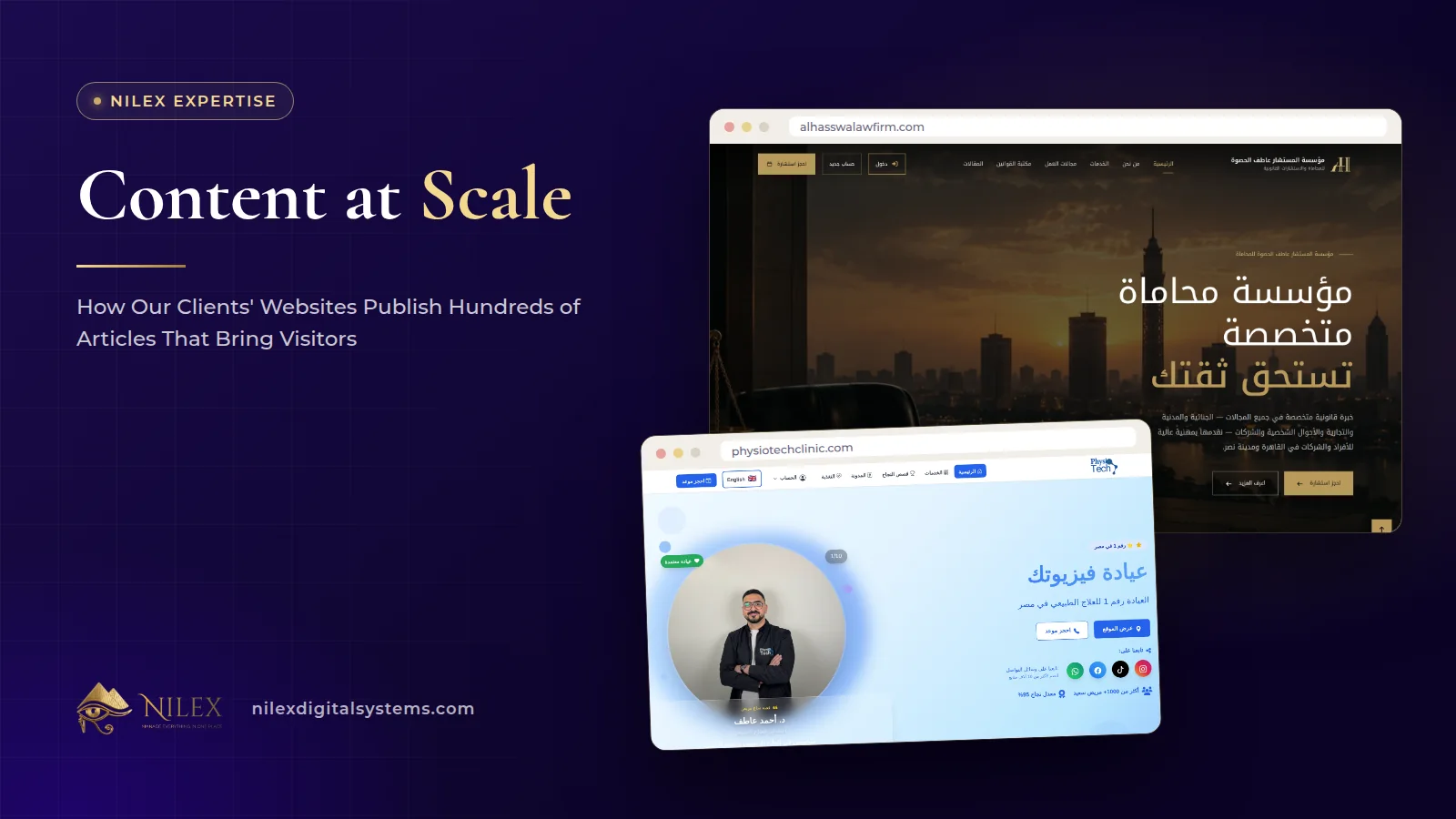
Our client sites show what this looks like in practice. PhysioTech Clinic has published more than 100 articles, Al Hasswa Law Firm more than 140 articles and legal guides next to a law library of more than 550 laws and decrees, and Dar El Ahram publishes legal articles alongside 800+ book pages. On our own site, this article is part of a programme of 157 topics in English and Arabic. Here is how the machinery behind them works.
Key takeaways
- Content at scale is a system problem first: an editor, automatic SEO fields, a sitemap that updates itself and Search Console from launch.
- Each of our client sites publishes a different kind of content: treatments and success stories for a clinic, practice areas and legal guides for a law firm, books, authors and articles for a publisher.
- Every article page on these sites carries its own title, description, address and share image, plus structured data.
- A fixed article structure (direct answer, key takeaways, question headings, a table, FAQ) makes hundreds of articles consistent and easy for Google and readers to use.
- Internal links turn separate articles into a network that leads readers to service pages and enquiries.
- Writing in Arabic and English natively, not by literal translation, lets a site answer searches in both languages.
What does "content at scale" actually mean for a business website?
For most Egyptian businesses, a website is a few pages: home, about, services and contact. Those pages can only rank for a handful of searches. Content at scale means publishing a page for each real question your customers ask: each condition a clinic treats, each legal problem a client faces, each book or topic a reader searches for.
That moves the website from one page competing for a broad search to hundreds of pages each competing for a precise one. A person who searches for a specific legal question is much closer to booking a consultation than someone who searches "lawyer". Our guide to service pages and articles that bring enquiries explains how to write each page; this article is about how a business keeps publishing them month after month.
What do our three client sites publish?
Each site was built around the content its audience searches for, not around a generic blog.
| Site | What it publishes | Published so far | Who writes |
|---|---|---|---|
| PhysioTech Clinic | A page for every treatment, a blog, patient success stories with video | 10 treatment pages, 100+ articles | A steady flow of articles as part of the SEO and content growth phase |
| Al Hasswa Law Firm | A page for every practice area, articles and legal guides, a law library | 10 practice areas, 140+ articles, 550+ laws and decrees | The firm's team, through an article editor in Arabic and English |
| Dar El Ahram | Book, author and legal-branch pages, legal articles, book-fair events, a newsletter | 800+ titles, 340+ author pages, 19 legal branches | The house's own legal articles, published on the store site |
Notice that for the law firm and the publisher, the content is not only articles. Book pages, author pages, practice-area pages and law-library entries are all pages that answer a search. The case studies of the physiotherapy clinic, the law firm and the large book catalogue go into each project in detail.
What publishing tools make hundreds of articles possible?
If every new article needs a developer, a business publishes five and stops. The sites we build put publishing in the hands of the business:
- An article editor in the dashboard. Al Hasswa Law Firm's team publishes its own legal content in Arabic and English from the same place where it manages its service packages.
- SEO fields on every page. Each article, like each treatment, practice area or book, has its own title, description, address (URL) and share image, so it can compete on Google on its own and look right when shared.
- Structured data. The pages carry structured data, for example for a local clinic on PhysioTech, which helps search engines understand what the page is.
- An XML sitemap. On Dar El Ahram the sitemap keeps itself up to date, so new pages are listed for search engines without anyone editing a file.
- Google Search Console from launch. All three sites were connected to Search Console at launch, so indexing can be followed from the first day.
- Server-side rendering. The sites are server-rendered, so search engines read the full article. Our article on server-side rendering and SEO explains why this matters.
What structure do we use for our own 157 articles?
When you publish at scale, every article cannot be designed from scratch. Our own programme follows one structure, and we recommend it to clients who publish regularly:
| Part | What it contains | Why it helps |
|---|---|---|
| Opening | Two short paragraphs that answer the question directly | Readers get the answer at once, and clear answers can be used in Google's AI answers |
| Key takeaways | Four to six bullet points | Busy readers can scan the whole article in seconds |
| Question headings | Six to nine sections, each answering one sub-question | Each heading can match a search on its own |
| A useful table | A comparison, checklist or who-sees-what table | Tables summarise decisions better than paragraphs |
| Next steps | A section on how we help, with links to the right page | Turns a reader into an enquiry without overselling |
| FAQ | Four to six short questions and answers | Answers the follow-up questions people actually type |
Every article also links to at least three related articles and to the relevant system, service or case-study page. Each section has an id, so a link can point straight to the answer. And there is one strict rule: every statement about our systems and clients must come from what we have actually built. A large content programme that invents features or numbers damages trust faster than it builds traffic.
Why do internal links matter more when you have hundreds of pages?
A hundred articles that do not link to each other are a hundred dead ends. Internal links do three jobs:
- They help readers go deeper. Someone reading about one legal problem often has a related one; a link keeps them on the site.
- They help search engines find and understand pages. New articles linked from older ones are discovered faster and are understood in context.
- They lead to the page that converts. On a law firm site, articles lead to the practice-area page and consultation booking; on a clinic site, to the treatment page and booking; on a bookshop, from an article to the book that covers the topic.
The habit that works: when you publish a new article, add a link to it from two or three older articles on related topics, not only from the new article outwards.
Should you publish in Arabic, English or both?
The clinic and bookshop sites are Arabic-first, and the law firm publishes its content in Arabic and English. Our own programme publishes every topic in both languages, written natively in each, not translated word for word. Arabic searches in Egypt are written in a different way from English ones, often in Egyptian dialect, and an Arabic article has to sound like the people searching.
Publishing in both languages lets a site answer searches in each of them, but it also doubles the writing work, so start with the language most of your customers search in. Our article on the Arabic SEO opportunity explains why Arabic content is often the bigger opening, and the guide to bilingual websites and hreflang covers the technical setup.
How do you keep publishing month after month?
Most business blogs stop after a few months, not because the articles failed, but because the process did. What keeps a programme going:
- A topic list prepared in advance. Write down the questions customers ask on the phone, at the counter and on WhatsApp. Each one is a topic. A list of fifty topics removes the "what do we write this week" problem.
- One owner. One person in the business is responsible for the list and the publishing calendar, even if several people write.
- A fixed template. The structure above means the writer focuses on the answer, not the layout.
- Expert review. A lawyer reviews legal articles, a doctor reviews treatment articles. Accuracy is what makes specialist content trusted.
- Search Console checks. PhysioTech's SEO phase included indexing fixes from Search Console audits. Check which pages are indexed and which searches bring visitors, then write more on what works. Our Search Console guide for business owners shows the reports to read.
What results can you expect, and when?
We do not promise rankings or traffic numbers, and you should be wary of anyone who does. What our client case studies describe is a change in where clients come from: PhysioTech's new patients arrive from Google searches for their exact condition, and Al Hasswa Law Firm is reachable from search instead of referrals alone. Dar El Ahram's readers find books by searching for an author or a specific legal reference.
Those results come from many pages each answering a precise search, published steadily and kept accurate. Articles take time to be indexed and to earn their place, so judge a content programme over months, not weeks.
How Nilex helps
We build websites where publishing is part of the design: SEO on every page, an articles section and Google Search Console setup at launch, and, depending on the package, an admin dashboard, structured data and Arabic and English. See what each package includes on the SEO business website service page.
If you also need bookings, a store or a management system behind the site, we connect them, as we did for the clinic, the law firm and the publisher; read the case studies on our clients page. To plan your own content programme, tell us about your business through the contact page.
Frequently asked questions
How many articles does a business website need?
There is no fixed number. Start with one page for each service or product and one article for each common customer question, then keep adding. PhysioTech's site, for example, reached 100+ articles through a steady flow of publishing after launch.
Do you write the articles for clients?
We build the publishing tools, the SEO setup and the article structure. On the law firm site, the firm's team publishes its own legal content through the article editor. If you need help with content, describe what you need on the contact page.
Can we use AI to write articles?
AI can help with drafts, but every article should be checked by someone who knows the subject, especially in law and health. Publishing many inaccurate pages hurts trust and rankings.
Should we update old articles or write new ones?
Both. Update articles when facts change, prices or laws for example, and keep adding new ones for questions you have not answered yet.
How long before articles bring visitors?
It varies with the topic and the competition. Watch Search Console for indexing and impressions in the first weeks, and judge results over several months.