
Physiotherapy Clinic Case Study: Online Booking, Patient Records and Four Portals for PhysioTech
How Nilex took PhysioTech, a physiotherapy clinic in Maadi, from a paper diary and spreadsheets to a bilingual website with a page for every treatment, online booking requests, digital patient records, finance, nutrition and four portals.
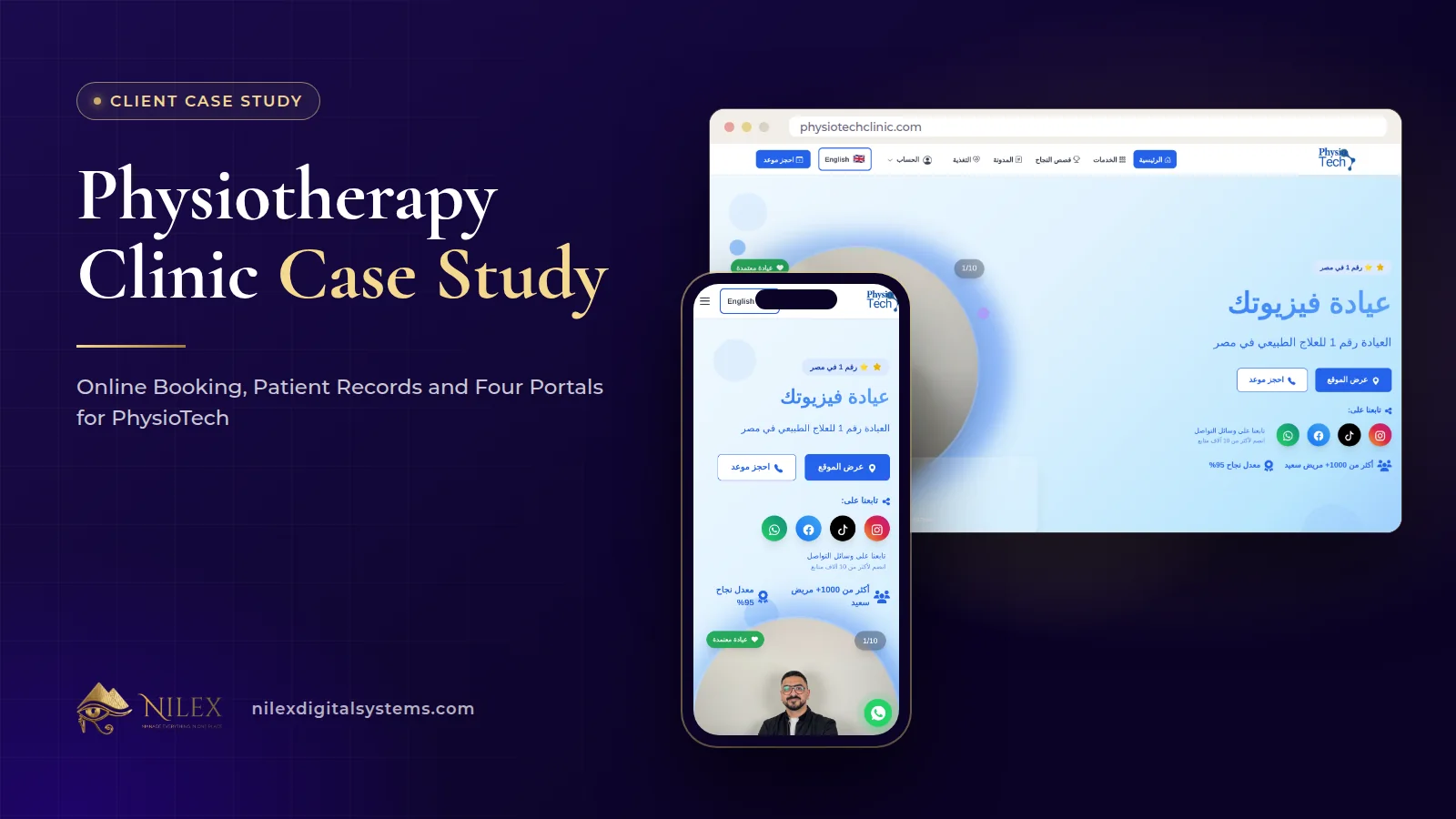
PhysioTech is a physiotherapy clinic in Maadi, Cairo. Before working with Nilex, its patients found it by word of mouth, bookings were taken by phone and written in a diary, and patient files, session notes and assessments lived on paper. We built the clinic a web app in four phases: a bilingual public website with a page for every treatment, a clinic management system with separate portals for doctors and patients, a finance and nutrition phase, and an ongoing SEO and content programme that has passed 100 published articles.
The result is one connected system: people searching for their condition can find a page about the treatment they need and send a booking request, and the clinic confirms it and runs the patient's sessions, records and payments from the same place. This case study explains what was built in each phase, why it was built in that order, and what other clinics can take from it.
Key takeaways
- PhysioTech moved from a phone-and-diary clinic to online booking requests that the clinic confirms.
- Patient records, assessments and medical profiles are digital, alongside doctors' schedules, rooms and sessions.
- Ten treatments have their own page, and the site carries a blog and patient success stories with video.
- The system has four portals: admin, doctor, patient and nutrition.
- Growth did not stop at launch: Search Console audits drove indexing fixes, and more than 100 articles have been published.
The clinic and the problem it had
PhysioTech treats patients in Maadi. Like many specialised clinics in Egypt, it was good at the clinical work and dependent on recommendations for new patients. The daily operation ran on habits that worked while the clinic was small:
- Bookings arrived by phone and went into a paper diary.
- Patient files, session notes and assessments were on paper.
- Doctors' schedules were arranged by hand.
- Income, expenses and packages were followed in spreadsheets.
There was also a gap outside the clinic. Someone in Cairo searching for help with a specific condition had nothing to find: the clinic had no way to show what it treats and the recoveries it achieves. The brief was therefore two-sided: become findable for specific conditions, and run the clinic from one system instead of a diary and a spreadsheet.
Before and after at a glance
| Area | Before | After |
|---|---|---|
| Bookings | Phone calls and a paper diary | Online booking requests that the clinic confirms |
| Patient files | Paper files and session notes | Digital patient records, assessments and medical profiles |
| Doctors' time | Schedules arranged by hand | Doctor schedules, rooms and sessions in one system |
| Money | Income and expenses in spreadsheets | Income, expenses and financial reports |
| Being found | Nothing to find on Google for specific conditions | A page for every treatment, a blog and success stories |
Phase 1: a public website built around treatments
We started with the part patients see. The website is server-rendered and available in Arabic and English, so every page reaches Google as complete content rather than an empty shell; our article on server-side rendering and SEO explains why that matters.
The key decision was structure: a page for every treatment instead of one "services" page. PhysioTech's treatments include sports injuries, post-surgery rehabilitation, home visits, chronic pain and manual therapy, among others, ten in total. A person searching for rehabilitation after an operation lands on the page about exactly that, not on a general list.
Alongside the treatment pages, the site carries a blog and patient success stories with video, so visitors can see the kind of recovery the clinic works towards. SEO was implemented on every page, not only the home page: each treatment, success story and blog post has its own title, description, address and share image, with structured data for a local clinic, an XML sitemap and Google Search Console connected at launch, prepared for search in Maadi and Cairo.
Phase 2: the clinic management system
Behind the website we built the system that runs the clinic. It covers patients, doctors, schedules, rooms, sessions, assessments, services and packages. In daily terms:
- Booking: patients send a booking request online, and the clinic confirms it, so the clinic stays in control of its schedule.
- Doctors, rooms and sessions: doctors' schedules, rooms and sessions sit in one system instead of being arranged by hand.
- Patient records: each patient has a digital record with assessments, a medical profile and session notes, replacing the paper file.
- Services and packages: the clinic's services and packages are defined in the system rather than tracked in a spreadsheet.
Doctors and patients each have their own portal, separate from the clinic's admin side. That separation is a design principle we apply across our systems, explained in a portal for every role. For the general feature list a clinic should look for, see clinic management software features; for the move from paper files, see electronic medical records in Egypt.
Phase 3: finance and nutrition
The third phase replaced the spreadsheets. Income and expenses are tracked in the system with financial reports, so the clinic's money sits next to the sessions and packages that generate it.
The same phase added a nutrition module. Nutrition has its own doctor portal and its own nutrition assessments, so the nutrition side of the clinic works inside the same system as physiotherapy instead of on separate paper forms.
Phase 4: SEO and content growth after launch
A website is not finished on launch day. After PhysioTech went live in September 2025, we kept working on two things:
- Indexing fixes from Search Console audits. Search Console shows which pages Google has indexed and which it has not, and why. Auditing those reports and fixing the causes is ongoing technical work; our Search Console guide for business owners explains the reports involved.
- A steady flow of articles. The blog has passed 100 published articles. How we run large article programmes for client sites is described in publishing hundreds of articles for client websites.
The four portals and who uses them
| Portal | Who uses it | Part of the project |
|---|---|---|
| Admin | The clinic's management and staff | Patients, doctors, schedules, rooms, sessions, services, packages, income and expenses |
| Doctor | Physiotherapy doctors | A separate portal for the clinic's doctors, built in the clinic system phase |
| Patient | The clinic's patients | A separate portal for patients, built in the clinic system phase |
| Nutrition | The nutrition doctor | Its own doctor portal with nutrition assessments |
Results
- 10 treatments with their own page.
- 100+ articles published.
- 4 portals: admin, doctor, patient and nutrition.
Beyond the numbers, the change is in how the clinic works: it manages bookings, patients and money in one place instead of a diary and a spreadsheet, and new patients arrive from Google searches for their exact condition.
The technology behind it is Angular with server-side rendering, Tailwind CSS, Node.js, Express, PostgreSQL, Sequelize and Nodemailer. Our article on Node.js, PostgreSQL and Angular for business systems explains why we build on this stack.
What other clinics can take from this project
- Start with what patients search for. A page per treatment answers a real search; a single services page rarely does.
- Keep the clinic in control of bookings. Booking requests that the clinic confirms suit a clinic whose sessions depend on a specific doctor and room. Our guide to online booking and reducing no-shows covers the patient side.
- Build in phases. Website first, then the system, then finance and specialised modules. Plan each phase so it is usable on its own.
- Treat health data with care. Patient records are sensitive; read what the law requires from clinics before you move files online.
- Keep publishing. Indexing fixes and regular articles are what turn a launched site into one that brings patients.
How Nilex helps
PhysioTech's project combined two of our services: an SEO business website and a custom management system. If you run a clinic or a service business and want something similar, a website that brings patients from search and a system that runs bookings, records and money behind it:
- Read the full PhysioTech Clinic case study and our other client projects.
- Tell us how your clinic works today and what you want to change on the contact page; we reply to every request.
Frequently asked questions
Where is PhysioTech Clinic?
PhysioTech is a physiotherapy clinic in Maadi, Cairo. Its website was prepared for search in Maadi and Cairo.
Can patients book online?
Yes. Patients send a booking request online and the clinic confirms it, so the clinic keeps control over doctors' schedules and rooms.
What are the four portals?
Admin, doctor, patient and nutrition. The nutrition portal has its own doctor access and nutrition assessments.
Is the website in Arabic and English?
Yes. The public website is server-rendered in Arabic and English, with a page for every treatment, a blog and patient success stories.
Can you build something similar for my clinic?
Yes. Clinic projects like this one are custom work combining a website and a management system. Contact us with your current way of working and we will reply with what we suggest.
 What Makes a Business System Professional: The Standards Nilex Builds Into Its Systems11 October 2026 · 11 min
 A Portal for Every Role: Why Nilex Systems Give Owners, Staff, Technicians and Customers Their Own Screens11 October 2026 · 9 min
 The Nilex Client Portal: Follow Your Project, Invoices, Payments and Requests in One Place11 October 2026 · 8 min