
Law Firm Web App Case Study: Practice-Area Pages, Paid Consultation Booking and a Law Library
How Nilex built Al Hasswa Law Firm a web app that brings clients from search: a page for each of ten practice areas, online consultation booking with paid consultations, 140+ articles, a law library of 550+ laws and decrees, and a practice management system.
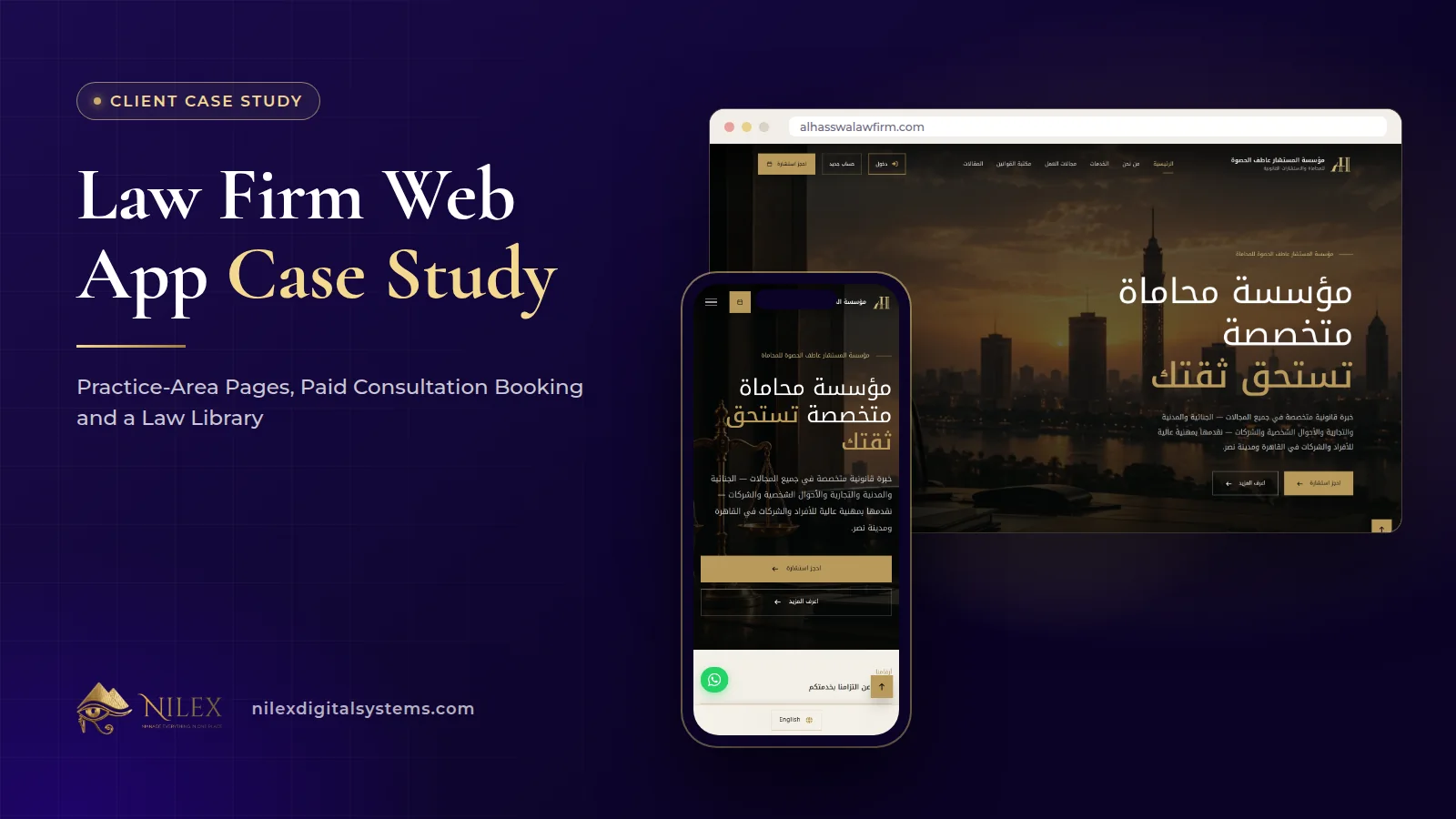
Al Hasswa Law Firm handles criminal, family and civil cases in Cairo. Like most law firms in Egypt, it depended on referrals: people searching Google for a lawyer in Nasr City, or for help with a specific legal problem, did not find it. Nilex built the firm a web app in four phases: a server-rendered website with a page for every practice area, online consultation booking with paid consultations, a law library with more than 550 laws and decrees plus an article editor, and a practice management system for clients, cases, hearings, deadlines and tasks.
The point of the project was to connect two things that are usually separate in a law firm: the place where new clients find you, and the place where the work is run. This case study explains how each phase was built, why the order mattered, and what other firms and professional practices can learn from it.
Key takeaways
- Each of the firm's ten practice areas has its own page, with its own title, description and link, so each can compete on Google on its own.
- Clients book a consultation online, choosing the type and a time within the firm's working hours, and pay online when the consultation is a paid one.
- The firm publishes its own articles and legal guides; more than 140 are live, alongside a searchable law library of more than 550 laws and decrees.
- A client portal with sign-up approval and employee portals sit on top of case files, hearings, deadlines, tasks, documents and powers of attorney.
- Consultation requests now arrive as records in a dashboard instead of phone calls to remember.
The firm and the problem it had
Before the project, the firm's situation was familiar to many practices in Egypt:
- New clients came from referrals only.
- The firm was not found on Google for lawyer searches.
- Consultation requests arrived by phone and message, and were easy to lose.
- The firm's legal knowledge was not published anywhere: no articles, no guides.
- Clients, cases, hearings and deadlines were followed in notebooks and spreadsheets.
The firm needed two things at once: a website that brings clients from search, and a system behind it that runs the practice. Building only the first would have produced more phone calls to lose; building only the second would have organised a practice with no new clients coming in.
Before and after at a glance
| Area | Before | After |
|---|---|---|
| New clients | Referrals only | Reachable from search through a page for every practice area |
| Consultations | Phone calls and messages, easy to lose | Online booking by type and time, with paid consultations |
| Legal content | Nothing published | 140+ articles and a searchable law library of 550+ laws and decrees |
| Clients | Followed in notebooks and spreadsheets | Client portal with sign-up approval |
| Case work | Cases, hearings and deadlines on paper | Cases, hearings, deadlines and tasks in one system |
Phase 1: a website built for search
The first phase was a fast, server-rendered website with technical SEO from day one. Server rendering means Google receives each page as complete content; our article on server-side rendering and SEO explains why that matters for ranking.
The central decision was one page per practice area. The firm's ten practice areas, criminal, civil, commercial, family, administrative, banking, corporate, cybercrime and the rest, each have their own page with their own title, description and link. Someone searching for a criminal lawyer and someone searching for help with a company matter are looking for different things, and a single "our services" page cannot answer both. Our guide to company website pages that rank explains the principle in general terms.
SEO covers every page of the site, practice areas, articles, packages and the pages in between, each with its own title, description, address and share image, plus structured data, an XML sitemap and Google Search Console connected at launch. The firm's service packages for individuals and for companies are managed from the same dashboard as the rest of the site.
Phase 2: consultation booking and payments
A visitor who has read a practice-area page should not have to find a phone number and hope someone answers. Clients can book a consultation from any page of the site:
- They choose the consultation type.
- They choose a time within the firm's working hours.
- They pay online when the consultation type requires it. Card payment runs through Paymob.
- The firm receives the booking in its dashboard and follows it from there.
This changed the nature of an enquiry. A consultation request is now a record with a type, a time and, where relevant, a payment, rather than a call someone has to remember to return. For the wider question of booking in service businesses, see online booking for service businesses, and for how card payments work in Egypt, our guide to payment gateways in Egypt.
Phase 3: the law library and the firm's own content
The third phase turned the firm's knowledge into something people can find. It has two parts:
- A law library with more than 550 laws and decrees, searchable on the site. It serves visitors looking for a legal text and gives the site depth on the subjects the firm practises.
- An article editor so the firm publishes its own legal content in Arabic and English, without waiting for a developer. More than 140 articles and legal guides have been published.
Articles answer people earlier in their search, while they are still trying to understand their problem, and the reader can book a consultation from any page of the site, articles included. We describe how articles and service pages work together in service pages and articles that bring enquiries, and how we run large publishing programmes in publishing hundreds of articles for client websites.
Phase 4: practice management behind the website
The last phase replaced the notebooks and spreadsheets. The firm's work now runs in one system:
- Case files (matters) for each client.
- Hearings and deadlines, the dates a law firm cannot afford to miss.
- Tasks assigned within the team.
- Documents and powers of attorney in the same system.
- Notifications and access rights for each team member, so each person sees and does what their role allows.
- A client portal with sign-up approval and employee portals, so clients and staff each have their own way in, and the firm decides who gets client access.
Sign-up approval is a small detail with a real purpose: a law firm's client area holds confidential matters, so an account is only active after the firm approves it. The general idea of separate access per role is explained in a portal for every role, and the value of linking a public site to the system behind it in a website connected to your management system.
Who uses which part
| User | Main part of the web app | What it replaced |
|---|---|---|
| Someone searching for legal help | Practice-area pages, articles, legal guides, law library | Nothing; the firm was not found |
| A new client | Consultation booking with online payment when needed | A phone call or message |
| An existing client | Client portal, after the firm approves the sign-up | There was no client portal |
| Lawyers and staff | Employee portal with cases, hearings, deadlines, tasks and documents, by access rights | Notebooks and spreadsheets |
| Firm management | Dashboard for bookings, articles, packages and the practice | Phone calls and messages to remember |
Results
- 10 practice areas with their own page.
- 140+ legal articles published.
- 550+ laws and decrees in the law library.
The firm is now reachable from search instead of referrals alone, and consultation requests arrive as records in a dashboard rather than as phone calls to remember. The web app launched in October 2025 and is built with Angular with server-side rendering, Tailwind CSS, Node.js, TypeScript, Express, PostgreSQL, Sequelize, Paymob and Nodemailer.
What other firms and professional practices can take from this
- Give each service its own page. Clients search for their problem, not for your firm's name.
- Make booking the next step on every page, and decide upfront which consultations are paid.
- Publish your knowledge. Articles and guides written by the firm are what bring people in early in their search.
- Connect the website to the work. A booking that lands in the same system as cases and deadlines does not get lost between two tools.
- Control client access. Approval before a client account is active suits any practice that holds confidential files.
How Nilex helps
The Al Hasswa project started as an SEO business website and grew into a full web app with booking, payments, content tools and practice management. If you run a law firm, a consultancy or another professional practice and want a site that brings clients from search and a system that runs the work behind it:
- Read the full Al Hasswa Law Firm case study and our other client projects.
- If you need case, deadline or task management built around your way of working, that is custom system work.
- Tell us about your practice on the contact page; we reply to every request.
Frequently asked questions
Which practice areas have their own pages?
Ten practice areas, including criminal, civil, commercial, family, administrative, banking, corporate and cybercrime, each with its own title, description and link.
How do paid consultations work?
The client chooses the consultation type and a time within the firm's working hours, pays online when that type requires payment, and the firm receives the booking in its dashboard.
Who writes the articles?
The firm publishes its own legal content in Arabic and English through an article editor in the dashboard. More than 140 articles and guides are live.
Can any visitor open a client account?
A visitor can sign up, but the client portal uses sign-up approval: the account is active only after the firm approves it.
What is in the law library?
More than 550 laws and decrees, searchable on the website.
 What Makes a Business System Professional: The Standards Nilex Builds Into Its Systems11 October 2026 · 11 min
 A Portal for Every Role: Why Nilex Systems Give Owners, Staff, Technicians and Customers Their Own Screens11 October 2026 · 9 min
 The Nilex Client Portal: Follow Your Project, Invoices, Payments and Requests in One Place11 October 2026 · 8 min