

Law Firm Website SEO in Egypt: How a Lawyer's Site Gets Found on Google
How a law firm website gets found on Google in Egypt: one page per practice area with local titles, a consultation booking page, an honest local page for your district and plain-Arabic articles, with Al Hasswa Law Firm's 51 service pages and about 250 articles as the example.
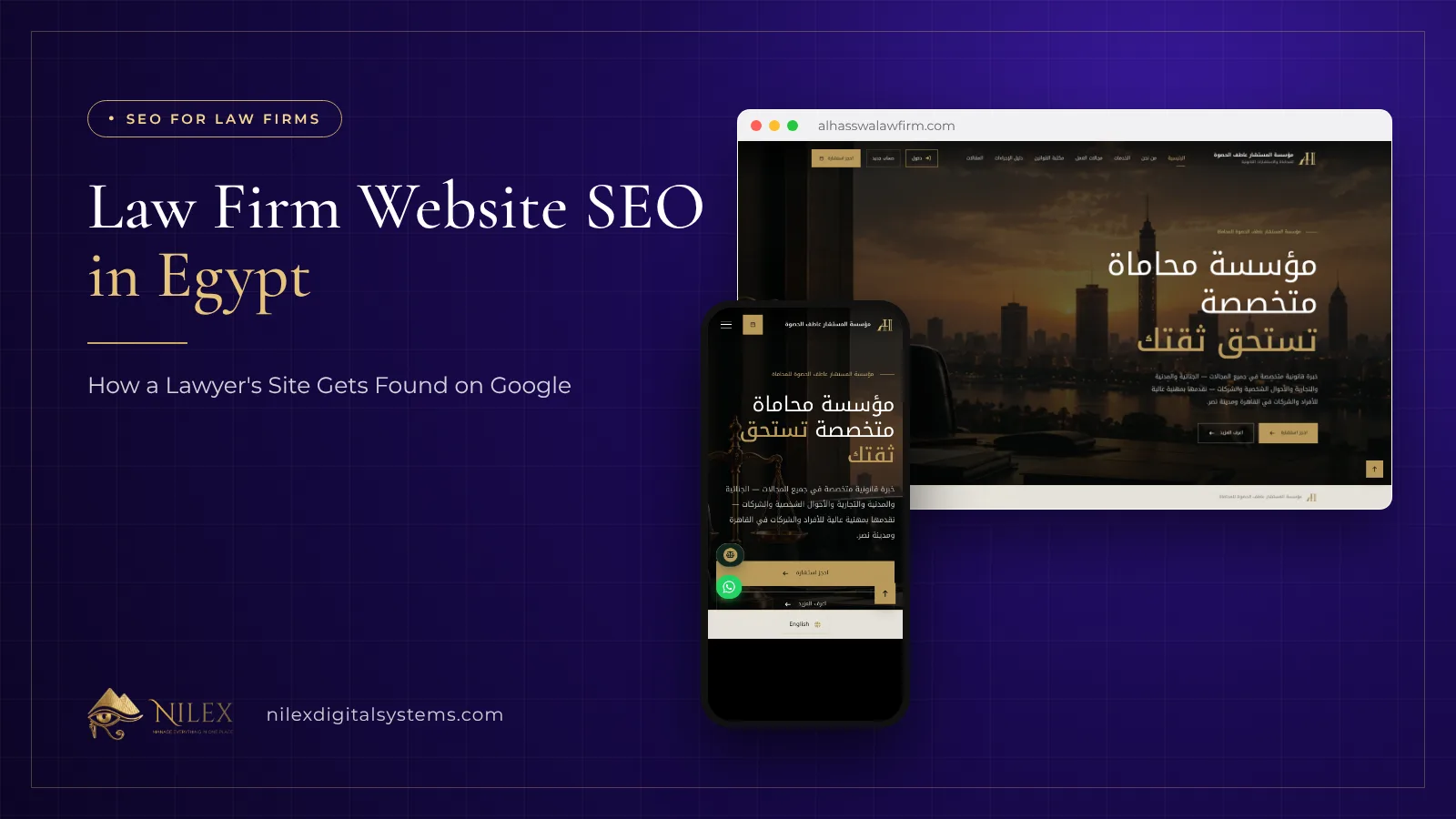
A law firm website gets found on Google in Egypt when every kind of search a client makes has a page built to answer it: a page for each practice area with a title that names the service and the city, a clear consultation booking page, a local page for the district the firm works from, and articles that answer real legal questions in plain Arabic. Design and logos matter far less than this structure, because Google matches a search to a page, not to a firm.
This guide is for lawyers and law firm owners in Egypt who are planning a new website, or who already have one that brings no enquiries. We use the public website of Al Hasswa Law Firm, a Nilex client in Nasr City, Cairo, as a working example: in November 2026 its sitemap lists about 988 pages, including 51 practice-area service pages and about 250 articles. The full story of how that web app was built, with booking, payments and case management, is in our law firm web app case study; here we look only at how the site's pages are organised so people can find it. This article is about the website, not about the law, and none of it is legal advice.
Key takeaways
- People search for a lawyer in four ways: by service and city, by district, by their own problem in their own words, and by action ("book a consultation"). Each needs a different page type.
- One page per practice area, each with its own title, description, heading and address, is the core of a law firm site. Al Hasswa has 51 of them, grouped into categories.
- Titles should say what the searcher typed: the service, the city and the specifics, for example «محامي تجاري في القاهرة | عقود ونزاعات وتحكيم تجاري».
- A dedicated booking page and a booking button on every page turn a reader into an enquiry.
- One honest local page for the district the firm actually works from beats dozens of copied city pages.
- Articles written by the firm in plain Egyptian Arabic catch people early, while they are still trying to understand their problem.
- The technical layer (complete server-rendered pages, sitemap, structured data, Search Console) makes sure all of this gets indexed; it does not replace the content.
How do people in Egypt search for a lawyer?
Few people search for a law firm by name before they have heard of it; they search for their situation. Each way of phrasing that search points to a different page:
| What the person searches | What they want | Page that should answer | Al Hasswa example |
|---|---|---|---|
| A service and a city, e.g. "commercial lawyer in Cairo" | A lawyer who handles their type of case, nearby | Practice-area (service) page | /services/commercial-cases |
| A district, e.g. «محامي في مدينة نصر» | A lawyer close to home or work | Local page for that district | /lawyer-nasr-city |
| Their problem in their own words | To understand what is happening and what they can do | Article or procedure guide | /articles/… (about 250 articles) |
| An action, e.g. «احجز استشارة قانونية» | To talk to a lawyer now | Consultation booking page | /book-consultation |
| The firm's name | To check the firm before calling | Home page and about page | / and /about |
A site with only a home page, a services list and a contact form answers the last row at best.
The home page: a hub, not the whole site
The home page has two jobs: rank for the firm's name and its broadest searches, and send every visitor to the page that matches their need. Al Hasswa's home page title combines the firm's name with three broad searches: lawyer in Cairo, lawyer in Egypt and lawyer in Nasr City. Its main menu leads straight to the sections that carry the search traffic: services, practice areas, the law library, the procedures guide and articles, with the booking button always visible.
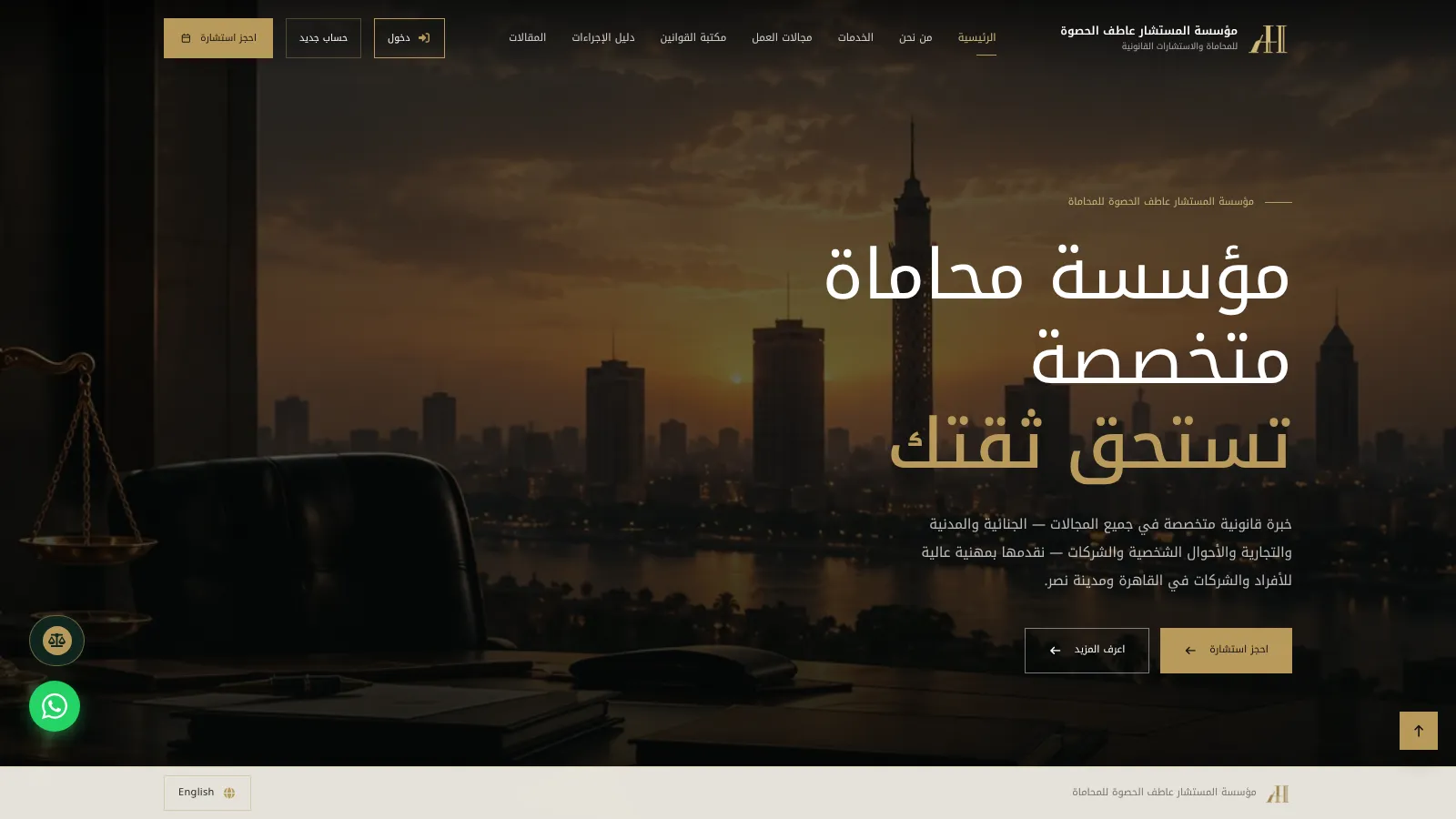
Further down, it links to practice areas, urgent situations and recent articles; those links also help Google discover the pages and see which matter most. Our guide to company website pages that rank explains the principle.
Why every practice area needs its own page
Someone with a dispute with a business partner and someone whose husband stopped paying maintenance are searching for completely different things. A single "our services" page with ten bullet points cannot rank for both. Each practice area, and each important service inside it, needs a page of its own with its own address, title, description and main heading.
On the Al Hasswa site, services are organised in two levels: category pages (for example family cases, criminal cases, corporate services) and 51 individual service pages under them, such as maintenance cases or custody and visitation under family cases. Each page can compete for its own searches, and each category page links down to its services.
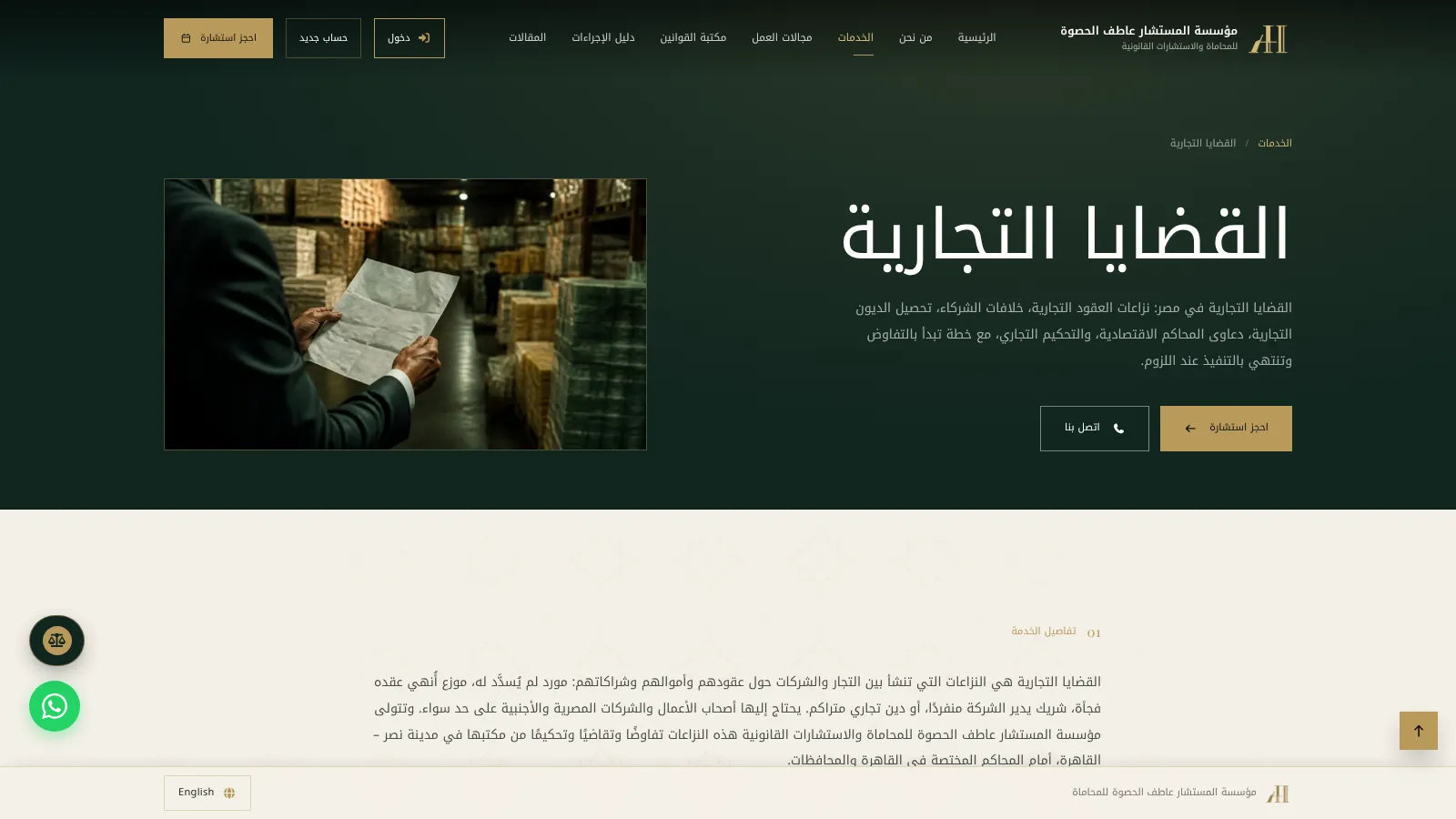
The commercial cases page shows a structure that works for most practice areas:
- A breadcrumb (Services / Commercial cases) and one main heading naming the service.
- A short opening listing the disputes covered, in clients' words.
- Sections that answer what a client wonders before calling: which disputes the firm takes, which court hears them, how the firm handles a dispute, the documents usually prepared, and common mistakes.
- Frequently asked questions about that practice area.
- Links to related articles and to the law library.
- A booking button and a call button at the top, and a booking prompt at the end.
For how service pages and articles share the work, see service pages and articles that bring enquiries.
Writing titles and descriptions with local intent
The page title is usually what Google shows as the blue link in results, and it is one of the clearest signals of what a page is about. Google's guidance on title links asks for titles that are descriptive, concise and unique to each page. For a law firm in Egypt, a pattern that works is: service + city + specifics + firm name.
Al Hasswa's titles follow it:
- Commercial cases: «محامي تجاري في القاهرة | عقود ونزاعات وتحكيم تجاري».
- Booking: «احجز استشارة قانونية | محامي في القاهرة ومدينة نصر».
- Local page: «محامي في مدينة نصر», followed by the firm's name.
Each title starts with the words a searcher types, names the city and the specifics, and ends with the brand; the meta description then expands on it. The most common mistake is the same title ("Law Office of …") on every page, which leaves Google guessing which page answers which search.
A consultation booking page and a booking button everywhere
Al Hasswa has a dedicated booking page, titled for people searching to book a legal consultation in Cairo and Nasr City, where the visitor chooses between four consultation types. The same booking link appears in the header of every page, inside service pages and at the end of articles; the home page alone links to it several times.
Two details make a booking page work:
- It is a real page with its own address and title, so it can be found directly by people who search to book, and linked from everywhere.
- The booking lands as a record the firm can follow up, not as a message someone has to remember. How that works in general is explained in online booking for service businesses.
One honest local page for your district
Many people in Cairo search by district. Al Hasswa's local page, «محامي في مدينة نصر», targets that search with its own content, not a copy of the home page:
- Why clients in Nasr City choose the firm.
- The practice areas served from there, each linking to its service page.
- How to reach the office: the address, working hours, phone and WhatsApp, and a map link.
- Frequently asked questions about the office and booking.
The site also describes the firm in structured data as a legal service with its address, area and opening hours, which helps Google connect the website to the place. Two cautions apply. First, a local page works alongside the firm's Google Business Profile, not instead of it; Google explains what affects local ranking in its Business Profile help, and our guide to local SEO and Google Maps in Egypt covers it. Second, do not create dozens of near-identical pages for areas you do not really serve: Google's spam policies treat such pages as doorway pages.
Articles that answer real questions in plain Arabic
Before most people look for a lawyer, they try to understand their problem. They type it the way they would say it. Al Hasswa publishes articles written in plain Egyptian Arabic for exactly those questions; one example title is «جوزك مش بيصرف عليكي؟ الطلاق لعدم الإنفاق…». About 250 articles are in the sitemap today.
Three things make these articles useful for search and for the firm:
- One question per article. The title is the question; the opening answers it; the sections follow the order in which a reader needs the information (what the law says, whether it applies, the steps, the documents, the court, the deadlines, common mistakes, a frequently asked questions block and the legal sources).
- The firm writes them. Legal topics affect people's lives and money, and Google's guidance on helpful, reliable content stresses expertise and trust. The people who practise the law are the right authors; Nilex does not write client content.
- Every article leads somewhere. Articles link to related articles, to the matching service page and to booking, so a reader who understands their problem can take the next step.
Alongside articles, Al Hasswa runs two larger content sections, a law library and a step-by-step procedures guide. We cover how those are structured and kept accurate in a separate article on law libraries and procedure guides as SEO content.
What the website build must take care of
Content is the firm's job. Making sure Google can read, understand and index every page is the job of the website itself. On the Al Hasswa site that includes:
- Complete pages from the server: title, description, headings and text are already in the HTML Google receives.
- A sitemap with every real page, about 988 addresses, declared in robots.txt with the "Sitemap:" directive.
- Private areas kept out of search: the admin area, client portal and payment result page are blocked in robots.txt.
- A canonical address on each page, so Google knows which address is the preferred version of that page.
- Structured data describing the firm as a legal service, with breadcrumbs on service pages and FAQ data on the local page.
- Search Console connected, to submit the sitemap and see which pages are indexed; our Search Console guide for business owners explains the reports.
Common mistakes on law firm websites
- All practice areas listed on one page, so no single service can rank.
- No booking page, only a phone number in the footer.
- Copied city pages for every district in Cairo with the same text.
- Articles in heavy legal language nobody types into Google, or that end without a link to the service or booking.
- Client portals, admin pages and test pages left open to crawling and appearing in results.
How Nilex helps
Nilex builds SEO-ready business websites for law firms and other professional practices: the page structure for practice areas, booking and local pages, an article editor the firm uses on its own, and the technical SEO (speed, server-rendered pages, structured data, sitemaps, Search Console). We do not write legal content, build links or promise rankings; the firm publishes its own articles, and we build the site so they get indexed and lead to bookings. When the firm also needs cases, hearings, deadlines and client portals behind the website, that is a custom system, as it was for Al Hasswa; read the Al Hasswa Law Firm client page and then tell us about your firm.
Frequently asked questions
How many pages does a law firm website need to rank?
There is no magic number. You need a page for each practice area you want clients for, a booking page, an about page, a local page for your district, and articles answering common questions. A smaller firm can start with its main practice areas and add pages as it publishes.
Who should write the content of a law firm website?
The firm. Legal content must be accurate and reflect the firm's experience, so the lawyers should write or approve every article and service page. The website company builds the structure, the editor and the technical SEO so that content gets indexed.
Should I make a page for every area of Cairo?
No. Make a local page for the place your office actually serves, with real content about it: address, hours, how to reach you and the services offered there. Near-identical pages for many areas can be treated by Google as doorway pages.
Should a law firm website in Egypt be in Arabic or English?
Most people in Egypt search for legal help in Arabic, often in Egyptian dialect, so Arabic pages should come first. An English version helps if you serve foreign clients or companies; each language version should have its own address and be linked to the other.
How long until a new law firm website appears on Google?
Google gives no timeline. After you submit the sitemap in Search Console you can see when pages are indexed; ranking then depends on content, competition and how well each page answers its search.
 Technical SEO From Development to Launch: Building a Site Google Can Actually Find11 November 2026 · 6 min
 Get Every Page Indexed: A Clean Google Search Console With No Coverage Errors11 November 2026 · 6 min
 Sitemaps, robots.txt and Structured Data: The Three Things That Get You Crawled, Indexed and Shown11 November 2026 · 5 min