

E-commerce SEO Checklist for Egypt 2026: What Two Live Stores With 1,400+ Products Teach
An e-commerce SEO checklist for Egyptian stores in 2026, drawn from two live stores with more than 1,400 products: product, category, brand and author pages, Arabic and English, speed, structured data and Search Console, and what the owner does versus what the build does.
E-commerce SEO in Egypt in 2026 comes down to two jobs done well together. The build must give every product, category, brand and author its own fast, server-rendered page with a unique title, description, clean address, structured data and correct Arabic and English versions, and it must keep filters and duplicates out of the index. The store owner must fill those pages with accurate prices, real specifications, good photos and answers to the questions buyers ask. Neither half works without the other, and no one can promise a ranking.
This checklist is for Egyptian store owners planning a new store or auditing an existing one. It is drawn from two live stores Nilex built, which together carry more than 1,400 products: Bashayer El Khair, a home-appliance store with 635 products in Arabic and English, and Dar El Ahram, a legal publisher with about 790 books. The details below are from their public pages and sitemaps in November 2026; we do not quote traffic or rankings.
Key takeaways
- Split the work clearly: the build handles structure, speed, tags, structured data, sitemaps and Search Console; the owner handles product data, photos, descriptions, articles and keeping prices true.
- Product pages should carry the exact name buyers search for. For appliances that means the model code in the title, the address and the structured data.
- Category, brand and author pages catch broader searches and need their own titles and, ideally, a short introduction written by the owner.
- Arabic and English need separate addresses linked with hreflang, and Arabic names written the way Egyptians search, not translated word for word.
- Structured data must match what the page shows. A wrong price in the markup is worse than no markup.
- Connect Google Search Console at launch, submit the sitemap and read the Page indexing and Performance reports every month.
Who does what: the build or the store owner?
A well-built store with empty descriptions will struggle, and so will good writing that Google cannot read. This is how the work divides on the stores we build.
| Area | What the build does | What the store owner does |
|---|---|---|
| Product pages | Own address, title, description, share image and structured data, generated from the product's data | Correct name and model code, specs, several real photos, a useful description, current price and stock |
| Categories and brands | One page per category, brand or author, with breadcrumbs and links to products | Choose categories that match how customers shop; write a short introduction for the important ones |
| Arabic and English | Separate addresses per language, hreflang, Arabic addresses for Arabic pages | Product names and descriptions in natural Arabic and English |
| Speed and rendering | Server-rendered pages, compressed images, mobile layouts | Upload sharp images; avoid huge files and embedded clutter |
| Index hygiene | Canonicals, robots.txt, noindex for private pages, a sitemap with only real pages | Tell the team before adding new filters or changing addresses |
| Content | An articles section with its own pages, titles and links to products | Write and publish the articles, buying guides and policy pages |
| Measurement | Search Console connected and sitemap submitted at launch | Read the reports monthly and act on what they show |
Product pages: the exact thing buyers type
Product pages answer the most specific searches, so they carry most of the catalogue's weight. On Bashayer El Khair the 635 products each have a page in Arabic and in English, so the sitemap lists 1,270 product addresses. Each one follows the same rules:
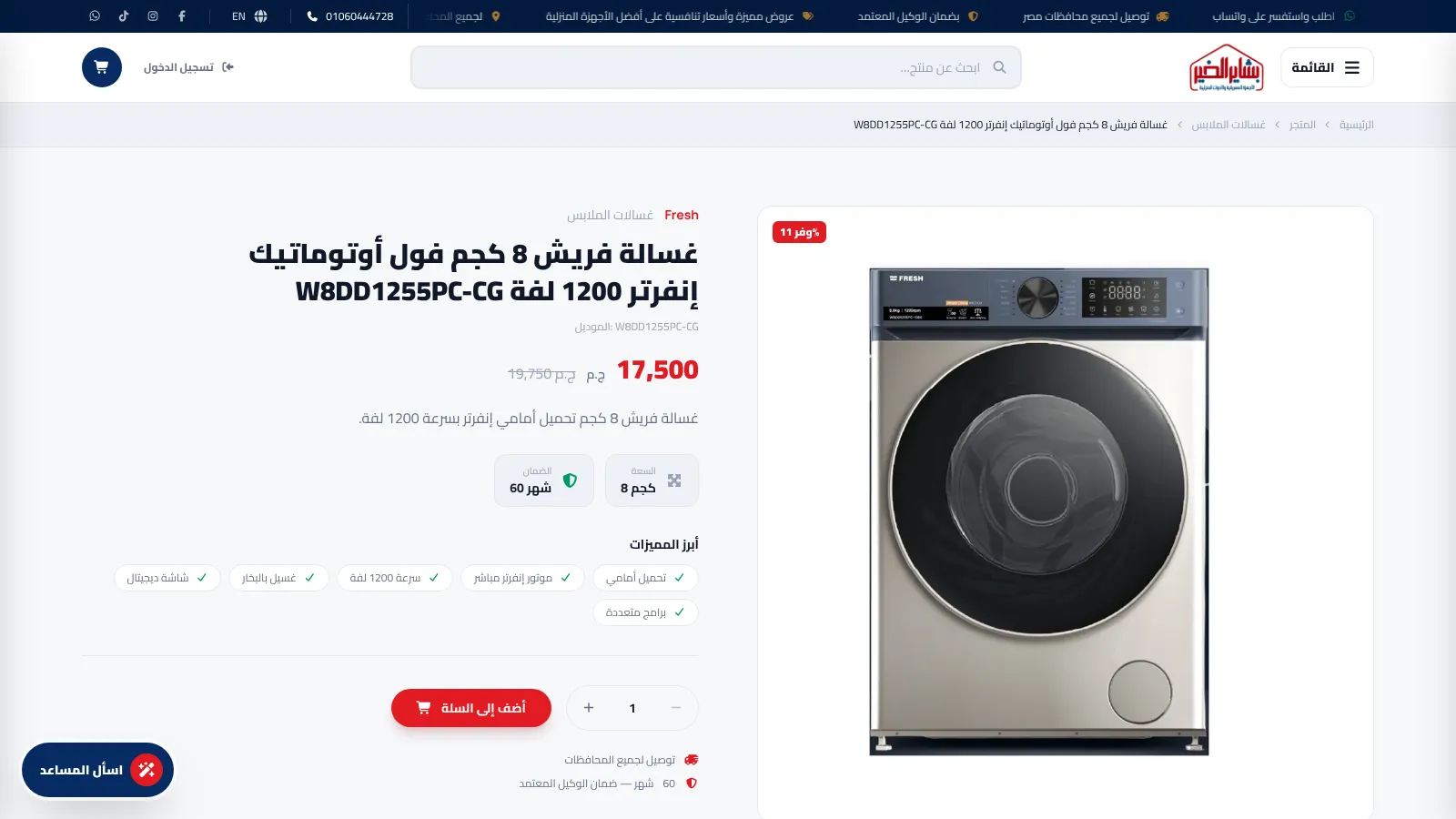
- The model code is in the title, the address and the markup. The English page for a Fresh 8 kg front-load washer is titled "Fresh 8kg Front Load Inverter Washer W8DD1255PC-CG", its address ends with the same words and code, and its structured data lists the code as the part number. Appliance buyers often search for the code they saw in a showroom.
- Breadcrumbs show where the product sits (home, shop, washing machines, product), on the page and in structured data.
- The deciding facts are on the page: brand, category, capacity, warranty period, key features, price, any old price and discount, delivery to all governorates, and the authorised-agent warranty.
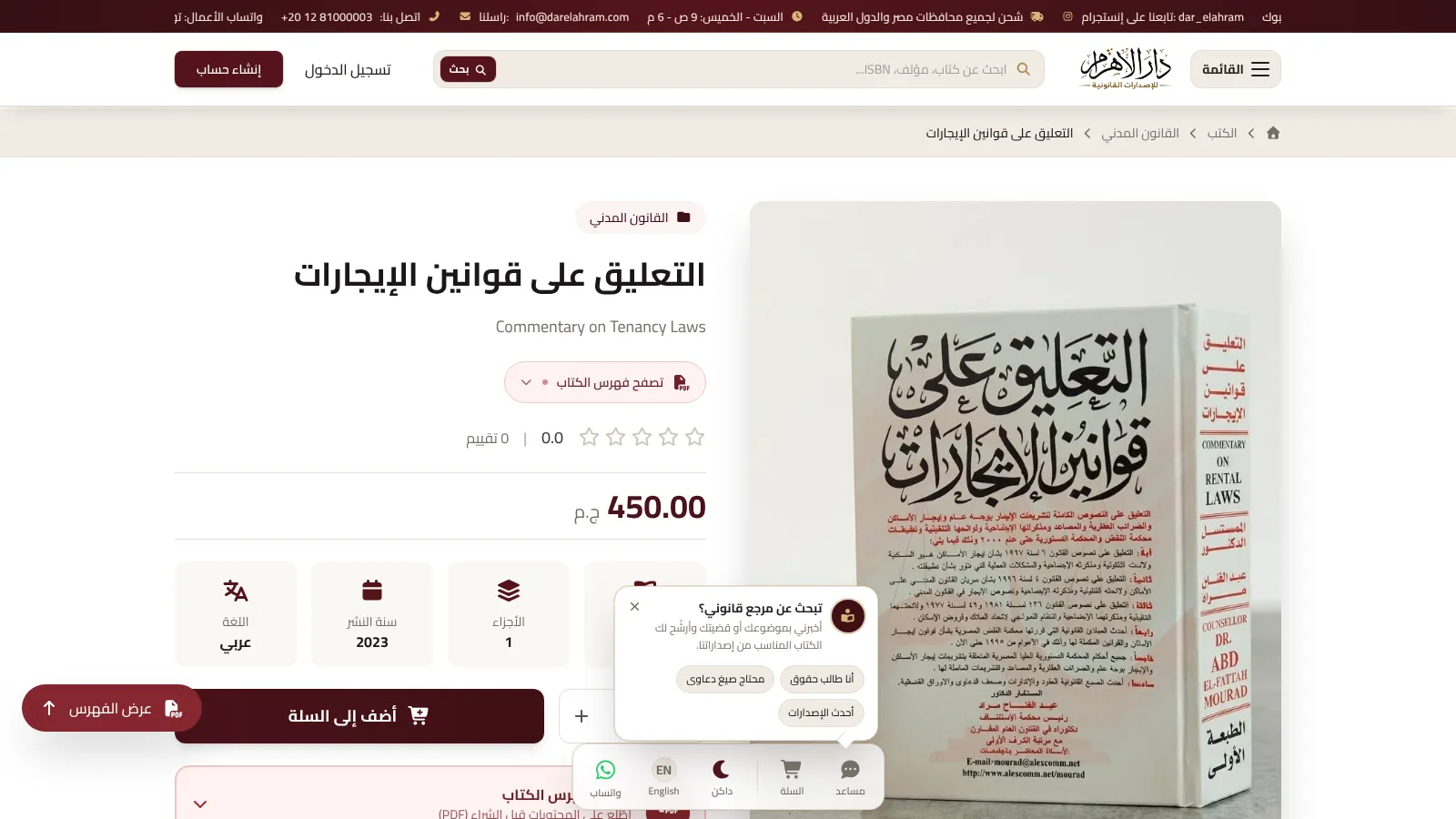
On Dar El Ahram the "product" is a book, and the page is built around what a lawyer checks before buying a reference: title, author, legal branch, publication year, number of volumes, language, price, reader reviews and a button to browse the book's table of contents as a PDF. The meta description is assembled from the data, naming the book, its author, its category and the publisher, so none of the roughly 790 pages goes live with a blank or duplicated description.
The owner's part is the text and the facts. Generated titles and descriptions are a safe minimum; real specifications, a description that answers buyers' questions and honest photos give a page far more to offer.
Category, brand and author pages: the broader searches
Many shoppers do not start from a model. They type "غسالات", "تكييفات سامسونج" or "كتب القانون المدني". Those searches land on grouping pages, which is why both stores give each grouping its own page with its own title:
- Bashayer El Khair has 33 category pages in each language, with titles such as «مكاوي — تسوق أونلاين | بشاير الخير», and its sitemap lists 48 brand pages in each language, each with a title like "Samsung Appliances — Prices & Offers".
- Dar El Ahram has 20 legal-branch pages and more than 70 author pages. A branch page opens with a short description of the books it covers, and author pages are titled «كتب ومؤلفات …» because readers search for a jurist's books.
The short introduction at the top of a category is owner content and worth writing for the categories that matter most: what the category includes, how to choose and which brands you carry. How to plan the tree itself is in our guide to categories, brands and filters, and the book-catalogue version is in SEO for a large book catalogue.
Arabic and English: two languages, two sets of searches
An Egyptian store usually sells in Arabic first, while some customers, and many product names, use English. On Bashayer El Khair every page exists at an Arabic address under /ar and an English one under /en, Arabic pages have Arabic addresses, and each page declares its other-language version with hreflang, with Arabic set as the default. Google explains the method in telling Google about localized versions of your page.
Translation is not the hard part; matching searches is. The English category "Electric Irons" is «مكاوي» in Arabic, not a literal translation, because that is what people type. Model codes stay the same in both languages. Dar El Ahram is Arabic-first and shows an English subtitle on book pages, such as "Commentary on Tenancy Laws". Our guide to running an Arabic and English store goes deeper.
Speed and rendering: what Google receives
When Google requests a page on either store, it receives the finished HTML with the title, description, main heading, product details and structured data already in it, because pages are rendered on the server. Content that appears only after scripts run in the browser is harder for search engines to read reliably.
Speed is measured with Core Web Vitals, which Google describes in its Core Web Vitals documentation. Test the mobile version first. The build is responsible for compressed images, light pages and a fast server; the owner's part is not uploading oversized photos or filling descriptions with heavy embeds.
Structured data: what each page type declares
Structured data is a machine-readable description of the page. Google's product structured data guide explains how product markup can make pages eligible for richer results such as price and availability. These are the types the two stores declare, from their public pages:
| Page | Structured data on the page | What it tells search engines |
|---|---|---|
| Appliance product | Product with Offer, Brand and warranty; BreadcrumbList | Name, model code, price in EGP, in stock, new, warranty length, brand, category path |
| Book | Book with Offer and the author as Person; BreadcrumbList | Title, author, price, category path |
| Author page | Person with a list of their Books | Who the jurist is and which books are theirs |
| Category page | BreadcrumbList; CollectionPage on Dar El Ahram | That the page is a collection and where it sits |
| Whole site | WebSite with a search action; Organization or Store | The store's name, contact details and how to search it |
The rule that matters most to owners: markup must match the visible page. Generating both from the same product record, as these stores do, keeps them in step; the owner's job is to keep that record true.
Index hygiene: filters, canonicals and sitemaps
A store with filters, sorting and on-site search can create thousands of duplicate addresses. Both stores give every page a canonical tag, keep private pages such as cart and checkout out of the index, point sorted and filtered versions back to the clean category, and list only real pages in a sitemap declared in robots.txt. Bashayer's sitemap lists about 1,660 URLs; Dar El Ahram's lists 988. The full method, with what each store does differently, is in filter URLs, canonicals and sitemaps for online stores.
Content the owner publishes
Product pages answer "which model?". Articles answer the questions before that: "which air conditioner for my room?", "front-load or top-load?", "which book covers this point of law?". Bashayer El Khair publishes Arabic articles from its own dashboard, and its sitemap lists 100 of them. Dar El Ahram publishes legal articles, a questions section and event pages. In both cases the store owner writes and publishes; the build gives each article its own page, title and links to related products.
Policy pages count too: Bashayer has shipping, returns, warranty, privacy and terms pages in both languages. How to plan this writing is in store content, brand story and articles.
Search Console: the only scoreboard you need at first
Both stores had Search Console connected at launch. Four monthly checks are enough:
- Sitemaps: read without errors, with a URL count close to your real number of pages.
- Page indexing: most sitemap pages indexed. Filter URLs grouped as "Alternate page with proper canonical tag" are normal.
- Performance: which searches bring visitors to which products and categories, which tells you where better descriptions would pay off.
- Shopping and enhancement reports: any structured data errors on product pages.
Our Search Console guide for business owners explains each report.
The checklist
| Item | Who | Done when |
|---|---|---|
| Every product has name, model code or ISBN, brand, category, specs, photos, price and stock | Owner | No product page is missing a field |
| Unique title, description, address and share image on every page | Build | Generated from data; important pages refined by hand |
| Category, brand and author pages with breadcrumbs | Build, with owner introductions | Each grouping has one clean page |
| Arabic and English addresses with hreflang | Build | Each page links its other-language version |
| Server-rendered, fast mobile pages | Build | Full content in the first response; mobile tested |
| Product, Book, Breadcrumb and Organization structured data | Build | Markup matches the visible page |
| Canonicals, robots.txt and a clean sitemap | Build | Only real pages in the sitemap |
| Buying guides, articles and policy pages | Owner | Published and linked to products |
| Search Console connected and checked monthly | Build at launch, owner after | Reports reviewed and issues raised |
Sources
- Google Search Central: E-commerce sites in Google Search
- Google Search Central: Product structured data
- Google Search Central: Localized versions of your page
- Google Search Central: Core Web Vitals
How Nilex helps
Nilex builds online stores for Egypt, Saudi Arabia and Kuwait with the build side of this checklist included: pages for every product, category, brand or author, titles and descriptions generated from your data, Arabic and English with hreflang, server rendering, structured data, a sitemap that lists only real pages and Search Console connected at launch. Our SEO is technical: we do not write your product descriptions or articles, build links or guarantee rankings. You publish the content, and the store is built so that content gets indexed.
See what is included on our e-commerce store service page, read the Bashayer El Khair case study and the Dar El Ahram project page, and tell us about your catalogue: how many products, which brands and which languages.
Frequently asked questions
How long until my store appears on Google?
No one can promise a date. Pages can appear once Google has crawled and indexed them; connecting Search Console at launch and submitting the sitemap lets you watch that happen and fix problems early.
Should the model code be in the product title?
For appliances and electronics, yes. Buyers search for codes, and the code also lets the shop, the supplier and the customer confirm the same item. Put it in the title, the address and the structured data.
Can I use the manufacturer's descriptions?
You can start with them, but many stores use the same text. Add the facts your customers ask about, your own photos for best sellers, and your warranty and delivery details.
Do I need both Arabic and English?
Not always. Many Egyptian stores sell mainly in Arabic. If some customers search in English, or product names are English, a second language with its own addresses and hreflang lets each page answer searches in that language.
Will Nilex write my product descriptions and articles?
No. Nilex handles the technical side: structure, speed, tags, structured data, sitemaps and Search Console. The store owner writes the descriptions and publishes the articles, and the store is built so they are found and indexed.
 Payment Gateways in Saudi Arabia for Online Stores: mada, Apple Pay, STC Pay, Tabby and Tamara5 November 2026 · 11 min
 Documenting an Online Store in Saudi Arabia: Commercial Registration, Freelance Document and E-Commerce Law5 November 2026 · 9 min
 Shipping for Online Stores in Saudi Arabia: Couriers, National Address, Cash on Delivery and Delivery Fees5 November 2026 · 9 min