
Store Content That Sells: Brand Story, Origin Pages, Buying Guides and Articles
Which content pages an online store needs beyond its products, and why they bring Google traffic and trust: brand story and origin pages at Anas Saleh Coffee, an articles section at Bashayer El Khair, and legal articles, events and reader questions at Dar El Ahram.
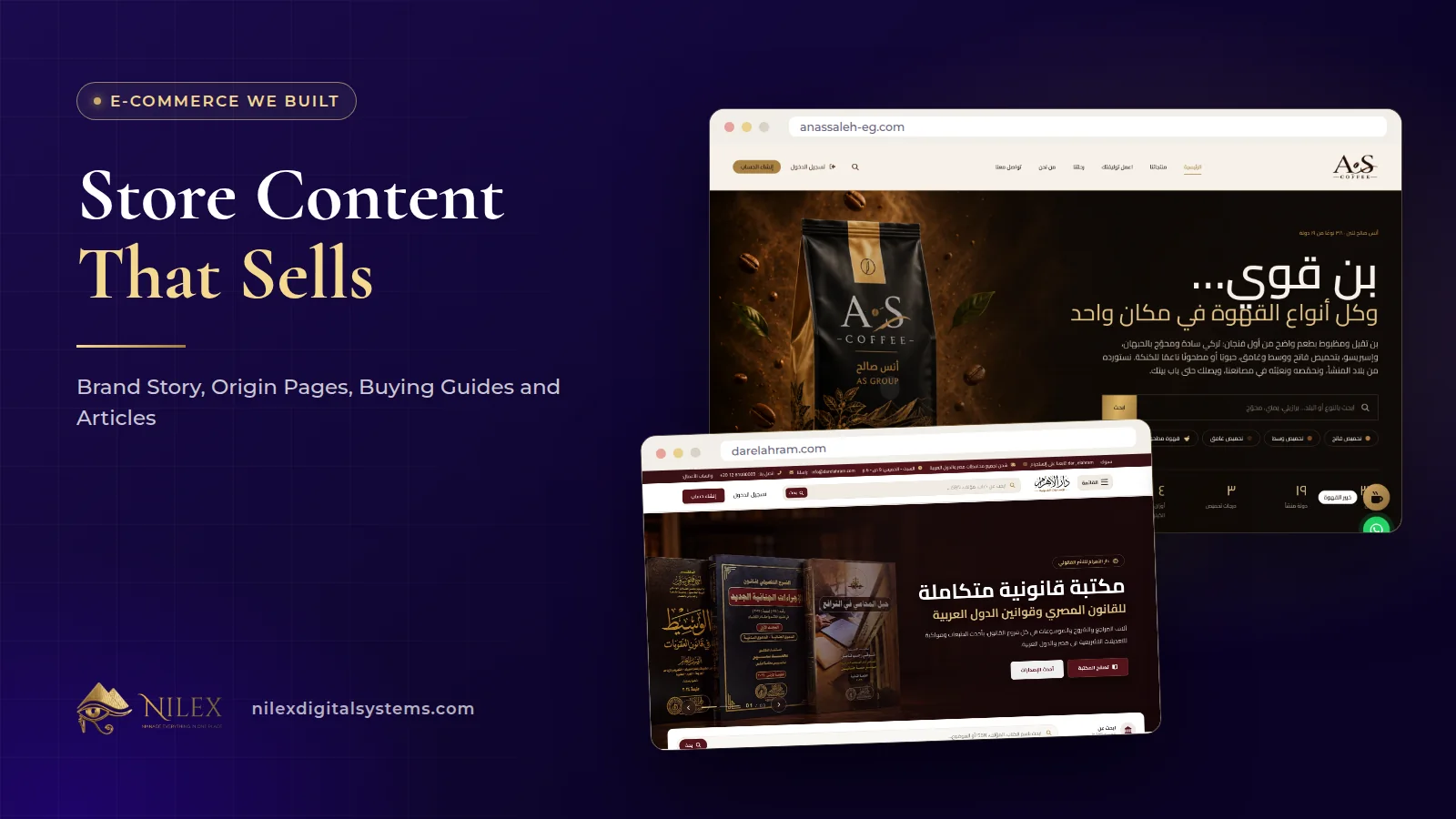
An online store needs content beyond its product pages: a page that tells the brand's story, pages that explain where the product comes from, an FAQ and clear policies, and articles that answer the questions customers ask before they buy. Product pages answer "how much is it and can I order it"; content pages answer "why this shop, and which one is right for me".
Those questions are often searched on Google before the product name, and they are the same questions customers otherwise send on WhatsApp one by one. In the stores we built for Anas Saleh Coffee, Bashayer El Khair and Dar El Ahram, content has its own place in the structure and in the dashboard. This article shows what each store has, what each type of page does, and how to plan content for your own store.
Key takeaways
- Content pages catch searches made before a customer knows which product they want, and they build trust before the first order.
- Anas Saleh Coffee gives its story and the origin of its beans their own pages: About Us and Our Journey, next to a page for every roast.
- Bashayer El Khair has an articles section the team writes and publishes from the dashboard, with images and embedded videos.
- Dar El Ahram publishes legal articles, book-fair events and reader questions, and readers can submit their own articles for review.
- FAQ and policy pages are content too: they answer the questions that otherwise arrive as messages.
Why does a store need content beyond product pages?
A product page is written for someone who has already chosen. Many shoppers have not. They search for the problem or the question: which air conditioner for a sunny bedroom, how a roast tastes, which book covers a point of law. If the store has no page that answers that question, the search goes to someone else, and the shopper meets your products only later, if at all.
Content also does a quieter job: it shows there is a real business behind the store. A roastery that explains where its beans come from, or an appliance shop that publishes a clear warranty policy, gives a first-time buyer a reason to order from a site they have never used before.
The brand story and origin pages
Before the store, Anas Saleh Coffee had no place of its own to show where its beans come from or how each roast tastes. So when we organised the catalogue, we gave the roastery's story and the origin of its beans their own pages. The storefront has an About Us page and an Our Journey page, both in Arabic and English, and the story of where the beans come from and how they are roasted has its own section.
A story page works best when it is specific. Instead of general claims about quality, it says what the business actually does: where the beans come from, how they are roasted, how the shop started. Those details are what a customer remembers and what makes a page worth linking to. The full store is described in the Anas Saleh Coffee store case study.
Product pages are content too
The first content any store publishes is its product descriptions. At Anas Saleh Coffee, every roast has its own page with its own photos, description and price. At Bashayer El Khair, every product carries its model code, price and availability. These pages are optimised one by one, with their own title, description, address and share image, so a single roast or a single model can be found in search.
A good description is written for the buyer, not copied from a supplier: what it tastes like, who it suits, what size of home it fits. The detailed rules are in our guide to product pages and structured data; the point here is that a product page is the start of a store's content, not the whole of it.
Articles and buying guides
Bashayer El Khair has an articles section in Arabic and English: a list of articles and a page for each one. The team writes them in the dashboard with a rich text editor, adds images and can embed a video in the article body. Staff can unpublish an article, which can be reversed, while permanent deletion is kept for the admin.
An articles section is where buying guides belong. For an appliance shop the useful questions are practical: how to compare two fridges, what to check in a warranty, what a bride needs for a first home. Each guide answers one question well and links to the category or products that fit, so a reader who arrives from Google has a next step.
A simple structure for a buying guide
- Answer the question in the first two paragraphs.
- Explain the two or three things that decide the choice.
- Show the matching category or products in the store.
- Link to the policy that matters: delivery, returns or warranty.
Some questions are better answered in conversation. At Bashayer El Khair, sizing an air conditioner for a specific room is handled by the AI shopping assistant, described in the AI appliance advisor case study. Articles and the assistant work together: the article is found on Google, the assistant answers the follow-up.
When content is the business: Dar El Ahram
For a legal publisher, content is close to the product itself. Dar El Ahram's site publishes legal articles in a blog, where each article page also shows related and recent posts. Readers with an account can write articles from their profile and submit them; the admin approves or rejects each one before it appears. The site also has pages for book-fair events and a questions section organised by type, and visitors can subscribe to the newsletter from the home page.
On top of that sit the catalogue pages that work as content in their own right: a page for each of 340+ authors and for each of the 19 legal branches, with SEO on every book, author, category and article page. How that catalogue is structured for Google is covered in SEO for a large catalogue, and the growth features around the store are in more than a store.
FAQ and policy pages: content that saves messages
Some of the most useful content on a store is not a blog post but the FAQ and the policies. Anas Saleh Coffee has FAQ, shipping, returns, privacy and terms pages. Bashayer El Khair has FAQ, shipping, warranty, privacy and terms pages, and a contact page with the shop's location on a map. Dar El Ahram has a purchase policy, a disclaimer, terms, privacy, an intellectual property page, author publishing terms and a publishing policy.
Each of these answers a question before it becomes a message: how much is delivery, can I return it, what does the warranty cover, who owns the content. Clear policy pages also make the checkout feel safer, because the customer knows what happens if something goes wrong.
The content map of three stores
| Content type | Where it exists | What it does for Google | What it does for the customer |
|---|---|---|---|
| Brand story (About, Our Journey) | Anas Saleh Coffee; About Us also at Bashayer El Khair | Ranks for the brand name and its story | Shows who is behind the store |
| Origin of the product | Anas Saleh Coffee | Catches searches about origins and taste | Explains why one roast differs from another |
| Articles and buying guides | Bashayer El Khair, Dar El Ahram | Catches questions asked before choosing a product | Helps choose, then links to the product |
| Reader articles, events, questions | Dar El Ahram | Adds fresh, specialised pages over time | Gives readers a reason to come back |
| FAQ and policies | Policies in all three stores; an FAQ page at Anas Saleh Coffee and Bashayer El Khair | Answers practical searches about delivery and returns | Removes doubt at checkout |
How to plan content for your own store
- Start from your messages. The questions your team answers on WhatsApp every week are your first articles and FAQ entries.
- One page, one question. A page that answers one question clearly is easier to find and easier to read than a long page about everything.
- Link content to products. Every guide should lead to the category or products it talks about.
- Write in both languages if your store has both. Our stores are Arabic-first with English versions; see bilingual online stores.
- Keep it current. Update a guide when prices, products or policies change, and unpublish what is no longer true.
The same thinking applies to service businesses; our guide to service pages and articles that bring enquiries covers intent, structure and calls to action in more depth.
How Nilex helps
We build the content structure into the store from the start: story and policy pages, an articles section managed from the dashboard where you need one, and SEO on every page. You can:
- See our e-commerce store service and its plans.
- See our SEO business website service if content and search are your main goal.
- Read the case studies for Anas Saleh Coffee, Bashayer El Khair and Dar El Ahram.
- Talk to us through the contact page.
Frequently asked questions
Does every online store need a blog?
Not every store, but every store needs some content: a story page, an FAQ and clear policies. An articles section is worth it when your customers have real questions before they buy, such as sizing, comparisons or how to use a product.
Who writes the articles?
Usually your team, because they know the products and the questions customers ask. In the Bashayer El Khair and Dar El Ahram stores, articles are written and published from the dashboard without a developer.
Can customers publish articles on the store?
On Dar El Ahram, readers with an account can write and submit articles from their profile, and the admin approves or rejects each one before it is published. Whether that fits your store depends on your audience.
What should a brand story page include?
Specific facts about your business: how it started, where the product comes from, how it is made or chosen. Specific details build more trust than general promises.
How soon does content bring traffic?
It depends on the competition for each question and on how well the page answers it, so nobody can promise a date. What helps is publishing pages that answer real questions and keeping them accurate.
 Starting Online Orders for Your Supermarket: A Practical Launch Plan, Decision by Decision11 October 2026 · 9 min
 Online Legal Bookshop Case Study: How Dar El Ahram Sells 800+ Legal Titles Online11 October 2026 · 11 min
 Selling Online From Egypt to Other Countries: Shipping Prices per Country, Local Zones and Card Payment11 October 2026 · 8 min