
Coffee Roastery Online Store Case Study: How Anas Saleh Coffee Sells by Brewing Method Across Egypt
How we built the Anas Saleh Coffee online store: a catalogue organised by brewing method, a page for every roast, story and origin pages, verified customer accounts, cash on delivery with a fixed fee for each of the 27 governorates, and a dashboard with daily financials.
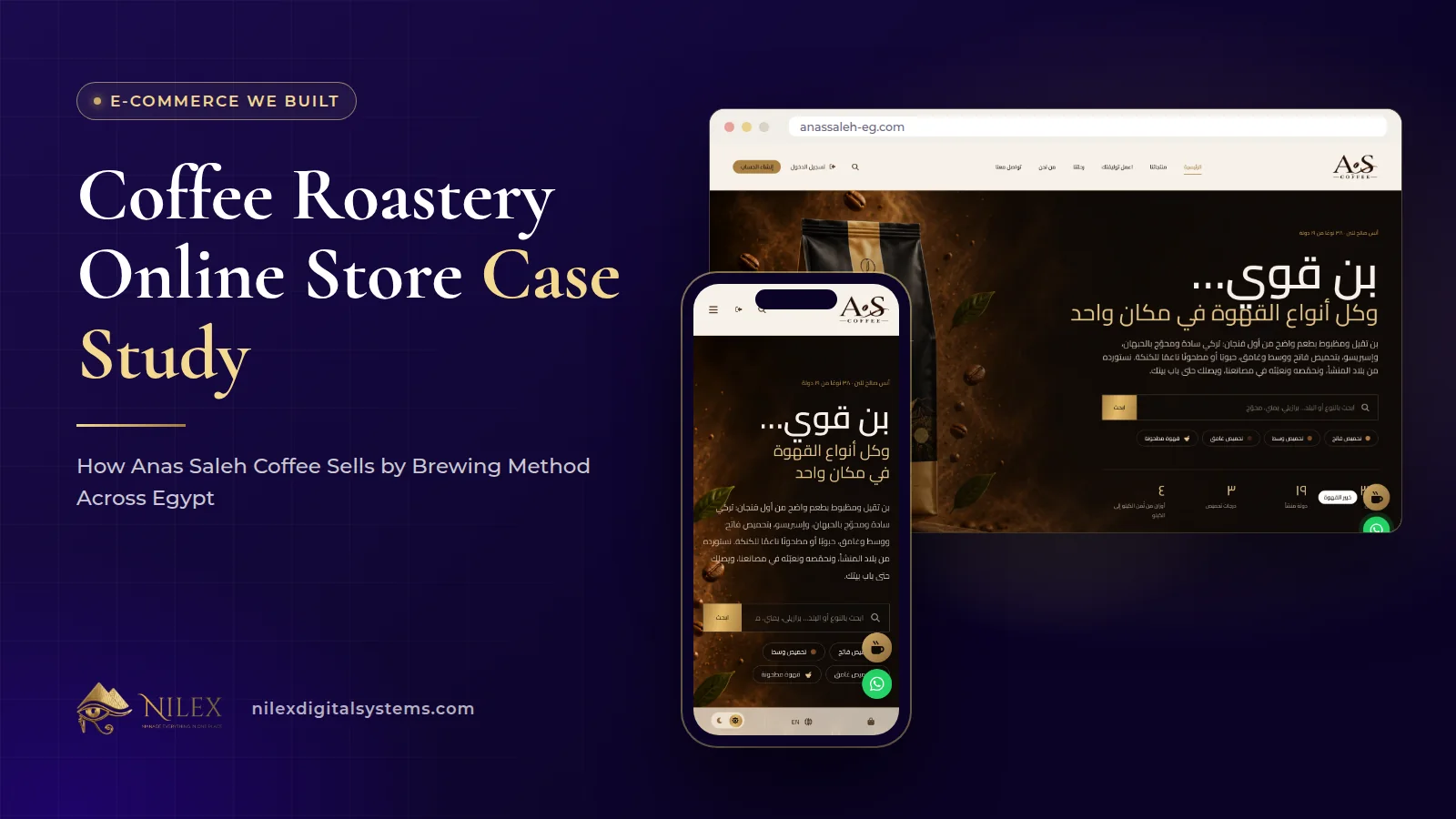
Anas Saleh Coffee is a Cairo roastery that used to sell only through its shop and through resellers. We built it an online store on its own domain, in Arabic and English, where customers shop by how they brew their coffee, open a page for every roast, create a verified account or check out as guests, and pay cash on delivery with a fixed delivery fee for each of Egypt's 27 governorates shown at checkout. The team runs products, orders and daily financials from one dashboard.
This case study is about the store itself: the catalogue, the checkout, the accounts and the back office. The AI coffee expert that designs custom blends was added later and has its own write-up, the AI coffee blend assistant case study. If you run a roastery and are wondering what a proper store needs beyond a product list, this is what we built and why.
Key takeaways
- The catalogue follows how people buy coffee: by brewing method, from whole beans to capsules, and by roast.
- Every roast has its own page with photos, a description and a price, and every product and category page carries its own SEO title, description and share image.
- The roastery's story and the origin of its beans live on their own pages, not squeezed into product descriptions.
- Delivery is no longer negotiated by phone: each of the 27 governorates has a fixed fee that the checkout adds automatically.
- The store launched in August 2026 with 98 products online, and the team follows orders, stock and daily figures from one dashboard.
Where the roastery started
Before the project, a customer who wanted a specific roast had to visit the shop or send a message. Orders from other cities were arranged one by one on the phone, and the delivery price was worked out again for every order. The roastery also had no place of its own to show where its beans come from or how each roast tastes, so that knowledge stayed with the people behind the counter.
None of this is unusual for a roastery in Egypt. The cost is hidden: every phone order takes a person's time, every delivery quote is a small negotiation, and customers who cannot see the range simply buy what they already know. The goal was a store that answers those questions on its own.
A catalogue organised by brewing method
Most coffee buyers do not start with an origin or a roast level. They start with their equipment: a Turkish pot, an espresso machine, a filter, or a capsule machine. So we organised the catalogue by brewing method and by roast. A customer who says "I use a kanaka" lands on coffee that suits a kanaka, instead of scrolling through everything.
Each category has its own image and its own page, and each roast has a product page with its photos, description and price. Search is available from every page, so a returning customer who knows the name can go straight to it. Our guide to structuring categories, brands and filters explains the reasoning behind this kind of structure in more detail; here the point is that the structure follows how coffee is actually bought, not a template.
Story, origin and policy pages
Specialty coffee is bought partly on trust: where the beans come from, who roasts them and how. The store gives that its own space. There is an About page and a separate "Our journey" page for the roastery's story and the origin of its beans, plus a contact page and an FAQ page.
Four policy pages sit alongside them: shipping, returns, privacy and terms. They are short, but they matter. A customer ordering from another governorate for the first time wants to know what happens if something is wrong before paying anything. Our article on store content that sells covers how brand story, origin pages and articles work together.
Cart, checkout and a fixed fee for every governorate
The checkout was designed to remove the phone call. The customer fills the cart, enters a name, phone number and address, chooses the governorate, and the store adds that governorate's delivery fee to the total straight away. The fee is fixed per governorate, so the number the customer sees is the number they pay on delivery.
- Payment: cash on delivery.
- Delivery: a fixed fee for each of the 27 governorates, calculated at checkout.
- Accounts are optional: customers can order as guests, and a signed-in customer's order is attached to their account.
- Order confirmation: after placing an order the customer sees a confirmation page with the order number, and a guest can look the order up again with the phone number used.
How we set governorate fees across our stores, and why visible fees save so much back-and-forth, is explained in delivery fees per governorate at checkout.
Customer accounts with email verification
Regular coffee buyers reorder, so accounts are useful to them. A customer registers with their name, email and phone, then confirms the email with a code sent to it. In "My account" they see their own orders and can update their phone number. Sign-in, registration and code resends are rate-limited against abuse.
We cover the design choices behind sign-up, verification and order history across our stores in customer accounts in an online store.
The dashboard the roastery runs every day
The back office was kept deliberately focused. The team signs in to one dashboard, which has five working areas:
| Dashboard area | What the team does there |
|---|---|
| Overview | Sees the main store and order figures at a glance |
| Products | Adds and edits roasts, uploads several photos, picks the main photo and orders the gallery, deactivates a product instead of deleting it |
| Categories | Creates and edits brewing-method categories with their images |
| Orders | Lists orders, opens one to update the customer's contact details, edit items, add notes, and change payment and order status |
| Financials | Follows daily order figures without exporting anything to a spreadsheet |
Editing items on an existing order matters more than it sounds: a customer who calls to add a second bag should not force the team to cancel and re-enter the order. The general practice of running orders, invoices and staff roles is covered in our guide to the online store back office.
Own domain, two languages and SEO on every product
The store launched on the roastery's own domain. The Arabic version is the default, with a full English version alongside it. Pages are rendered on the server, so search engines receive the full content of each page.
SEO was applied to every product and category page, not just the home page: each has its own title, description, address and share image, with product structured data, an XML sitemap and Google Search Console connected at launch. That is what lets a single roast be found in search on its own, instead of only the shop's name.
What changed for the roastery
| Before the store | After launch (August 2026) |
|---|---|
| Sales through the shop and resellers only | An online store in Arabic and English on its own domain |
| Orders arranged one by one by phone and chat | Cart and checkout, with guest ordering or verified accounts |
| Delivery fees worked out for every order | A fixed fee for each of the 27 governorates at checkout |
| No place to present each roast and its origin | 98 products online, a page for every roast, story and origin pages |
| Orders followed in conversations | Orders, stock and daily financials in one dashboard |
The roastery now sells directly to customers at home instead of through resellers only, and each week's roast batches are sold and tracked from one screen.
What other roasteries can take from this
- Decide your top level from your customers' first question. For coffee it is usually the brewing method.
- Write one page per roast. A good roast page answers what it tastes like, which method it suits and what it costs.
- Publish delivery fees before you launch. A fee per governorate removes most "how much to my city?" messages.
- Give your story a page. Origin and roasting are part of what you sell.
- Keep the dashboard small at first. Products, categories, orders and daily figures cover the first months.
If your challenge is inside the roastery rather than online, such as green-bean stock, blend recipes and production, that is a different system; see our guide to coffee roastery management systems.
How Nilex helps
We build online stores around how you sell, with SEO on every product page, cash on delivery or online payment, and an order dashboard; the details and packages are on our e-commerce store service page. You can see the Anas Saleh Coffee project, with its screens, on the client case study page. If you also need the back end of a roastery, our ready-made coffee roastery and factory management system covers it and has its own request form. Or simply tell us about your shop and we will suggest where to start.
Frequently asked questions
Does the store take card payments?
The Anas Saleh Coffee store launched with cash on delivery. Card and wallet payments are available in the stores we build when the business has a payment gateway account; it is a choice per store, not a limitation of the platform.
Can the roastery add and edit products itself?
Yes. The roastery's team adds products, photos, prices and categories from the dashboard, and a product can be deactivated instead of deleted, so it can be brought back later.
What if a courier changes its prices?
The fee for each governorate is stored in the store, so it is changed once and the checkout uses the new fee from that moment on.
Do customers have to create an account?
No. Guests can order with their phone number and look the order up later. An account adds an order history and keeps the customer's details.
Is the AI coffee expert part of every store?
No. It was added for this roastery in a later phase of the project. How it designs and prices blends is explained in the AI coffee expert case study.
 Starting Online Orders for Your Supermarket: A Practical Launch Plan, Decision by Decision11 October 2026 · 9 min
 Online Legal Bookshop Case Study: How Dar El Ahram Sells 800+ Legal Titles Online11 October 2026 · 11 min
 Selling Online From Egypt to Other Countries: Shipping Prices per Country, Local Zones and Card Payment11 October 2026 · 8 min