

Payroll Sheet in Saudi Arabia: Excel Template or a System? What Every Monthly Payroll Must Include
What a Saudi payroll sheet (مسير رواتب) must contain: basic salary, housing and transport allowances, overtime, GOSI deductions, advances and net pay; a column-by-column template; how Mudad and the Wage Protection System fit in; and when to move from Excel to a system.
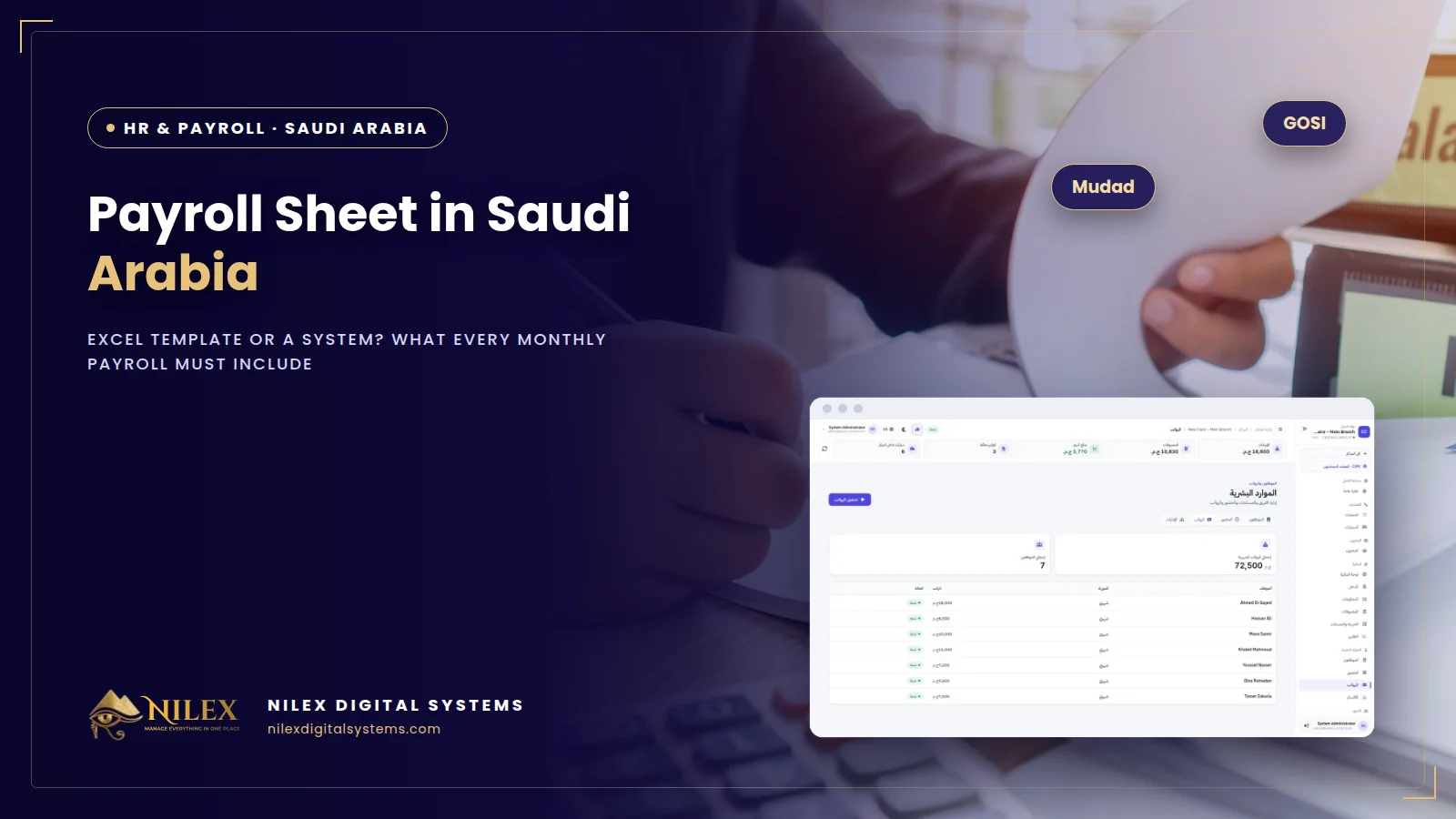
A Saudi payroll sheet (مسير رواتب) lists, for every employee and every month, the basic salary, housing, transport and other allowances, overtime, commissions, deductions such as the GOSI employee share, absences and advances, and the net pay transferred to the employee's bank account. It is the document the salary transfer and the Wage Protection System file are built from. Excel is fine for a handful of employees; once attendance, overtime, commissions and several branches feed into it every month, a system that keeps payroll next to the work is safer.
"مسير رواتب" is searched about 6,600 times a month in Saudi Arabia, and people look for ready templates in Word, PDF and Excel (about 590, 480 and 110 searches a month; Google Keyword Planner, Oct 2026). This guide describes the template column by column, explains the rules each column depends on, and helps you decide when a template is no longer enough. It is general information, not payroll or legal advice: check rates and rules with GOSI, the Ministry of Human Resources and Social Development and your accountant.
Key takeaways
- Every payroll line needs gross pay broken into its parts, every deduction with its reason, and the net pay with the bank account it goes to.
- GOSI contributions are calculated on basic salary plus housing allowance, up to a contributory wage ceiling of SAR 45,000 a month (PwC tax summary).
- For Saudi employees on the standard rates, PwC lists 9.75% deducted from the employee and 11.75% paid by the employer; for non-Saudis the employer pays 2% occupational hazard.
- Overtime under Article 107 of the Labour Law is the hourly wage plus 50% of the basic wage, per hour.
- Wage Protection System files are uploaded through Mudad; since 1 March 2025 the upload window is 30 days (Deloitte).
- Nilex systems include attendance, overtime, advances, deductions, commissions and monthly payroll, but are not integrated with Mudad, WPS or GOSI.

What a payroll sheet is for
The payroll sheet answers three questions every month: what each employee earned, what was deducted and why, and how much was transferred to whom. Finance uses it to make the salary transfer, management uses it to approve the month, and it becomes the basis for the wage file you submit for wage protection. If an employee disputes a deduction six months later, the sheet, the attendance record behind it and the approval are your evidence.
That is why a good payroll sheet is not just names and totals. Each figure must trace back to something: a contract for the basic salary, an attendance record for an absence deduction, a signed advance for an advance recovery, an approved overtime request for overtime.
A payroll sheet template, column by column
Use this structure whether you build it in Excel or read it from a system. The columns are a suggestion; adjust them to your contracts.
| Column | What it contains | Notes |
|---|---|---|
| Employee number and name | As in the contract | One row per employee per month |
| Nationality and ID / iqama number | Saudi or non-Saudi | Decides which GOSI contributions apply |
| Department / branch and job title | Where the cost belongs | Needed for branch cost reports |
| Bank and IBAN | Where the net pay goes | Must match the wage file |
| Working days / days absent | From attendance | Basis for absence deductions |
| Basic salary | From the contract | Part of the GOSI contributory wage |
| Housing allowance | Cash or in kind | Part of the GOSI contributory wage |
| Transport and other allowances | Per contract or policy | List each allowance type separately |
| Overtime hours and amount | Approved hours only | Article 107 rate |
| Commissions / bonuses | Per policy | Keep the calculation sheet |
| Gross pay | Sum of the above | Check formula on every row |
| GOSI employee deduction | Saudi employees | Rate per GOSI for that employee |
| Absence and other deductions | With the reason | Must follow the Labour Law limits |
| Advance recovery | Instalment of a loan or advance | Link to the signed advance |
| Net pay | Gross minus deductions | The amount transferred |
| Approval / signature | Who approved the month | Keep a signed PDF |
GOSI contributions: what to deduct
According to the PwC Worldwide Tax Summary for Saudi Arabia (last reviewed July 2026), contributions are calculated monthly on basic salary plus housing allowance, whether housing is paid in cash or in kind, up to SAR 45,000. PwC lists these standard rates:
- Saudi employees: 9% social insurance plus 0.75% unemployment insurance (SANED) deducted from the employee, 9.75% in total; the employer pays 9% social insurance, 2% occupational hazard and 0.75% SANED, 11.75% in total.
- Non-Saudi employees: the employer pays 2% occupational hazard; there is no employee deduction.
Rates are changing for some employees. Under the amended Social Insurance Law in force since 3 July 2024, WTW reports that the retirement contribution rises from 9% to 11% each for employer and employee in steps of 0.5 percentage points, and Mercans reports that the increase applies to new entrants to the workforce, with no change for existing contributors. The sources differ on the exact schedule, so confirm each employee's rate on GOSI before you run payroll.
Illustrative example only (مثال توضيحي): a Saudi employee on the standard rates with basic salary SAR 6,000, housing SAR 1,500 and transport SAR 500 has a contributory wage of SAR 7,500. The employee deduction is 9.75% of 7,500, about SAR 731; the employer's share is 11.75%, about SAR 881. Transport is not part of the contributory wage in this example.
Overtime: the Article 107 rate
The Ministry of Human Resources and Social Development explains Article 107 of the Labour Law: overtime is paid at the hourly wage plus 50% of the basic wage, and with the worker's consent the employer may give paid compensatory leave instead. Hours worked on public holidays count as overtime. The working-hours limits are 8 hours a day or 48 hours a week under the standard rules.
Illustrative example only (مثال توضيحي): an employee earns a total of SAR 8,000 a month with a basic salary of SAR 6,000. Assuming 240 working hours in the month for the calculation, the hourly wage is about SAR 33.3 and 50% of the basic hourly wage is SAR 12.5, so one overtime hour is about SAR 45.8. How you calculate the hourly wage should be agreed with your adviser and applied consistently.
Mudad and the Wage Protection System
The Wage Protection System lets the authorities check that salaries are paid as contracted. Establishments upload their wage files through the Mudad platform. Deloitte reported that from 1 March 2025 the Ministry of Human Resources and Social Development reduced the period for uploading WPS files from 60 days to 30 days. Requirements and file formats change, so follow Mudad's and the ministry's current guidance. In practice this means your payroll sheet must be finished, approved and consistent with the actual bank transfers in time for the upload.
Word, PDF or Excel template?
- Excel is the only one of the three that calculates. Use it for the working sheet, with formulas locked and one row per employee.
- PDF is for the approved, signed version you archive each month and give to auditors.
- Word suits a payslip or a letter, not a calculation. Copying numbers into Word tables invites errors.
Most small companies end up with all three: an Excel sheet, a PDF of the approved month and payslips. The more files there are, the more chances for the versions to disagree.
When to move from Excel to a system
- Attendance comes from another place and is typed into the sheet every month.
- Overtime, commissions and advances are tracked in separate files or messages.
- You have more than one branch, and each sends its own sheet.
- More than one person edits the file, and nobody knows who changed a formula.
- Branch managers can see everyone's salary because the file is shared.
- Payroll takes days to close because the numbers have to be reconciled.
Two or three of these together are a sign that the risk of an error, and the hours spent each month, now cost more than a system.
What payroll in a Nilex system looks like
Several Nilex systems keep HR and payroll inside the operations system, as explained in HR, attendance and payroll inside your operations system. In the car protection centers system, HR covers employees by department, attendance, overtime, advances, deductions, technician commissions and monthly payroll. The employee file holds the national ID, contract, hire date, base salary, payment method, social insurance number and enrollment date, dependents and an attendance log. Staff salaries are part of the ready PDF reports, in Arabic or English, and each branch manager sees only their own center. The car repair workshop system, described in the car repair center system for Saudi Arabia, lists finance and HR per branch in its Growing Network plan.
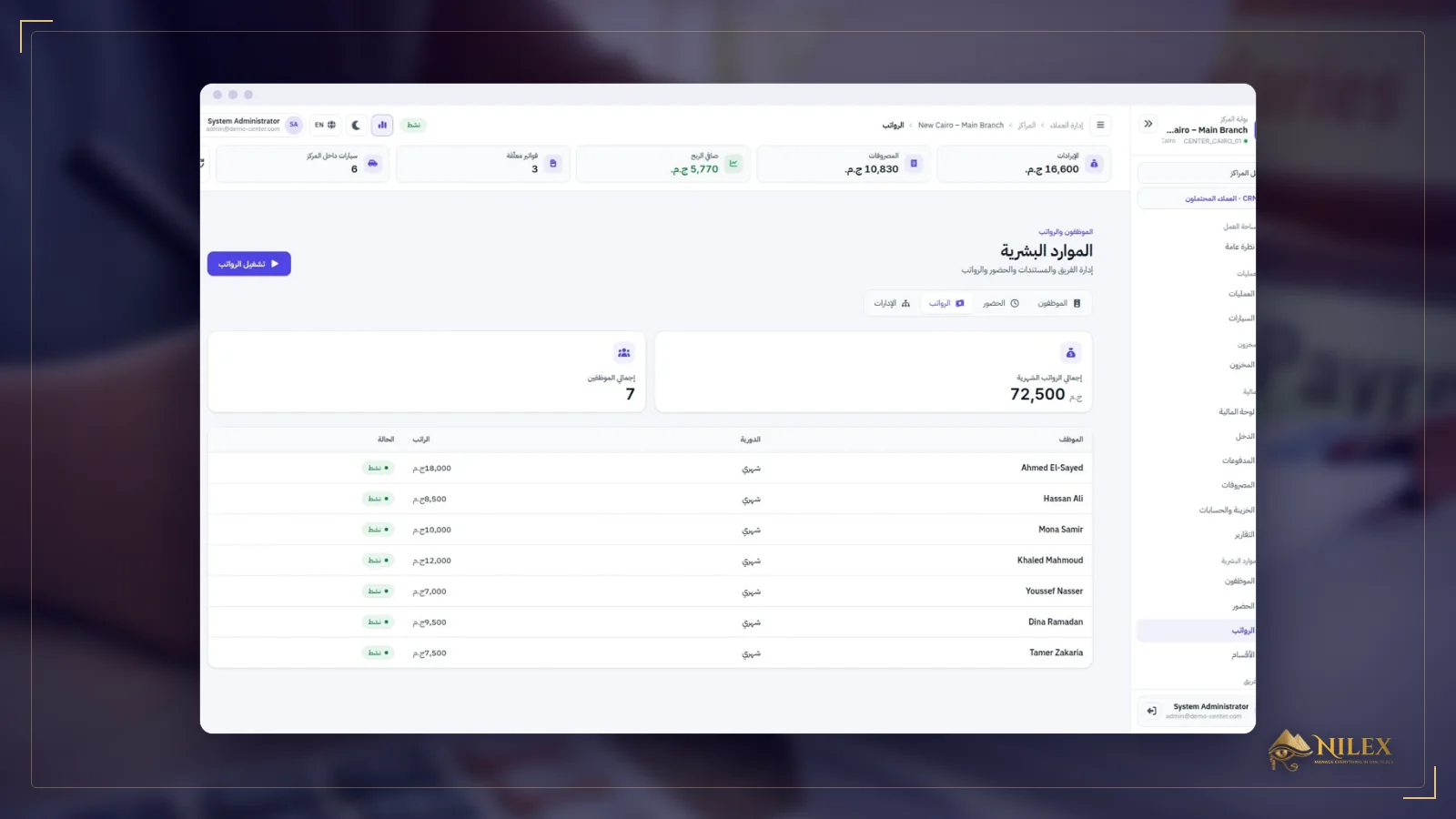
What the systems do not do is just as important. They are not integrated with Mudad, the Wage Protection System, GOSI or Qiwa, and they do not calculate GOSI contributions automatically. You still prepare and upload the wage file on Mudad and handle contributions on GOSI's portal, using the approved figures from the system. If your payroll uses allowance types or rules the system page does not list, they are agreed and quoted during scoping. Payroll in a protection or tint center often goes together with VAT invoicing questions; see e-invoicing for car protection centers and our pillar on the car protection center system in Saudi Arabia.
How Nilex helps
If you run a car protection, tint or ceramic center, or a car repair workshop, see the HR and payroll features and plans on the car protection centers system page and the car repair workshop system page. For other sectors, a custom ERP system can include employees and payroll for your whole company. Every project starts with a written quotation that can be paid in installments, includes 14 days after delivery to test and report errors, and 30 days of free fixes to the delivered work after acceptance. Your employee and payroll data stays yours, and you can get a copy, for example in Excel or CSV, on request; see who owns your business data. Contact us to discuss your payroll.
Sources
- PwC Worldwide Tax Summaries: Saudi Arabia, individual, other taxes (social security)
- WTW: Saudi Arabia new social security system (2024)
- Mercans: Saudi Arabia new Social Security Law statutory alert
- Ministry of Human Resources and Social Development: working hours and overtime
- Deloitte: update on the Wage Protection System file uploading period (2025)
Frequently asked questions
What should a payroll sheet in Saudi Arabia include?
For each employee: identification and nationality, bank account, working days, basic salary, housing, transport and other allowances, overtime, commissions, gross pay, GOSI deduction where it applies, other deductions with reasons, advance recoveries, net pay and the approval of the month.
How much GOSI is deducted from a Saudi employee's salary?
PwC lists 9.75% of basic salary plus housing for Saudi employees on the standard rates (9% social insurance and 0.75% SANED). New entrants under the amended Social Insurance Law may have a higher retirement rate, so confirm each employee's rate on GOSI.
Is an Excel payroll template enough?
For a small team with simple pay, yes, if formulas are locked and the approved month is saved as a signed PDF. When attendance, overtime, commissions and several branches feed the sheet every month, a system reduces errors and closing time.
Is the Nilex system integrated with Mudad or GOSI?
No. Nilex systems manage attendance, overtime, advances, deductions, commissions and monthly payroll, but they are not integrated with Mudad, the Wage Protection System, GOSI or Qiwa. You upload the wage file on Mudad using the approved figures.
How is overtime calculated in Saudi Arabia?
Under Article 107 of the Labour Law, each overtime hour is paid at the hourly wage plus 50% of the basic wage, or compensated with paid leave if the worker agrees.
 Clinic Management System for Every Specialty: One Professional Core, Built Around Your Clinic8 November 2026 · 8 min
 Dental Clinic Management Software: Treatment Plans, Chairs, Visits and Installments in One System8 November 2026 · 6 min
 Dermatology and Laser Clinic Management System: Session Packages, Photos and Follow-Ups Done Right8 November 2026 · 5 min