
Job Cards, Estimates and Customer Approval: How Car Repair Workshops Avoid Price Disputes
How a car repair workshop uses a proper job card, an inspection checklist and an estimate the customer approves line by line from a link to avoid the "I never agreed to that" argument at delivery.
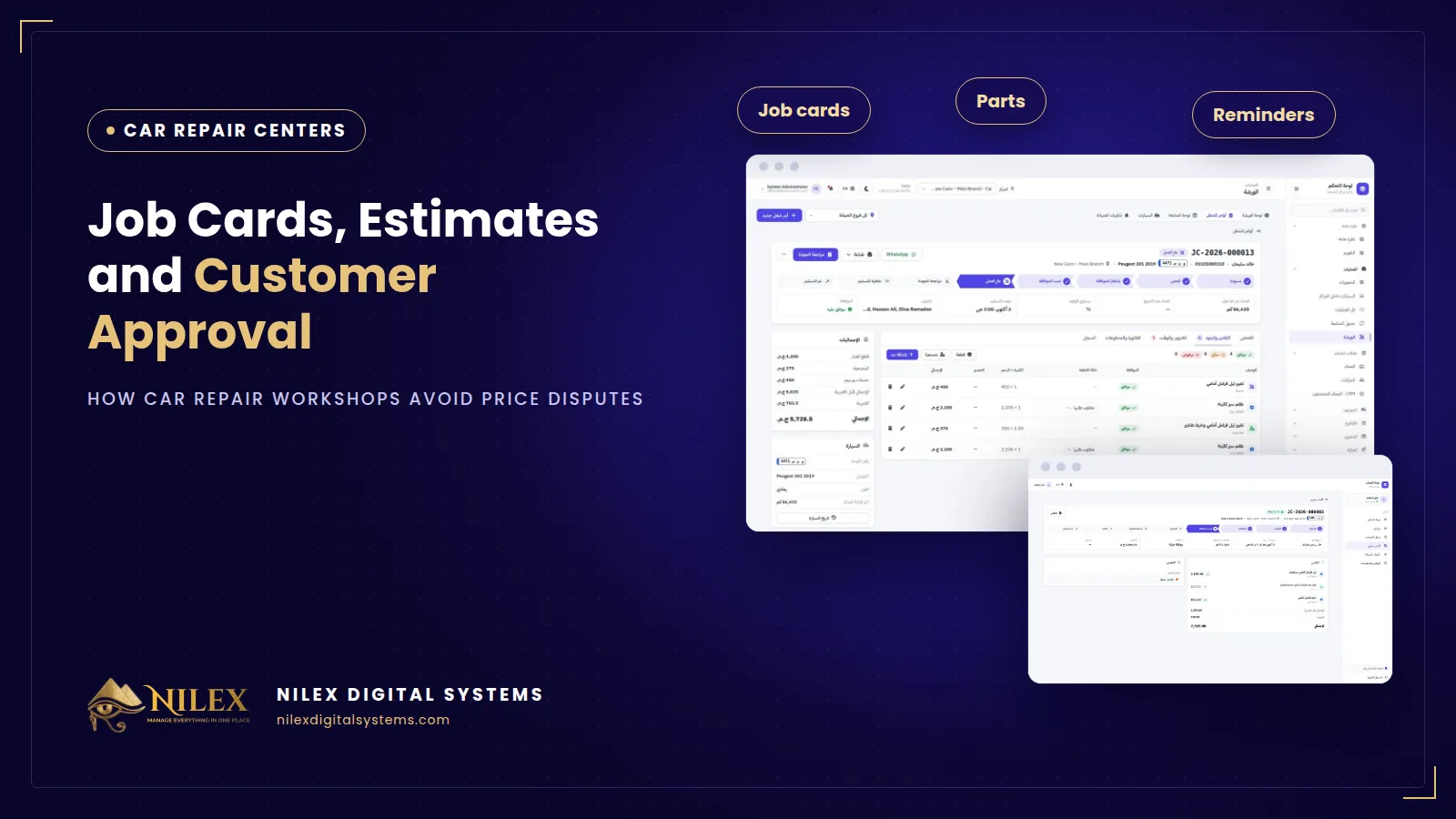
A job card is the record a car repair workshop opens when a car arrives: who the customer is, which car, the odometer, the fuel level and what the customer is complaining about. The inspection turns that complaint into a diagnosis, and the estimate turns the diagnosis into priced lines that the customer approves or declines one by one. When all three are written down and the approval is recorded, the most common argument in a workshop, "I never agreed to that", has a two-minute answer.
Without them, the price lives in a phone call. The advisor says "around two thousand", the technician finds something else, the work grows, and at delivery the customer sees a number he does not recognise. Either the workshop gives a discount it did not plan, or the customer leaves angry and does not return.
Key takeaways
- Record the odometer, fuel level, complaint and promised time at check-in, before anyone touches the car.
- Use an inspection checklist where each item is OK, needs attention or urgent, so the customer understands priorities.
- Build the estimate from separate lines: parts, labor hours and services, with totals and tax.
- Let the customer approve or decline each line, from a link on his phone or at the counter, and record how and by whom.
- Start work only on approved lines; any exception should be a manager's decision, recorded in the job card.
What should a workshop job card record?
- Customer and car: found by search, not typed again on every visit, so the car's history is attached.
- Odometer in: the base for the warranty conversation, the next service reminder and the vehicle history.
- Fuel level: a small detail that ends a familiar complaint.
- Priority and promised time: what the advisor promised, so the floor knows what is late.
- The customer's complaints in his own words: "noise from the front when braking", "A/C weak".
Speed decides whether this happens on a busy morning. A job card opened in a few short steps (customer, car, check-in, an optional first estimate, review) is filled in; a long form is skipped.
From complaint to diagnosis: the inspection checklist
A checklist gives every inspection the same shape. Each item is marked OK, needs attention or urgent, the technician writes the diagnosis, and internal notes stay internal. The customer then receives something he can read: three urgent items, two to watch, the rest fine. That clarity is what makes him approve the urgent lines today and come back for the others.
Building an estimate the customer understands
A good estimate separates what the money is for:
- Parts taken from the branch stock, with the quantity available visible, so you do not promise a part you do not have.
- Labor by the hour.
- Services from the price list, such as an oil change or a wheel alignment.
- Totals and tax calculated, not added up on a calculator.
An illustrative example: a brake complaint becomes four lines: front pads (part), front discs (part), labor (1.5 hours) and brake fluid change (service). The customer approves pads, labor and fluid, and declines the discs for now. The invoice later contains three lines, and the declined line is a reason to call him again.
Approval by link, line by line
The estimate is sent by WhatsApp, SMS or email with a link. The customer opens it on his phone and approves or declines each line. If he prefers to call or come to the counter, the approval is recorded there with the method and the name of the person who approved. Either way the job card shows exactly what was agreed and when.
Line-by-line approval matters more than a single "OK". A customer who can decline one item without refusing the whole estimate feels in control, and the workshop does not lose the whole job because of one expensive part.
Phone approval vs approval recorded per line
| Phone call or voice note | Approval per line, recorded | |
|---|---|---|
| What was agreed | "Around two thousand" | Each line with its price |
| Who agreed and how | Unclear | Method and name recorded |
| Extra work found later | Done, argued at delivery | New line sent for approval |
| Declined items | Forgotten | Visible for a later call |
| The invoice | Typed again | Built from approved lines |
When work has to start before approval
Sometimes the customer cannot be reached and the car has to move. The rule should be clear: only a manager can allow it, and the decision is written in the job card timeline with the name and time. That keeps the exception rare and traceable. A timeline that records every action, who did it and when, is also your protection inside the team; our article on permissions and audit logs explains why that record matters.
At delivery: no surprises
Before a car is marked ready, approved parts should all be issued and the odometer out recorded. The invoice comes from the approved lines, and the estimate, job card and invoice print as Arabic PDFs the customer can keep. Car protection centers solve the same problem with a signed check-in report and a digital warranty; see car check-in reports and digital warranties.
How Nilex helps
The car repair center and workshop management system opens job cards in five steps with odometer, fuel, priority, promised time and complaints, records inspections as OK, needs attention or urgent, builds estimates from parts, labor and services, sends them by WhatsApp, SMS or email, and lets the customer approve or decline each line from the customer portal or at the counter. Work starts on approved lines; exceptions are a manager's decision recorded in the timeline. The full cycle is in our guide to the car repair workshop management system, and parts are covered in spare parts and technician time. See the plans on the system page or contact us.
Frequently asked questions
What if the customer does not use a smartphone?
Call him, read the lines, and record the approval at the counter with the method (phone) and his name. The record is what matters, not the channel.
What if the technician finds something new during the work?
Add it as a new estimate line and send it for approval. Do not fold it into an existing line.
Should declined lines be deleted?
No. A declined line is useful: it tells you what the car still needs and gives you a reason to contact the customer later.
Does the estimate show tax?
Yes. Totals and tax are calculated on the estimate, so the number the customer approves matches the invoice.
 What Makes a Business System Professional: The Standards Nilex Builds Into Its Systems11 October 2026 · 11 min
 A Portal for Every Role: Why Nilex Systems Give Owners, Staff, Technicians and Customers Their Own Screens11 October 2026 · 9 min
 The Nilex Client Portal: Follow Your Project, Invoices, Payments and Requests in One Place11 October 2026 · 8 min