
Spare Parts and Technician Time in the Workshop: Stop Fitting Parts Nobody Bills
How a car repair workshop controls spare parts issued per job from each branch's stock, makes sure every approved part is billed, and records technicians' time so you know what each job and each technician really took.
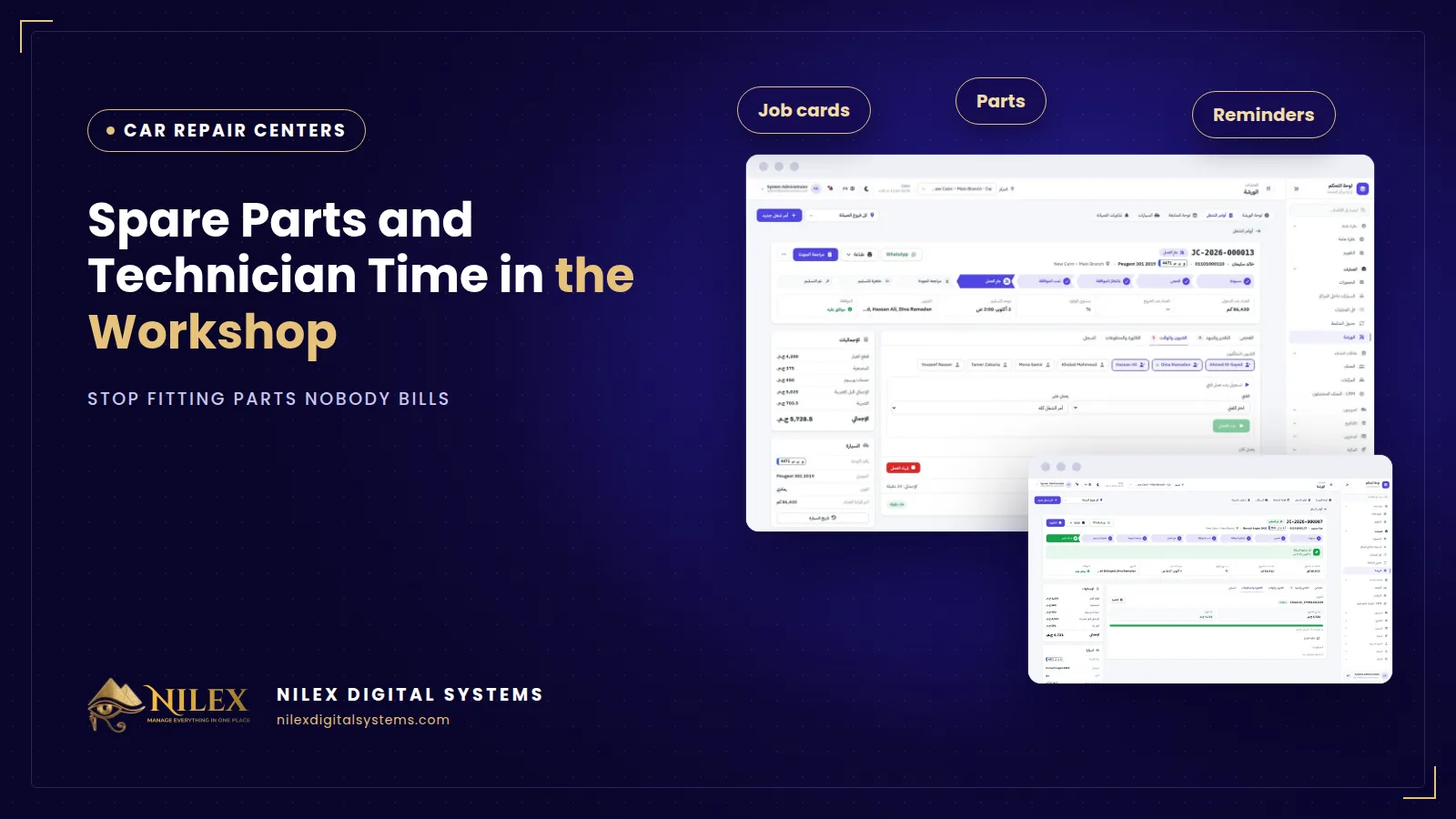
In a car repair workshop, spare parts and technicians' hours are the two biggest costs, and the two easiest to lose track of. The fix is to tie both to the job card: every part is issued to a specific job from a specific branch's stock, and every technician records when he starts and stops work on that job. Then the invoice includes what was really used, and you know how long each job took and how much each technician worked.
The usual leak is simple. A technician takes a filter from the shelf, fits it, and the advisor forgets to add it. Or a part is ordered for a car, arrives, sits on a shelf, and is fitted to a different car. At the end of the month the stock count is short and nobody can say where the difference went.
Key takeaways
- Parts should be chosen on the estimate from the branch stock, with the available quantity visible.
- Each part on a job should move through clear statuses: to-order, ordered, received, issued.
- Issuing a part should deduct it from that branch's stock automatically.
- A car should not be marked ready until every approved part has been issued, so nothing fitted is left off the invoice.
- Technicians should record start and stop on each job; that is how you learn real job times.
Where do workshop parts go missing?
- Fitted, not billed. The part went into the car but never reached the invoice.
- Ordered for one car, used on another. The first customer waits again, and the records do not match.
- Promised but not in stock. The advisor approves a line with a part the branch does not have, and the car waits for days.
- One stock for all branches. The system says ten, but they are in the other branch.
How parts should move on a job
1. Chosen on the estimate, with stock in view
When the advisor adds a part to the estimate, he sees how many the branch has. If there are none, he knows the car will wait, and he can tell the customer before approval, not after. The estimate itself is covered in job cards, estimates and customer approval.
2. Clear statuses after approval
Once the line is approved, the part is either issued from stock or follows to-order, ordered, received. The job card itself can sit in "waiting for parts", so the floor and the customer know why the car is not moving.
3. Issuing deducts from the branch
Issuing a part to the job deducts it from that branch's stock. Stock becomes a result of real work, not a separate sheet someone updates on Thursday.
4. No "ready" until approved parts are issued
Before the job can move to ready, the system checks that every approved part was issued and the odometer out is recorded. This single check closes the most common leak: the part that went into the car but not onto the invoice.
Parts on paper vs parts issued per job
| Shelf + written job card | Issued per job in the system | |
|---|---|---|
| Stock available when quoting | Ask the storekeeper | Shown on the estimate line |
| Part waiting for supplier | A note on the card | To-order, ordered, received |
| Stock deduction | Manual, if at all | On issue, from that branch |
| Part fitted but not billed | Found at stock count, maybe | Blocked before "ready" |
| Stock per branch | One mixed number | Each branch separately |
Technician time: what you can learn from start and stop
Assign one or more technicians to each job, and let each one record when he starts and stops. You then see the time per job and per technician. That record answers questions owners usually guess at:
- How long does this kind of job really take? Useful when you set labor hours on the next estimate.
- Who worked on this car? Useful when a car comes back with the same complaint.
- How many hours did each technician actually spend on jobs this week? Useful for planning shifts, hiring and fair incentives.
An illustrative example: an estimate allows 2 labor hours for a clutch job, but the recorded time on the last several clutch jobs is closer to 3. Either the labor price is too low or something in the process slows the job down; either way you now know where to look.
Be careful how you use the numbers. Time recorded is not the same as quality, and a fast technician who causes comebacks is not productive. Read time together with returning complaints, not alone.
Several branches: keep stock and teams separate
When you run more than one branch, each needs its own stock, jobs and team, and management needs one view of every car inside every branch and what is late. The car protection series covers the same question for detailing and PPF networks in managing several car protection branches; the logic of separate stock and comparable KPIs is the same, and for film stock specifically see film stock by the meter.
How Nilex helps
In the car repair center and workshop management system, parts are chosen on the estimate from the branch stock with the quantity shown, move from to-order to ordered, received and issued, and issuing deducts them from the branch. A car cannot be marked ready until approved parts are issued and the odometer out is recorded. Technicians are assigned to each job and record start and stop, so you see the time per job and per technician. The rest of the cycle is in our guide to the car repair workshop management system. See the plans on the system page for branches and users per plan, or contact us.
Frequently asked questions
Can more than one technician work on the same job?
Yes. Several technicians can be assigned, and each records his own start and stop, so you see each person's time on the job.
What if a part is not in stock?
The line shows it, the part follows to-order, ordered and received, and the job can sit in "waiting for parts" so everyone knows why the car is waiting.
Is technician time the same as payroll?
No. Time on jobs shows where hours went. How you pay technicians, fixed salary or incentives, is your policy; the record just gives you facts to base it on.
Do we still need a stock count?
Yes, periodically. But when parts are deducted on issue, the count confirms the numbers instead of discovering them.
 What Makes a Business System Professional: The Standards Nilex Builds Into Its Systems11 October 2026 · 11 min
 A Portal for Every Role: Why Nilex Systems Give Owners, Staff, Technicians and Customers Their Own Screens11 October 2026 · 9 min
 The Nilex Client Portal: Follow Your Project, Invoices, Payments and Requests in One Place11 October 2026 · 8 min