
Student Attendance and Absence Warnings: How Schools Stop Finding Out Too Late
How schools in Egypt can run daily attendance taken by teachers, absence excuses from parents, a school calendar and absence warnings kept as settings the school reviews against Ministry decisions.
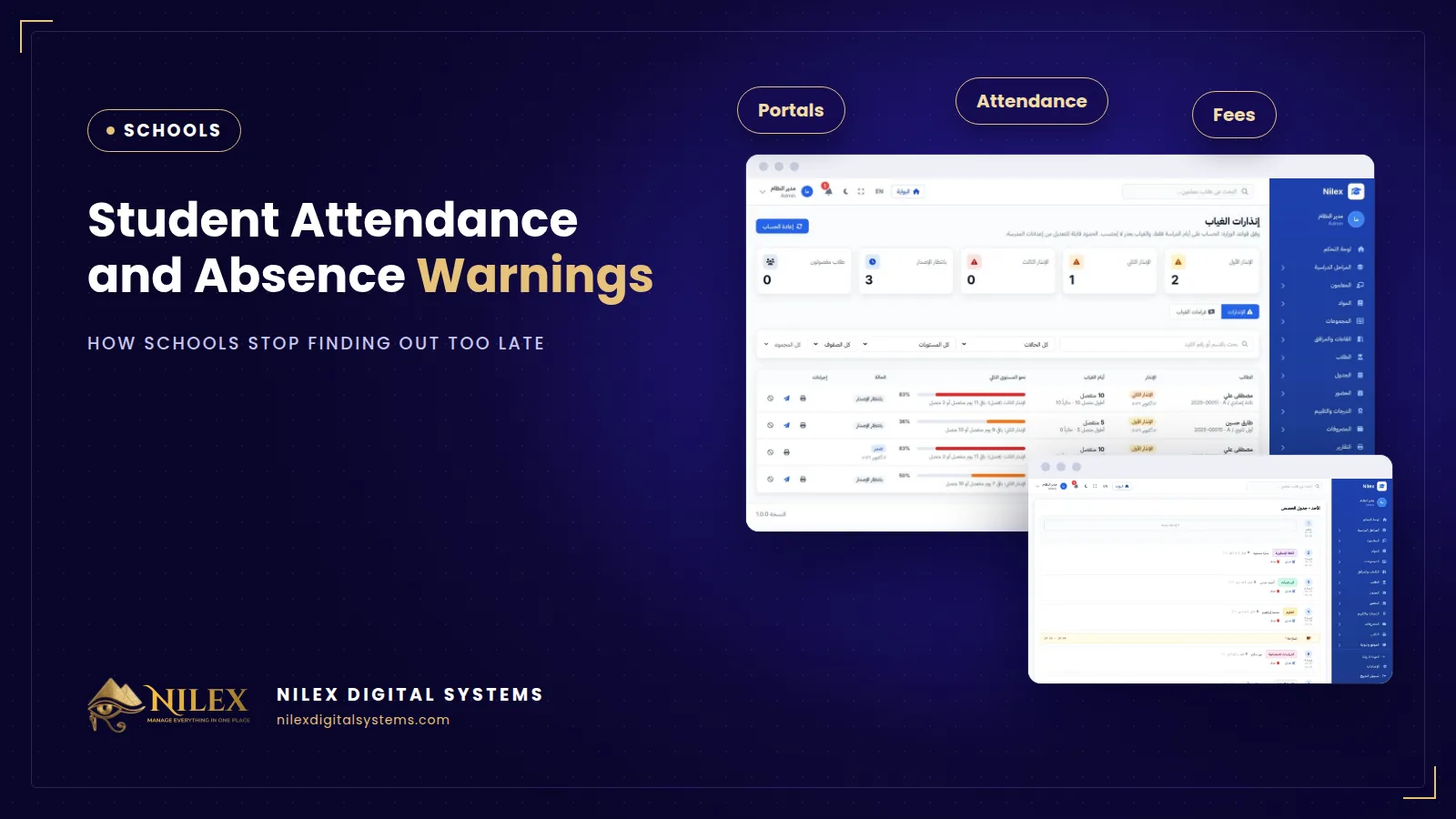
Managing student attendance well means three things: the teacher records who is present in the period itself, absences are counted against the school calendar and the excuses parents send, and warnings go out on time according to the rules your school applies. When attendance lives on paper sheets and an end-of-month spreadsheet, warnings arrive late, excuses get lost and the school finds out about a problem only when a student is close to losing the right to sit an exam.
This guide explains how schools in Egypt can organise daily attendance, absence warnings and excuses in a system, and why the warning rules should be settings the school reviews, not numbers fixed in software.
Key takeaways
- Attendance is most accurate when the teacher takes it in the period, not when the office collects sheets at the end of the day.
- A school calendar of holidays and non-teaching days keeps those days out of the absence count.
- Parents should be able to send an absence excuse from their portal, and the school decides whether to accept it.
- Warning thresholds and dismissal rules change with Ministry decisions, so keep them as settings and review them every year.
- Parents seeing attendance in their portal is the simplest early warning there is.
Why does attendance on paper fail?
- Late data. Sheets reach the office at noon and are typed in at the end of the week, if at all.
- Counting by hand. Someone has to add up absences per student to know who has reached a warning, and that someone is busy.
- Holidays and events. A trip day or an official holiday is counted as an absence for half the school.
- Excuses on paper. A medical note handed to a teacher never reaches the file.
- Parents in the dark. The family hears about the absences when the warning arrives, not when the pattern starts.
How should daily attendance work?
- The timetable decides which teacher is with which class in each period.
- The teacher opens the class list from the system and marks who is absent; it takes a minute.
- The record is saved with the date, class and teacher, and the office sees today's absences straight away.
- The school calendar marks holidays and non-teaching days, so they are not counted.
- Parents see the attendance in their portal and can send an excuse.
This depends on a clean timetable: if a teacher is booked in two classes at once, attendance for one of them is missing. That is why the timetable should block teacher and room clashes when it is built. Our school management system guide shows how the timetable, attendance and grades connect.
How should absence excuses be handled?
An excuse should be a record, not a piece of paper. The parent sends it from the portal with the reason. The school's staff review it and accept or reject it. Accepted excuses are counted separately, because the rules often treat absence with an acceptable excuse differently from absence without one. Keep the decision and who made it on record, so there is no argument later.
Absence warnings: settings, not hard-coded numbers
Egyptian schools apply Ministry of Education decisions on absence warnings, dismissal and the right to sit exams. These decisions are issued and updated by the Ministry, and they can differ by stage. A system should therefore hold the warning rules as settings: how many days of absence trigger the first warning, the second, the final warning and dismissal, and whether excused days are counted. The school's administration reviews these numbers at the start of each year against the decisions in force.
As one verified example of a rule to check: a Ministry periodical published in October 2022 states that a student who has not attended at least 85% of actual school days, after excused absences are deducted, may not sit the exam as a regular student. It also asks schools to register absences electronically every week and to inform parents periodically. Confirm the current decision for your stage before you set the thresholds.
| Setting to review each year | Who confirms it | Why it matters |
|---|---|---|
| Days of absence for each warning level | School administration | Warnings must match the decision in force |
| Days that lead to dismissal | School administration | A dismissal letter is a serious step for the family |
| Whether excused days count | School administration | Changes who reaches a warning |
| Holidays and non-teaching days | School office | Keeps those days out of the count |
| Who may accept an excuse | Principal or deputy | One clear decision-maker avoids disputes |
With the settings in place, the system calculates who has reached each level and prepares the warnings and dismissal letters for the school to review and print, instead of someone counting by hand.
Reports worth asking for
- Today's absences by class, for the morning round.
- Students close to the next warning level, so the social worker can call the family early.
- Absences per student over a period, with excused and unexcused days.
- Official reports for printing or export to CSV.
Attendance records are personal data about children. Limit who can see and change them, and keep a trail of changes; our article on permissions and audit logs explains why, and our privacy guide covers Egypt's data protection law.
How Nilex helps
The Nilex school management system includes a clash-free timetable, daily attendance taken by the teacher, a school calendar, absence warnings and dismissal letters based on Ministry rules kept as settings you review every year, and excuses sent by parents from their portal. Parents see attendance in the parent portal. Attendance is part of the School Management and Complete School plans; see the plans and the timetable and attendance video on the system page, or contact us.
Sources
Frequently asked questions
Who takes attendance, the teacher or the office?
The teacher, in the period. The office sees the result immediately and follows up.
What happens when the Ministry changes the rules?
The administration updates the warning settings. Nothing needs to be reprogrammed.
Can a parent send an excuse?
Yes, from the parent portal. The school reviews it and decides whether to accept it.
Are parents notified of warnings automatically?
Parents see attendance in their portal. The warnings and dismissal letters are prepared in the system for the school to issue; email delivery is not available today.
Does attendance connect to fees or payroll?
Student attendance is separate from fees. Staff attendance, leave and payroll are part of HR in the complete plan; see school fees and staff payroll.
 What Makes a Business System Professional: The Standards Nilex Builds Into Its Systems11 October 2026 · 11 min
 A Portal for Every Role: Why Nilex Systems Give Owners, Staff, Technicians and Customers Their Own Screens11 October 2026 · 9 min
 The Nilex Client Portal: Follow Your Project, Invoices, Payments and Requests in One Place11 October 2026 · 8 min