

Car Protection Studio Website: The Pages That Bring PPF, Ceramic and Tint Bookings
How a PPF, nano-ceramic or tint studio website brings bookings: one page per service, package and branch, real "Our work" projects, articles that answer pre-booking questions, Arabic and English versions, and a clean sitemap, using Layer Protect's 50-URL site as the example.
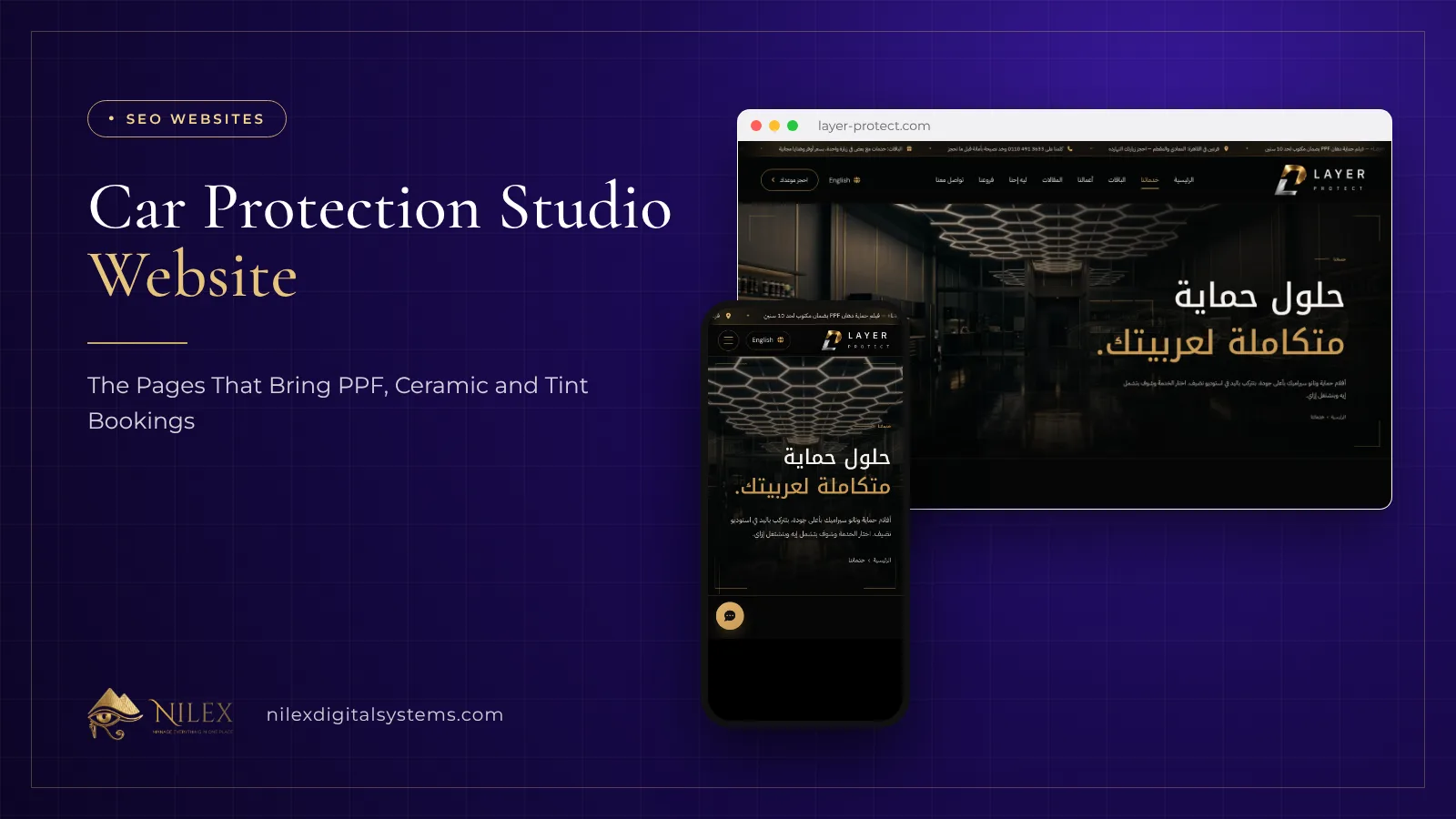
A website brings bookings to a PPF, nano-ceramic or window-tint studio when it has one page for every thing a customer searches for: a page per service, a page per package, a page per branch, real "Our work" projects, and articles that answer the questions people ask before they book. Each page targets one kind of search, in Arabic and in English, and every page ends in a way to book, call or message. A single home page with a phone number cannot match all of those searches, however good it looks.
This guide is for owners and marketing managers of car protection studios in Egypt and the Gulf who want a website that brings enquiries. It uses the public site Nilex built for Layer Protect, an authorized Layer+ dealer with two studios in Cairo, as a working example: its sitemap lists 50 URLs, and we walk through what each one is for.
Key takeaways
- Searches for car protection are specific: a service ("full body PPF"), a need ("new car protection"), a place ("PPF in Maadi") or a question ("PPF or nano ceramic?"). Each needs its own page.
- One page per service and one per package lets each page carry its own title, description, photos and booking button.
- One page per branch, with the address, map and phone, is what matches local searches and supports your Google Business Profile.
- "Our work" shows real cars from your studio, which is the proof customers look for before they trust a price.
- Articles answer pre-booking questions; the studio writes them, and the site is built so they get indexed.
- Arabic and English versions of every page, linked to each other, double the searches a page can match without mixing languages.
- A clean sitemap with only real pages, submitted in Search Console, tells Google exactly what exists.
Why doesn't a one-page studio website bring bookings?
Most studio websites start as a single page: a photo of a shiny car, a list of services and a WhatsApp button. That works for people who already know your name. It does little for someone who searches "PPF Cairo" or "nano ceramic Mokattam".
Google ranks pages, not businesses. A page that tries to cover PPF, ceramic, tint, wrapping, two branches and a warranty at once is a weak answer to each of those searches. Google's own SEO starter guide makes the same point in plainer terms: organize the site so each topic has a clear page, and write titles that describe that page.
The fix is more pages, each with one job. Our general guide to company website pages that rank explains the principle; below is how it applies to a protection studio.
Which page answers which search?
The table below matches each kind to the page type that answers it and shows the matching Layer Protect URL. The example searches are illustrative, not measured search volumes.
| What the customer is looking for | Example search (illustrative) | Page that answers it | Layer Protect example |
|---|---|---|---|
| A specific service | "full body PPF Cairo" | Service page | /services/full-body-ppf |
| A bundle for a situation | "new car protection package" | Package page | /packages/new-car-package |
| A studio near them | "car protection Maadi" | Branch page | /locations/maadi |
| Proof of quality | "PPF before and after" | "Our work" gallery and project pages | /work |
| An answer before deciding | "PPF vs nano ceramic" | Blog article | /blog/ppf-vs-nano-ceramic |
| The brand itself | "Layer Protect" | Home page | / (Arabic), /en (English) |
| Ready to book | "book PPF appointment" | Contact and booking page | /contact |
One page per service: PPF, ceramic, tint and wrap
Layer Protect's site has five service pages: full body PPF, front PPF, ceramic coating, window tinting and car wrapping. Each has its own address, its own title and its own description, for example «حماية دهان PPF كاملة للسيارة في القاهرة» in Arabic and "Full Body PPF in Cairo" in English. Full body and front PPF are split because people search for them separately.
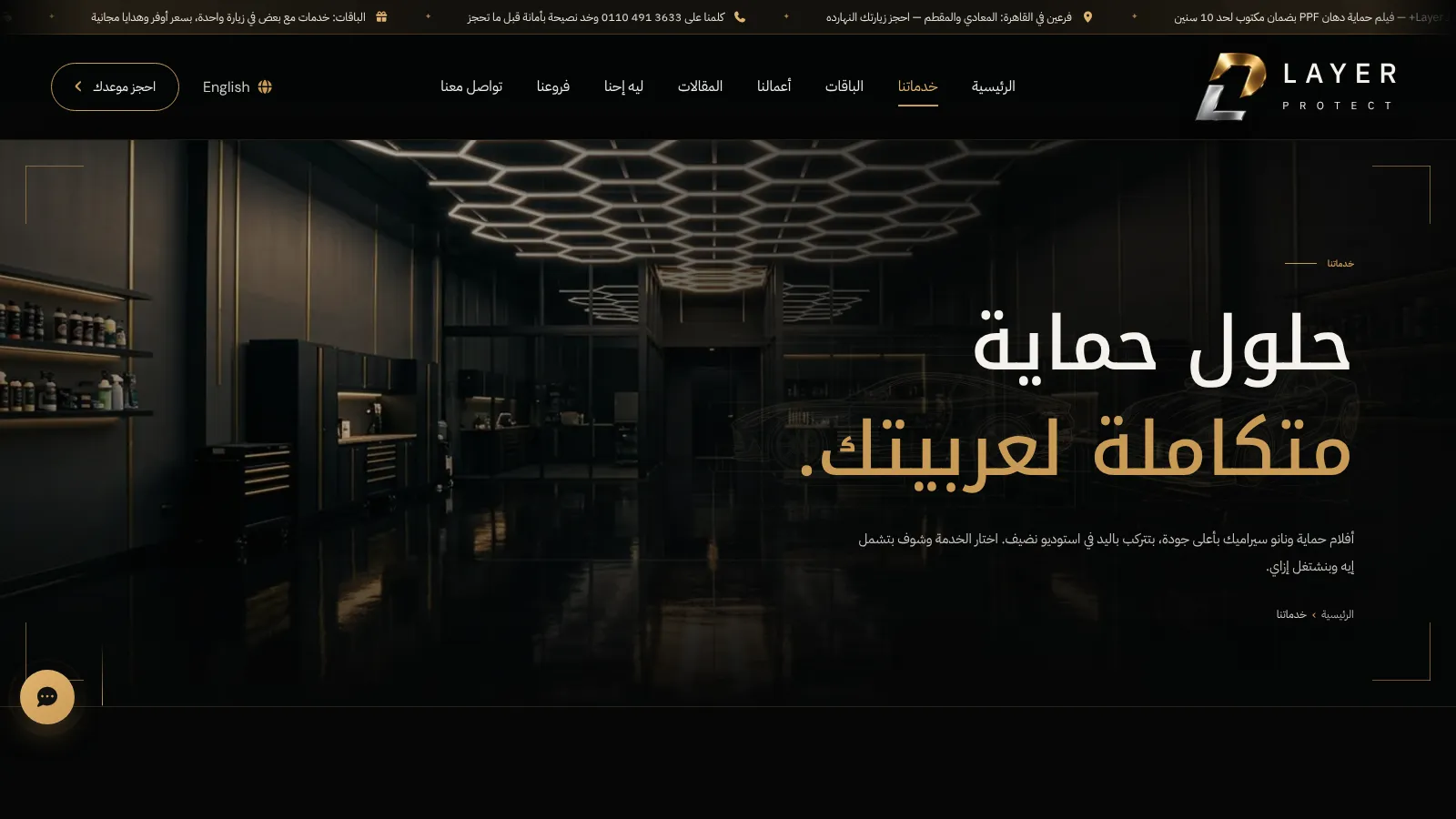
A useful service page for a studio includes:
- A title with the service and the city, for example "Full Body PPF in Cairo", because people add the place to their search.
- What the service protects against in plain words: stone chips, scratches, sun, heat, depending on the service.
- Which parts it covers and how the job is done, as the studio describes its own process.
- The warranty as the studio states it. Layer Protect's site states a written warranty of up to 10 years for its premium PPF; that is the studio's own claim and the website simply publishes it.
- Photos of real installs and links to related "Our work" projects.
- A booking button and a WhatsApp or call button on the page, not only on the contact page.
Each service page also carries structured data describing the service and a breadcrumb trail.
Package pages: matching the customer's situation
Packages answer a different question from services. A customer who has just bought a car does not always know whether they want PPF, ceramic or tint; they search for "new car protection". Layer Protect publishes two package pages, a new car package (ceramic coating and window tint) and a complete protection package, each with its own URL.
A package page should say what is included, who it suits and how to book it. If the studio shows prices, they are its own prices and must be kept current. In Layer Protect's case, packages are edited in the CRM and published to the site, so a change made once reaches the website, the sales screens and the AI chat.
One page per branch: how local searches find you
Someone in Maadi searching for car protection wants a studio they can drive to. Layer Protect has a locations page and one page for each studio: /locations/maadi and /locations/mokattam. The Maadi page's title is «مركز حماية سيارات في المعادي — PPF ونانو سيراميك» in Arabic and "Car Protection Studio in Maadi, Cairo" in English, and its description contains the address and phone number.
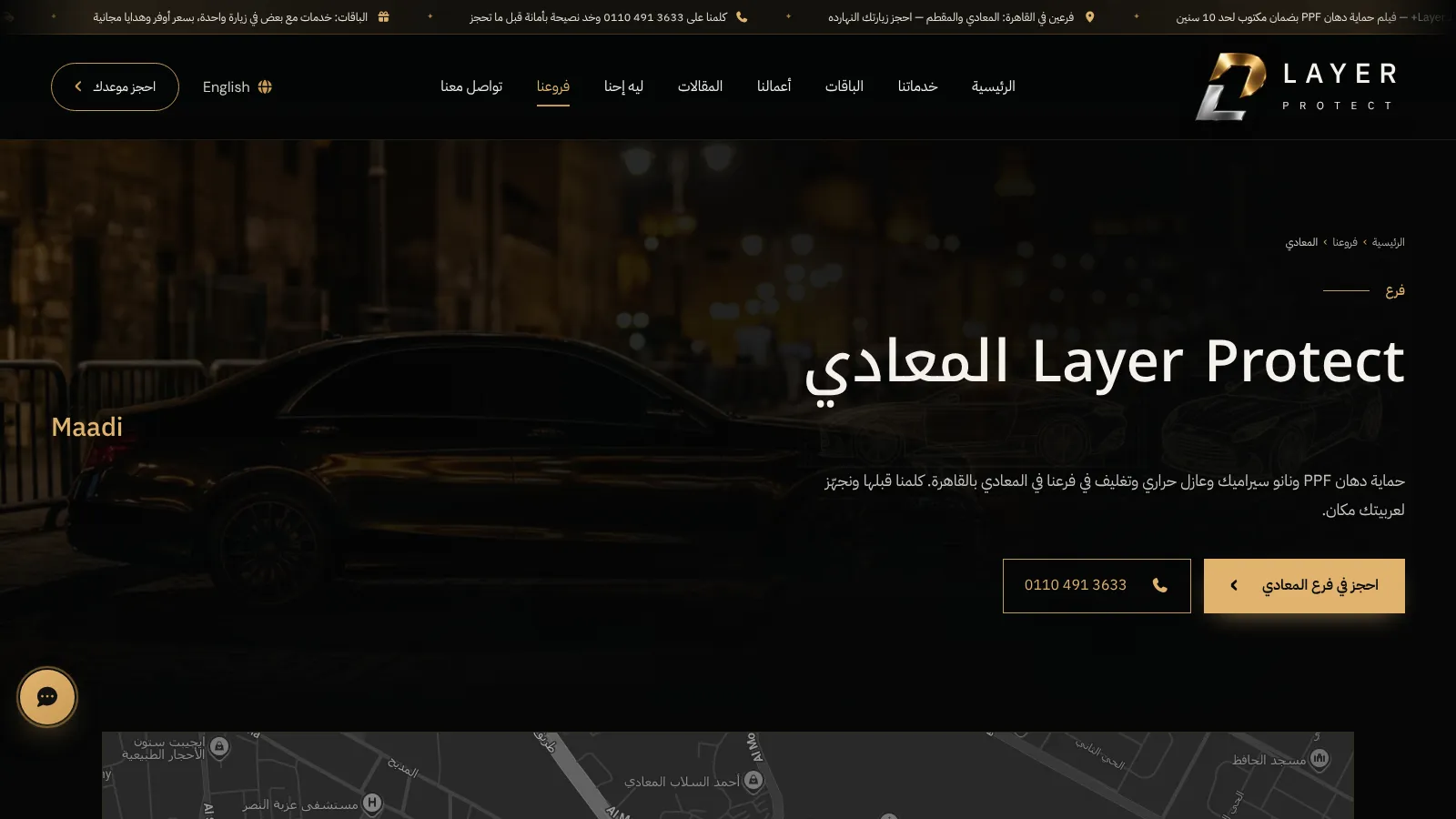
A branch page should include:
- The district and city in the title, and the full address with landmarks and a map.
- The phone number and WhatsApp, and opening hours.
- Which services this branch offers, linking to the service pages.
- Local business structured data with the address and map coordinates, which Layer Protect's branch pages carry. Google documents this markup in its local business structured data guide.
The branch page works with the studio's Google Business Profile; keep the name, address and phone identical in both. Our guide to local SEO and Google Maps in Egypt covers the profile side.
"Our work": real cars as proof
Car owners hesitate before paying for PPF because they cannot see the result in advance; photos of real cars from your studio are the answer. Layer Protect's "Our work" page, titled "Our Work — PPF, Ceramic & Tint Projects", shows real cars protected at its Maadi and Mokattam studios, and the system lets each project have its own page as the studio adds them.
A good project entry shows the car (make and model), the service done, a few clear photos and a short note. It links to the service page, and the service page links back to its projects, so visitors move from "what is it" to "show me" to "book it". Use only your own photos of your own work.
Articles that answer pre-booking questions
Before a customer books, they ask questions: is PPF worth it in Egypt's heat and dust, PPF or nano ceramic, how long does window film last, how should I wash the car after ceramic? Each question is a search, and an article is the page that answers it. Layer Protect's blog has eight articles in each language, for example a PPF guide for Egypt, PPF versus nano ceramic, aftercare for PPF and ceramic, heat-rejecting window film, and a guide to protecting a new car.
The studio writes these articles from its own experience, which makes them believable. Nilex's part is technical: each article gets a clean URL, title and description, joins the sitemap when published, and links to the related service and booking page. For how to write articles that lead to enquiries, see our guide to service pages and articles that bring leads.
Arabic and English: two versions of every page
In Cairo car owners search in Arabic, in English, or a mix of both. Layer Protect's site is Arabic at the root (/) and English under /en, and every page has its pair: /services/full-body-ppf and /en/services/full-body-ppf, /locations/maadi and /en/locations/maadi. Each pair declares the other as its alternate language version, with Arabic (Egypt) as the default, following Google's guidance on localized versions of a page.
The rule that matters: one language per page, written with the words each audience actually uses (حماية دهان، نانو سيراميك، عازل حراري in Arabic). Our article on bilingual websites for Egypt and the Gulf goes deeper.
What a 50-URL sitemap looks like
A sitemap lists every real page you want search engines to know about, and nothing else. Here is how Layer Protect's 50 URLs break down, counting Arabic and English separately:
| Page type | Arabic | English | Total |
|---|---|---|---|
| Home, services list, packages list, our work, blog list, locations list, about, contact | 8 | 8 | 16 |
| Branch pages (Maadi, Mokattam) | 2 | 2 | 4 |
| Service pages | 5 | 5 | 10 |
| Package pages | 2 | 2 | 4 |
| Blog articles | 8 | 8 | 16 |
| Total | 25 | 25 | 50 |
Each sitemap entry lists its language alternates, the robots file declares the sitemap, and the sitemap is submitted in Search Console, which reports which pages are indexed. When the studio adds a service, package, project or article in the CRM, the new page joins the sitemap automatically. Google explains sitemaps in its sitemaps overview, and our Search Console guide for business owners shows how to read the reports.
From a visit to a booking
On Layer Protect's site, three paths lead from any page to the sales team:
- The booking form creates a lead in the CRM that someone on the team owns.
- WhatsApp and call buttons take the visitor straight to the studio. WhatsApp messages arrive in the CRM's shared inbox and calls go through the office phone system connected to the CRM; see our article on click-to-call and the call log.
- An AI chat answers visitors about services, packages, prices and branches at any hour and steers them to book. Read more in our article on the WhatsApp inbox and AI sales assistant for car protection studios.
Because the website content comes from the CRM the sales team uses, the site and the salesperson say the same thing. The full story is in the Layer Protect CRM and website case study.
How Nilex helps
Nilex builds SEO-ready business websites where the technical side is done properly: one clean URL per service, package, branch, project and article; titles and descriptions you can edit; Arabic and English versions linked to each other; structured data for services and branches; a sitemap that lists only real pages; fast pages; and Search Console set up. Our SEO work is technical only. We do not write your articles, build links or promise rankings; your studio publishes its own content, and the site is built so that content gets found and indexed.
The website can be connected to a sales CRM, so bookings land as leads with an owner, as on Layer Protect's project. When the studio grows into operations (job cards, film stock, warranties, technician pay), the car protection centers management system can be added later. To see how a website and a management system share data, read a website connected to your management system. Contact us to plan your studio's website.
Frequently asked questions
How many pages does a car protection studio website need?
As many as the real things customers search for: one per service, one per package, one per branch, the "Our work" gallery with its projects, the blog articles, plus home, about and contact, in each language. Layer Protect's site has 50 URLs across Arabic and English; a studio with more branches or packages will have more.
Should I make pages for districts where I have no branch?
No. A branch page should describe a real place customers can visit. Pages for districts with no studio, filled with copied text, rarely help and can make the whole site look less trustworthy. Use real branch pages and your Google Business Profile instead.
Should I show prices on my service and package pages?
That is the studio's decision. If you show prices, keep them current and make clear what they include, because an outdated price causes disputes. If prices depend on the car, explain what affects the price and invite the customer to ask for a quote.
Do I need both Arabic and English versions?
In Egypt many customers search in Arabic and some in English, so two versions let each page match both. Keep one language per page and link each page to its pair so search engines show the right version.
Will Nilex write the blog articles for my studio?
No. Nilex handles the technical side: page structure, speed, indexing, sitemaps, structured data and Search Console. The studio writes its own articles, which is what makes them credible, and the site is built so they get indexed and linked to the right service pages.
Can my team update services, packages and branches without a developer?
Yes, when the website is managed from the CRM as in Layer Protect's case: services, packages, branches and "Our work" are edited there and published to the site, and new pages are added to the sitemap automatically.
 Technical SEO From Development to Launch: Building a Site Google Can Actually Find11 November 2026 · 6 min
 Get Every Page Indexed: A Clean Google Search Console With No Coverage Errors11 November 2026 · 6 min
 Sitemaps, robots.txt and Structured Data: The Three Things That Get You Crawled, Indexed and Shown11 November 2026 · 5 min