
Real Estate CRM: Leads Kanban, Call Logs and Follow-Ups That Don't Slip
How a real estate CRM keeps buyer leads from going cold: a kanban board by stage, a log of every call, follow-ups with overdue alerts, interested units linked to the inventory and website enquiries that become leads.
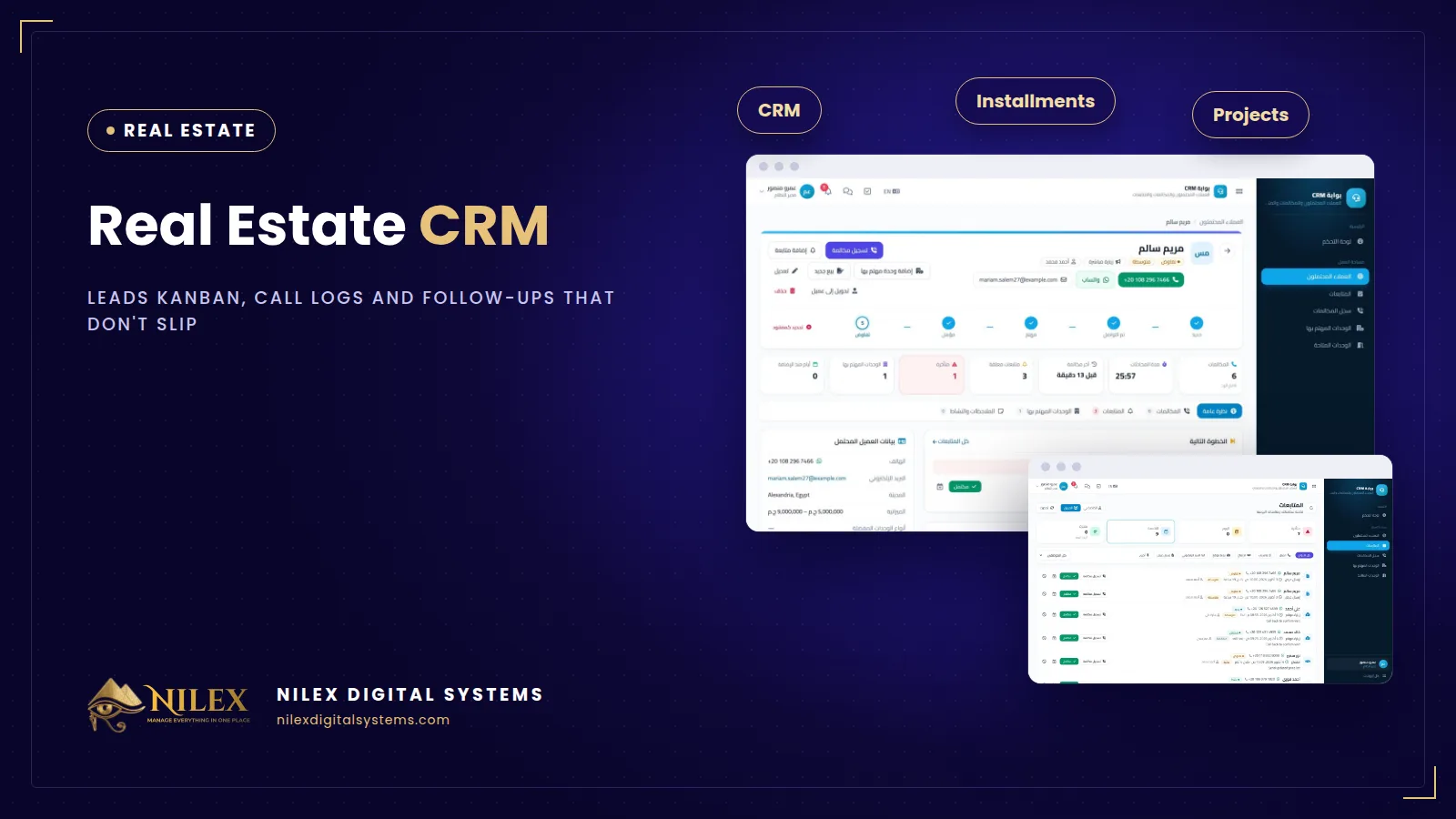
A real estate CRM keeps every buyer enquiry in one place from the first call to the signed contract: leads on a kanban board by stage, a log of every call, scheduled follow-ups with overdue alerts, and the units each lead is interested in. For a developer, the CRM has to be linked to the unit inventory and the website, so agents offer only available units and every online enquiry becomes a lead with an owner and a follow-up date.
Property is a long sale. A buyer may call after a billboard, visit the sales office a month later, compare three projects and decide after the next price increase. Over that time the lead talks to several people on your team. If the history lives in an agent's phone and a notebook, the second agent starts from zero, the buyer repeats himself, and the lead goes cold. When the agent leaves, the leads leave with him.
Key takeaways
- Every lead needs a stage, an owner and a next follow-up date. A lead without a next step is a lead you will lose.
- Log every call with its result, channel, duration and a short summary, so anyone can pick up the conversation.
- Each agent should start the day from a follow-ups queue: overdue, due today and upcoming.
- Interested units should be linked to the real inventory, not typed as free text.
- Website enquiries must become CRM leads automatically, with a follow-up, not emails waiting in an inbox.
Why does a developer need its own kind of CRM?
If you are new to the idea, start with our explainer what is a CRM. A general CRM tracks contacts and deals. A developer needs more than that, because the product is a specific unit that can be sold only once, at a price that changes with each phase. A CRM that does not know which units are available lets agents promise a unit that was sold yesterday. A CRM that is not connected to sales contracts cannot tell management which leads turned into revenue.
Leads on a kanban board
A kanban board shows leads as cards in columns, one column per stage. In a real estate CRM the stages are typically:
- New: the enquiry has arrived and nobody has spoken to the buyer yet.
- Contacted: the first call or message has happened.
- Interested: the buyer asked about specific units, prices or plans.
- Qualified: budget, timing and the type of unit are clear.
- Negotiation: price, payment plan and unit are being agreed.
The sales manager sees at a glance where leads pile up. Many leads stuck in new means slow first response. Many in interested and few in qualified means agents are not asking the right questions.
Call logs that anyone can read
Each lead has its own page. Every call is logged with its result, the channel, the duration and a summary. Three lines are enough: "Wants a three-bedroom on a low floor, budget confirmed, prefers a long plan, call back after he visits the site on Saturday." When the lead calls the office and another agent answers, that agent reads the page and continues the conversation instead of starting again.
Many Egyptian sales teams also work heavily on WhatsApp. Our article on WhatsApp and CRM for sales teams explains how to keep those conversations from living only on personal phones.
Follow-ups and overdue alerts
Every call should end with a next step: a follow-up with a date. The CRM then gives each agent a follow-ups queue with three lists: overdue, due today and upcoming. Overdue follow-ups raise alerts, so the manager knows which leads are being neglected before the buyer signs with someone else. This single habit, never closing a call without a scheduled follow-up, does more for conversion than most sales training.
Interested units linked to the inventory
When a lead says "I like the corner apartment on the fourth floor of building B", that should be recorded as a link to the actual unit, not a note. Then:
- The agent sees the unit's current status and price before calling back.
- The project team can see how many leads are interested in each unit and which units nobody asks about.
- When the lead is ready, the sale starts from an available unit and a payment plan. See payment plans and installments.
Website enquiries that become leads
A developer's website should show available units straight from the inventory. When a visitor fills in a contact form, the enquiry should not land in a shared mailbox. It should become a CRM lead with a follow-up for the lead owner, so it appears in an agent's queue the same day. This closes one of the most common gaps: online enquiries answered days late, or not at all.
Notebook and WhatsApp vs a general CRM vs a real estate CRM
| Need | Notebook + WhatsApp | General CRM | Real estate CRM in a developer system |
|---|---|---|---|
| Lead stage | In the agent's head | Deal pipeline | Kanban: new, contacted, interested, qualified, negotiation |
| Call history | Scattered chats | Activity log | Result, channel, duration and summary per call |
| Today's follow-ups | Memory | Tasks | Queue of overdue, today and upcoming, with alerts |
| Interested units | Free text | Free text or custom fields | Linked to the inventory with live status |
| Website enquiries | Email inbox | Form integration | Become leads with a follow-up automatically |
| Lead to contract | Retyped | Separate system | Same system as sales and collections |
Who can see the leads?
Lead lists are valuable and they are personal data. Agents should see their own leads, managers their team's, and nobody should be able to export the whole list without permission. Our guides on CRM and Egypt's data protection law and permissions and audit logs cover what to set up.
How Nilex helps
The CRM is one of the department portals in Nilex's real estate developer management system. Leads move through new, contacted, interested, qualified and negotiation on a kanban board; each lead has a page with every call (result, channel, duration and summary), scheduled follow-ups, overdue alerts and the units they are interested in; and the follow-ups queue shows each agent what is overdue, due today and coming up. Customers have a 360° profile, and there is a sales dashboard with tasks. In the full commercial package, interested units are linked to the inventory, the company website shows available units, and website enquiries become CRM leads. Brokerage and sales companies can start with the CRM and sales package; see the plans on the system page. Read the series pillar on real estate developer management systems for the full picture.
Frequently asked questions
How many agents and projects can use it?
All packages include unlimited projects and users.
Do website enquiries reach the sales team?
Yes. Every contact form becomes a CRM lead with a follow-up for the lead owner.
Is it connected to WhatsApp?
The CRM logs calls with their channel and summary. A direct WhatsApp integration is not part of the described system; if you need one, ask us about adding it.
We are a brokerage, not a developer. Does it fit?
Yes. The CRM and sales package is made for sales teams and brokers: leads, follow-ups, customers and sales contracts.
What happens when an agent leaves?
The leads, calls and follow-ups stay in the system, not in his phone, so the next agent who picks up a lead reads its full history.
If your leads still live in notebooks and personal phones, talk to Nilex.
 What Makes a Business System Professional: The Standards Nilex Builds Into Its Systems11 October 2026 · 11 min
 A Portal for Every Role: Why Nilex Systems Give Owners, Staff, Technicians and Customers Their Own Screens11 October 2026 · 9 min
 The Nilex Client Portal: Follow Your Project, Invoices, Payments and Requests in One Place11 October 2026 · 8 min