
Green Coffee Stock and Roasting Loss: Why Roastery Stock Goes Wrong and How to Fix It
Why green and roasted coffee need separate stock, how to measure and use roasting loss for quantities and cost, how supply orders keep stock honest, and the usual reasons roastery stock never matches.
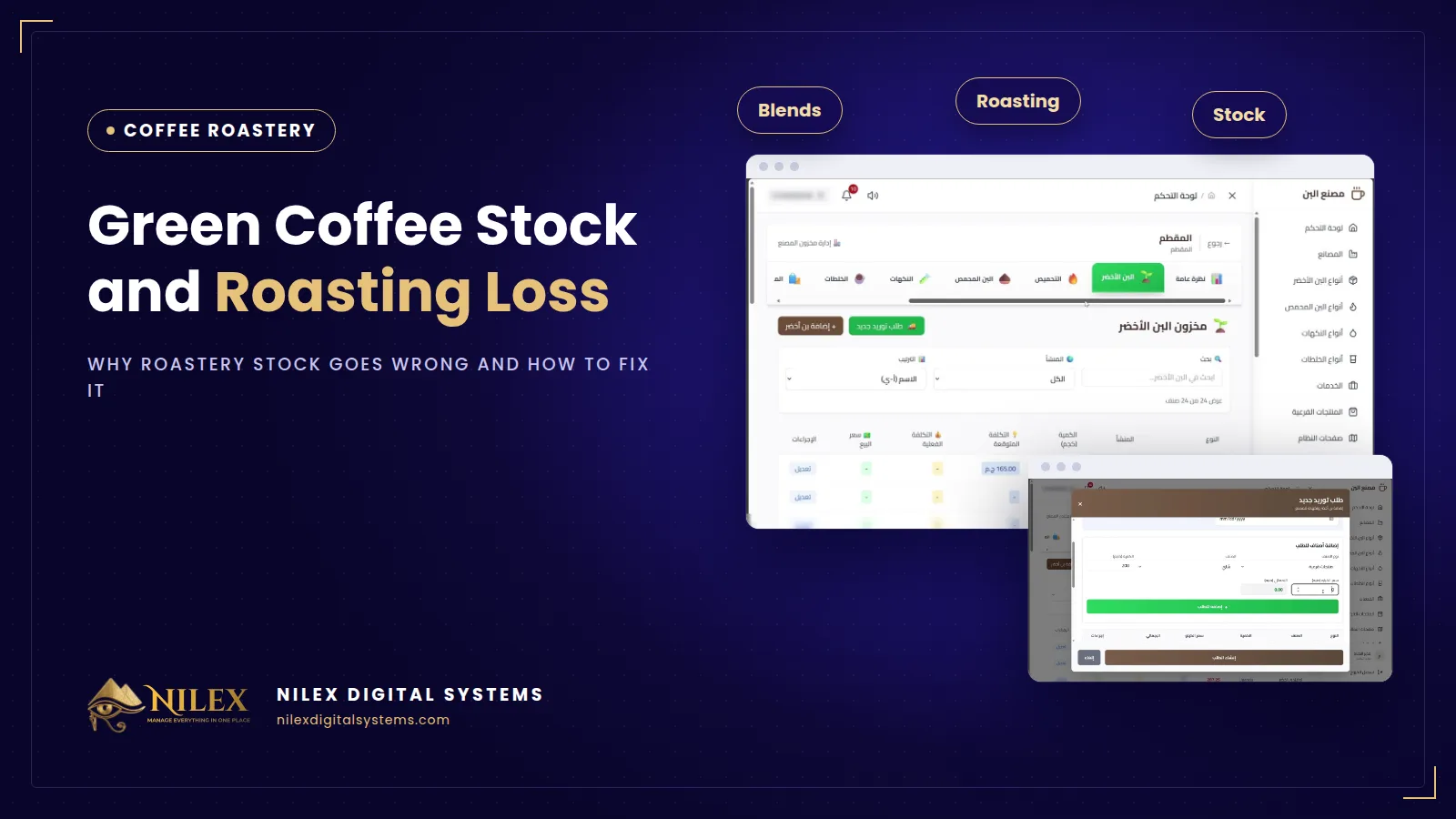
Green coffee and roasted coffee are two different stock items, linked by roasting loss: the share of weight the beans lose in the roaster. A roastery that records them as one item, or ignores the loss, will always find less roasted coffee on the shelf than on paper and will underprice every kilo it sells. Tracking green stock per factory, the loss for each bean and roast level, and every supply order by the kilo is what keeps both stock and cost honest.
This guide explains the difference between green and roasted stock, how to calculate and use roasting loss, how supply orders fit in, and why roastery stock goes wrong without them.
Key takeaways
- Green coffee is what you buy; roasted coffee is what you sell or blend. They need separate stock.
- Roasting loss is a percentage of weight, different for each bean and each roast level. Measure your own.
- The cost of a roasted kilo is the green cost divided by (1 minus loss), not the green price.
- Every purchase of green coffee, flavours and side products should be a supply order recorded by the kilo.
- Each factory or production site needs its own stock and its own expected and actual cost.
Green vs roasted stock: why two numbers?
Green coffee arrives in sacks from the supplier. It is stable, it is bought by origin and it is valued at what you paid. Roasted coffee is a different product: lighter per bean, with a shorter shelf life, sold or blended within days or weeks. Mixing the two into one "Brazil" line causes three problems:
- Quantities never match. 100 kg of green does not become 100 kg of roasted. The difference looks like theft or waste when it is neither.
- Buying is blind. You cannot tell whether you are short of green beans for next week or short of roasted coffee for today.
- Cost is wrong. A roasted kilo valued at the green price is undervalued, so stock value and margins are overstated.
Keeping green coffee as its own item, with its origin, quantity and cost per factory, and roasted coffee as another item with its own cost and selling price, removes all three.
What is roasting loss and how do you use it?
During roasting, beans lose moisture and some mass. Darker roasts generally lose more than lighter ones, and different beans behave differently. Rather than borrowing a figure from the internet, weigh what goes into the roaster and what comes out for a few batches of each bean and roast level, and record your own percentages.
Once recorded, the loss answers two everyday questions:
How much green do I need?
Green needed = roasted needed ÷ (1 − loss). To get 50 kg of medium roast from a bean that loses 16%, you need 50 ÷ 0.84 ≈ 59.5 kg of green coffee.
What does a roasted kilo cost?
Roasted cost per kg = green cost per kg ÷ (1 − loss). The same formula, applied to cost instead of weight.
| Bean and roast | Loss | Green for 50 kg roasted | Green cost per kg | Roasted cost per kg |
|---|---|---|---|---|
| Brazil, light | 14% | 58.1 kg | 200 | 232.56 |
| Brazil, medium | 16% | 59.5 kg | 200 | 238.10 |
| Brazil, dark | 20% | 62.5 kg | 200 | 250.00 |
Illustrative example: loss rates and prices are made up to show the method. Use the figures you measure in your own roastery. The table shows why the roast level matters: the same green bean gives three different roasted costs. This feeds directly into blend recipes and costing.
Why does roastery stock go wrong?
When owners say "the stock never matches", the causes are usually the same:
- Roasting loss not recorded. The gap between green bought and roasted produced is never explained.
- Purchases not recorded as supply orders. A few sacks bought in cash from a second supplier never enter the system.
- One stock for several sites. Green coffee in the second factory is counted as available in the first.
- Customer coffee mixed with own coffee. Beans a customer brought to be roasted end up counted as roastery stock.
- Returns not decided. Returned bags sit in a corner, neither back in stock nor written off.
- Old cost prices. The green price changed three shipments ago, but the cost used for pricing did not.
Each of these is a process problem before it is a software problem, but software that has a place for each step makes the process easy to follow. Our article on the signs you have outgrown Excel covers when spreadsheets stop being enough.
Supply orders: where stock starts
Every kilo of stock should arrive through a supply order. A good supply order records:
- the supplier;
- each item: green coffee type, flavour or side product;
- the quantity by the kilo and the price per kilo;
- the total, calculated, not typed.
With every purchase recorded this way, the expected cost of green coffee follows real prices, and a sudden price increase from a supplier is visible immediately. For more on purchasing discipline and supplier balances in general, see our guide to purchase orders and supplier accounts.
Monthly stock checklist for a roastery
| Check | What to look for |
|---|---|
| Count green sacks per factory | Matches green stock by origin |
| Weigh roasted coffee and blends | Matches roasted and blend stock |
| Compare green used with roasted produced | Gap close to your recorded loss |
| Review supply orders | No purchases outside the system |
| Compare expected and actual cost | Update prices after supplier changes |
| Review returns | Each one back in stock or disposed |
How Nilex helps
The coffee roastery and factory management system from Nilex records each green coffee type with its origin and the weight lost at light, medium and dark roast, and uses that loss when costing roasted coffee. Green coffee stock in each factory shows quantity, origin, expected and actual cost; roasted coffee, flavours and side products each have their unit, expected cost, actual cost and selling price. Purchases are recorded as supply orders from suppliers with green coffee, flavours and side products by the kilo and the total calculated. Every factory has its own dashboard with stock value, costs and revenue, with tabs for green, roasted, flavours, blends and orders. Packages are on the system page, and the full picture is in what a coffee roastery system must track.
Frequently asked questions
What is a normal roasting loss?
It depends on the bean, its moisture, your roaster and the roast level. Measure it yourself over a few batches and record it per bean and roast level rather than using a general figure.
Should the same bean at different roast levels be separate items?
For roasted stock and blends, yes. Medium and dark roast of the same bean differ in weight loss, cost and taste.
How do I keep customers' beans out of my stock?
Record roasting or grinding of customer coffee as a service-only order, so only the service is sold and your stock is not touched. See orders with roasting and grinding services.
Can each factory have its own stock?
Yes. Each factory keeps its own stock and dashboard, while coffee types, flavours and blends are shared.
If your green and roasted stock never seem to agree, talk to Nilex and see how the system records them from the first supply order.
 The Roastery Production Calculator: Planning Roasts and Blends From Customer Orders11 October 2026 · 9 min
 Running Several Coffee Factories or Roasteries From One System: Factory Dashboard and Stock per Site11 October 2026 · 8 min
 Sales Rep Portal and Online Requests From Shops: How Distributors Take Orders Without Paper11 October 2026 · 10 min