
From Facebook Posts and WhatsApp Orders to Your Own Online Store: What Changed for Three Egyptian Sellers
A before-and-after look at three Egyptian sellers who moved from phone, WhatsApp and social media posts to their own online store: a legal publisher, a coffee roastery and a home-appliance shop. What the store fixed, and why social media stays as a channel.
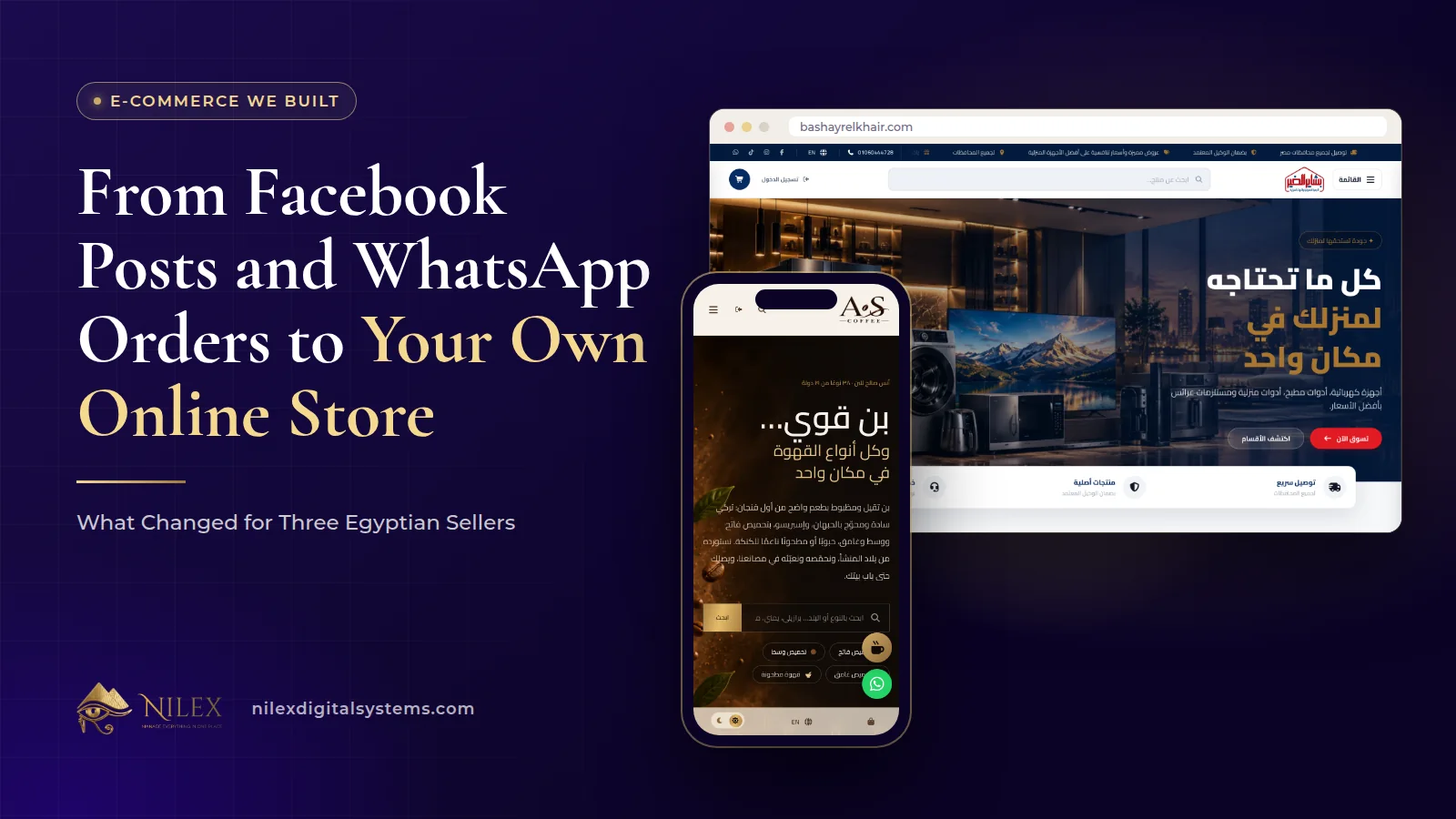
Selling through Facebook posts and WhatsApp messages works until the catalogue grows. Prices in old posts go out of date, every customer asks the same questions about each product, delivery fees are worked out one order at a time, and orders end up on paper. Your own online store fixes those problems by giving every product one page with one correct price, calculating delivery at checkout, and putting every order in one dashboard.
It does not mean leaving social media. Posts and WhatsApp chats can stay; the difference is that those conversations can now point to a product page instead of replacing it. Here is what changed for Dar El Ahram, Anas Saleh Coffee and Bashayer El Khair, based on what each store actually has.
Key takeaways
- Dar El Ahram moved from phone and WhatsApp orders tracked on paper and cash-only payment to 800+ titles online, card payment or cash on delivery, and one dashboard.
- Anas Saleh Coffee moved from shop and reseller sales with delivery fees worked out per order to a store with a fixed delivery fee for each of the 27 governorates.
- Bashayer El Khair moved from prices in social posts that went out of date to 400+ products whose prices are edited once in the dashboard.
- The store answers the repeated questions, so the team's time goes to the questions that need a person.
- Social media and WhatsApp stay as channels that send customers to product pages.
What selling on social media looks like as you grow
Many Egyptian shops start online the same way: a page, some posts with photos and prices, and a WhatsApp number. It is fast and free to start, and for a small catalogue it is enough. The trouble starts with volume. A post from three months ago still shows an old price. A customer asks for a product that sold out. Two people ask the same question about the same model on the same day. Someone writes an order in a notebook, and someone else has to find it later.
None of this is a marketing problem. It is a structure problem: there is no single place where the catalogue, the prices and the orders live. That is what a store adds.
Dar El Ahram: from phone orders on paper to an online bookshop
Before. Dar El Ahram is one of the largest legal publishing houses in Egypt. Its catalogue was known only by the branches and the sales team. Orders came in by phone and WhatsApp and were followed on paper, payment was cash only, and no book or author page could be found on Google, so readers outside Cairo and abroad had no easy way to buy. A reader also had to know the exact title to ask for it.
After. More than 800 titles are online, each with its own page, alongside pages for 340+ authors and 19 legal branches. Readers pay by card online or in cash on delivery, books ship to every governorate and to other countries, and the team follows every order, customer and payment from one dashboard. An AI assistant recommends books for a reader's legal situation, so the reader no longer needs the exact title. The full story is in the Dar El Ahram case study.
Anas Saleh Coffee: from the shop and resellers to customers at home
Before. The roastery sold through its shop and through resellers. Customers who wanted a specific roast had to visit or message, orders from other cities were arranged one by one on the phone, and the delivery price was worked out for every order. There was no place to present each roast and its origin.
After. An online store in Arabic and English, organised by roast and by brewing method, with a page for every roast showing its photos and price. A fixed delivery fee for each of the 27 governorates is calculated at checkout, and orders, stock and daily financials are followed from one dashboard. The roastery now sells directly to customers at home instead of through resellers only. See the Anas Saleh Coffee store case study.
Bashayer El Khair: from out-of-date posts to prices that stay correct
Before. Bashayer El Khair sells home appliances, kitchen tools and bridal packages from dozens of brands. The catalogue lived in social media posts, where prices went out of date quickly and customers messaged to ask about every model. Offers were announced by hand, and orders and invoices were written manually.
After. More than 400 products with model codes and prices, organised in 23 categories with pages for 38 brands. Timed offers and bundles run with a countdown, orders produce PDF invoices sent by email, and prices and stock are edited once in the dashboard and change everywhere. Customers can compare models and prices before they come to the shop. See the Bashayer El Khair case study.
What the store fixed, problem by problem
| Problem when selling through posts and chat | What the store does instead | Example |
|---|---|---|
| Prices go out of date in old posts | One product record, one price, edited once | Bashayer El Khair |
| Customers ask about every product | A page per product with photos, price and details | All three stores |
| Delivery fee worked out per order | Fee for the customer's governorate calculated at checkout | Anas Saleh Coffee, Bashayer El Khair, Dar El Ahram |
| Cash only | Card payment online or cash on delivery | Dar El Ahram |
| Orders written on paper | Every order in one dashboard, with status and payment | All three stores |
| Invoices written by hand | PDF invoices generated and sent by email | Bashayer El Khair |
| Offers announced by hand | Timed offers and bundles with a countdown | Bashayer El Khair |
| Not found on Google | SEO on every product, category and brand or author page | All three stores |
Keep social media, but point it at the store
Moving to a store does not mean closing the page or the WhatsApp number. It changes their job. A post no longer has to carry the price and the full details, because it can link to the product page where the price is always current. A customer who messages can be sent the link to the exact model or roast. And because product pages on these stores have their own share image, a link pasted into a chat or a post shows a proper preview.
Some channels are built into the store itself. Dar El Ahram can send WhatsApp announcements about books, and its readers can sign in with their Google or Facebook accounts. At Bashayer El Khair, each offer has its own page, so a post about an offer can link straight to it.
What still needs your team
A store removes repeated work; it does not remove the need for people. Cash-on-delivery orders still benefit from a confirmation before shipping, which we discuss in cash on delivery in Egypt. Unusual questions, such as an installation detail or a large space at Bashayer El Khair, are handed by the AI assistant to the team. And someone has to keep products, photos and prices accurate, which is now a job done once in the dashboard instead of in every post.
How to move from social selling to a store
- Collect the catalogue. Turn the products scattered across posts into one list with names, photos, prices and, where it matters, model codes.
- Decide the structure. Organise categories the way customers buy: by brewing method for coffee, by category and brand for appliances, by legal branch and author for books.
- Fix the delivery fees. Set a fee per governorate so customers see the total before they order.
- Choose payment methods. Cash on delivery is enough to start; card payment can be a later phase, as it was for Dar El Ahram.
- Write the policies. Shipping, returns or warranty, privacy and terms.
- Launch, then announce. Tell your followers, and start linking posts and replies to product pages.
Our online store launch checklist covers the preparation in detail, and SaaS or custom store helps you decide how to build it.
How Nilex helps
We build online stores for Egyptian sellers who have outgrown posts and chats: a page for every product, delivery fees per governorate, cash on delivery and card payment where needed, and one dashboard for orders. You can:
- Read the case studies for Dar El Ahram, Anas Saleh Coffee and Bashayer El Khair.
- See our e-commerce store service and its plans.
- Read what we learned launching online stores in Egypt.
- Send us your catalogue and how you sell today through the contact page.
Frequently asked questions
Should I stop selling on Facebook and WhatsApp once I have a store?
No. Keep them as channels and use them to send customers to product pages. The store becomes the place where prices, stock and orders are correct; social media becomes the place where people discover you.
When is the right time to move to a store?
When the same problems repeat every week: old prices in posts, the same questions about every product, delivery fees calculated by hand, or orders lost on paper. Those are signs the catalogue has outgrown chat.
Do I need every product online on day one?
No. Dar El Ahram started with a first version of the catalogue and store and added payments, shipping abroad and the AI assistant in later phases. Start with what sells and grow from there.
Will my customers actually order from the site?
Some will order directly, others will still message first. A store helps both: the first group orders without waiting, and the second gets a link to the exact product with its current price.
Can I start with cash on delivery only?
Yes. Anas Saleh Coffee and Bashayer El Khair launched with cash on delivery and a delivery fee per governorate. Dar El Ahram added card payment in its second phase.
 Starting Online Orders for Your Supermarket: A Practical Launch Plan, Decision by Decision11 October 2026 · 9 min
 Online Legal Bookshop Case Study: How Dar El Ahram Sells 800+ Legal Titles Online11 October 2026 · 11 min
 Selling Online From Egypt to Other Countries: Shipping Prices per Country, Local Zones and Card Payment11 October 2026 · 8 min